
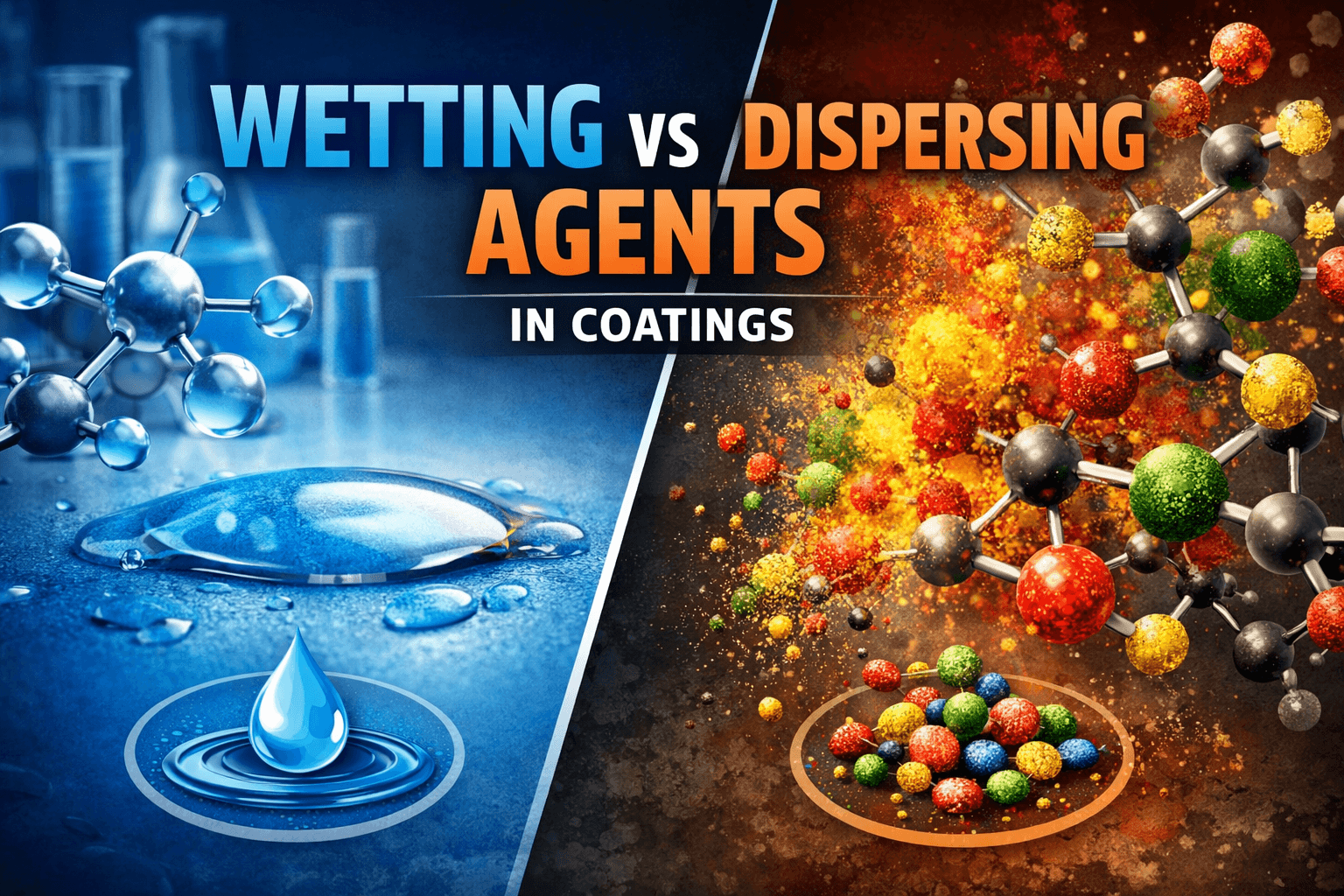
Wetting vs Dispersing Agents in Coatings Explained
Wetting vs dispersing agents in coatings is an important topic in pigment dispersion and coating formulation. Although these additives are often discussed together, they perform different functions. Wetting agents help the liquid coating medium spread over pigment surfaces, while dispersing additives help stabilize pigment particles after they have been separated. Understanding this difference is essential for achieving stable formulations, better color development, and consistent coating performance.
Main Function
Wetting agents help the liquid coating system spread over pigment surfaces during the first stage of dispersion.
Stabilization Role
Dispersing additives help keep pigment particles separated after grinding and reduce re-agglomeration.
Why It Matters
Both additive types support better pigment dispersion, improved stability, and more consistent coating performance.

Wetting vs dispersing agents in coatings is a common question in coating formulation because both additive types are closely connected to pigment dispersion. However, they do not do the same job. In practice, wetting and dispersion are two different stages of the same process, and both are necessary for good coating quality.
During pigment dispersion, the coating formulator needs the liquid medium to first contact and spread over the pigment surface. After that, the pigment particles must be separated and stabilized so they do not come back together. This is why modern formulations often use specialized wetting and dispersing agents for coatings along with advanced dispersing additives for coatings and, where required, hyperdispersant additives.
What Are Wetting Agents in Coatings?
Wetting agents are additives that reduce the interfacial tension between the liquid coating medium and the pigment surface. Their role is to help the liquid spread more effectively over pigment particles so that the dispersion process can begin properly.
Many pigments are difficult to wet because of their surface characteristics and because air can remain trapped around them. If wetting is incomplete, pigment incorporation becomes inefficient and the grinding stage becomes less effective. This can affect color development, gloss, viscosity behavior, and final coating consistency.
Functions of wetting agents
- Reduce interfacial tension between pigment and liquid medium
- Improve pigment incorporation into the coating system
- Support more efficient grinding
- Help the liquid phase spread over difficult pigment surfaces
- Improve the first stage of pigment dispersion
What Are Dispersing Agents in Coatings?
Dispersing agents work after wetting. Once pigment agglomerates are broken down during grinding, the separated particles need to remain stable in the formulation. Dispersing additives adsorb onto the surface of these particles and help prevent them from coming back together.
This stabilization is important because pigment re-agglomeration can reduce color strength, affect gloss, create viscosity instability, and lead to uneven appearance in the final coating film. In demanding systems, advanced dispersing additives and hyperdispersants are used to improve stability, especially with difficult pigments such as carbon black.
Steric Stabilization
Polymeric chains around pigment particles create a physical barrier and reduce the chance of re-agglomeration.
Electrostatic Stabilization
Surface charge helps keep pigment particles apart by increasing repulsion between them.
Difference Between Wetting and Dispersing Agents in Coatings
The difference between wetting and dispersing agents in coatings becomes clear when you look at the stages of pigment dispersion. Wetting agents support the initial contact between pigment and liquid medium, while dispersing additives help maintain particle separation after grinding.
| Property | Wetting Agents | Dispersing Agents |
|---|---|---|
| Main role | Help liquid spread over pigment surface | Stabilize separated pigment particles |
| Stage of action | Beginning of dispersion | After pigment separation and grinding |
| Primary benefit | Improves pigment wetting and incorporation | Prevents re-agglomeration and improves stability |
| Impact on formulation | Supports efficient grinding | Supports storage stability and consistency |
| Importance in coatings | Helps start proper dispersion | Helps maintain dispersion quality over time |
Why Both Wetting and Dispersing Agents Are Important
In real coating formulations, wetting alone is not enough. If the liquid reaches the pigment surface but the separated particles are not stabilized, the system can still become unstable. In the same way, a dispersing additive cannot perform properly if the pigment has not been wetted effectively in the first place.
This is why formulators often evaluate both additive functions together. Good pigment dispersion depends on proper wetting, efficient particle separation, and stable long-term dispersion. This becomes even more important in industrial coatings where consistent performance, visual appearance, and batch-to-batch reliability are critical.
Effective pigment dispersion is not just about breaking particles apart. It also depends on wetting the pigment surface properly and keeping those particles stable throughout the coating system.
Applications of Wetting and Dispersing Additives in Coatings
Wetting and dispersing additives are used in many types of coating systems where pigment stability and visual consistency matter. Their importance increases when working with difficult pigments, high pigment loading, or demanding formulation requirements.
In these applications, suitable additive selection can help improve pigment dispersion, color strength, gloss, flow behavior, and long-term storage stability. For difficult pigment systems, coating manufacturers may also use specialized hyperdispersant additives to achieve stronger stabilization.
Choosing the Right Wetting and Dispersing Additives
The right additive package depends on the coating system, pigment type, resin compatibility, and processing conditions. Water-based and solvent-based systems may require different approaches, and pigment characteristics can also influence additive selection.
Points to evaluate during additive selection
- Type of pigment used in the formulation
- Difficulty of pigment wetting and dispersion
- Required storage stability and consistency
- Compatibility with resin and coating system
- Performance requirements such as gloss, color development, and viscosity control
For formulators looking to improve pigment stability and performance, working with an experienced coating additives manufacturer can help in selecting suitable wetting agents, dispersing additives, and related specialty additives for coating formulations.
Conclusion
Wetting vs dispersing agents in coatings is not just a terminology question. It is a practical formulation issue that directly affects pigment dispersion, formulation stability, and final coating performance. Wetting agents help pigments interact with the liquid medium, while dispersing additives help maintain stable separation after grinding.
Together, these additives support better pigment distribution, improved consistency, and more reliable coating performance across industrial applications. Understanding the difference helps formulators make better additive choices and build more stable coating systems.
Explore Related Coating Additives
Discover additive solutions for pigment wetting, dispersion stability, and industrial coating performance improvement.
Frequently Asked Questions
Wetting agents help the liquid coating medium spread over pigment surfaces, while dispersing agents stabilize pigment particles after they have been separated.
Wetting agents reduce interfacial tension and help the liquid phase contact the pigment surface properly, which supports efficient dispersion.
Dispersing additives help keep pigment particles separated after grinding and reduce the risk of re-agglomeration, improving formulation stability.
Yes. Hyperdispersants are often used for difficult pigment systems, including carbon black, where stronger stabilization is required.