
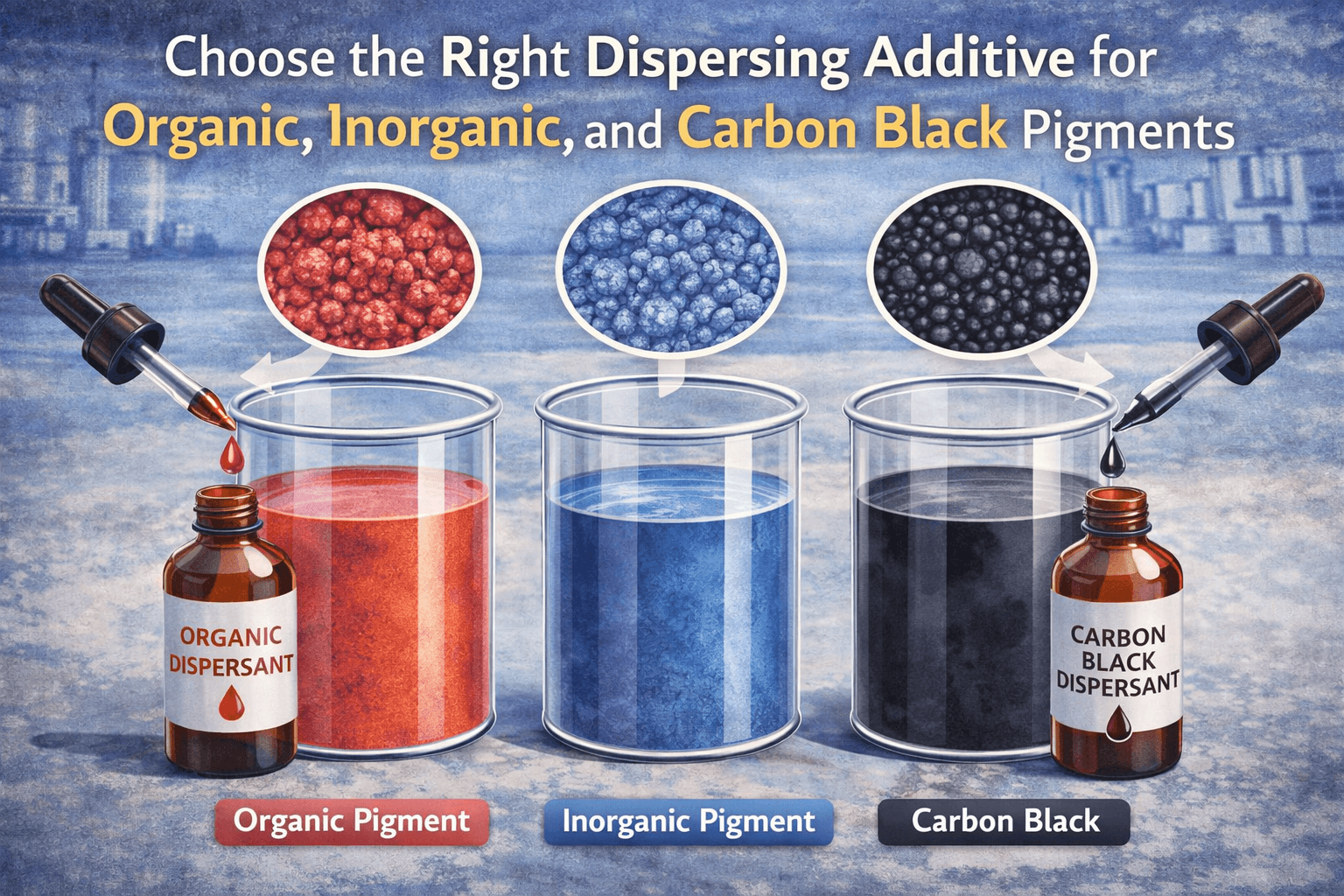
How to Choose the Right Dispersing Additive for Organic, Inorganic, and Carbon Black Pigments
Selecting the right dispersing additive is critical for achieving stable viscosity, strong color development, reduced reflocculation, and reliable long-term coating performance. This guide explains how to evaluate dispersing additives across organic pigments, inorganic pigments, and carbon black systems.
What this blog covers
How dispersing additive selection changes based on pigment type, formulation environment, and performance goals.
Who it is for
Coating formulators, technical buyers, R&D teams, and manufacturers working with pigment-rich systems.
Main focus
Organic pigments, inorganic pigments, carbon black, hyperdispersants, stability, viscosity, and dispersion quality.
Core outcome
Better additive selection for improved grind efficiency, final appearance, storage stability, and process consistency.
Why dispersing additive selection matters
A dispersing additive does far more than simply help pigments enter the liquid phase. In coatings, the right additive supports wetting, improves deagglomeration during grinding, and helps stabilize pigment particles so they remain evenly distributed in the formulation. When this selection is poor, formulators often face higher millbase viscosity, poor color development, gloss loss, flooding, floating, settling, or inconsistent storage stability.
The reason additive selection becomes so important is that pigment families behave differently. Organic pigments, inorganic pigments, and carbon black do not respond to the same stabilization approach in the same way. Surface area, particle structure, surface chemistry, and loading demand can change the additive requirement significantly.
The three stages a dispersing additive supports
To choose the right product, it helps to understand what a dispersing additive is expected to do in an actual coating system.
1. Wetting
The additive helps the liquid phase spread across the pigment surface faster, improving initial incorporation and process efficiency.
2. Deagglomeration
During grinding or high-shear dispersion, the additive supports the separation of pigment agglomerates into finer distributed particles.
3. Stabilization
After dispersion, the additive helps keep particles apart and reduces reflocculation, viscosity instability, and long-term settling issues.
4. Performance retention
The right additive helps maintain color strength, gloss, blackness, opacity, application consistency, and storage stability over time.
Common signs that the current additive is not performing well
- Millbase viscosity rises sharply during or after dispersion
- Color strength is lower than expected
- Carbon black shows weak jetness or poor blackness
- Gloss and appearance drop after storage
- Floating, flooding, or reflocculation appears in the system
- Soft settling progresses into hard sediment over time
Understanding the three major pigment groups
A single dispersing additive cannot always deliver identical results across every pigment family. Understanding the broad behavior of each group is the starting point for better additive selection.
Organic pigments
Organic pigments are often selected for bright shades, strong tinting, and high color value. Many of them have smaller particle size and relatively high surface area, which can increase additive demand. These systems often need stronger stabilization to avoid reflocculation and maintain color development.
Inorganic pigments
Inorganic pigments are widely used where opacity, durability, weather resistance, and cost-performance balance matter. Titanium dioxide, iron oxides, and similar pigments can respond very differently from organics. Their density and surface characteristics influence both dosage and dispersant choice.
Carbon black
Carbon black is one of the most demanding pigment classes in coatings. Its fine particle size, high surface area, and structured nature can cause major viscosity rise, poor dispersion stability, and lower-than-expected color performance when the additive is not well matched.
| Pigment Type | Main Challenge | Selection Priority | Typical Risk if Wrong Additive Is Used |
|---|---|---|---|
| Organic pigments | High surface area, stabilization demand | Color strength, reflocculation control, gloss retention | Weak shade development, flooding, floating, instability |
| Inorganic pigments | Stable distribution, opacity consistency, settling control | Compatibility, viscosity control, process reliability | Settling, poor opacity consistency, unstable grind |
| Carbon black | Very high additive demand, viscosity sensitivity | Jetness, low viscosity, strong stabilization | Poor blackness, reflocculation, gloss loss, seeding |
Key factors to evaluate before selecting a dispersing additive
Choosing the right additive should begin with the full formulation context rather than just the pigment name. The same pigment can behave differently depending on binder chemistry, medium, solids level, and processing conditions.
How to choose a dispersing additive for organic pigments
Organic pigments are often used where brightness, chroma, and visual appearance are important. Because many organic pigments have higher surface area and are more difficult to stabilize than simpler inorganic systems, they often benefit from a more targeted and stronger dispersing approach.
What to look for
- Fast and complete wetting of the pigment surface
- Efficient deagglomeration during grinding
- Strong resistance to reflocculation
- Stable viscosity profile after dispersion
- Good resin compatibility for final coating appearance
- Improved tint strength and color consistency
Common goals in organic pigment systems
A suitable dispersing additive for organic pigments can help improve color strength, maintain brightness, reduce flooding and floating, support gloss, and improve storage stability. In many cases, a polymeric dispersing additive or hyperdispersant strategy is more effective than using a basic wetting aid alone.
How to choose a dispersing additive for inorganic pigments
Inorganic pigments often appear easier to handle than organic pigments, but they still require the right dispersing additive for stable processing and consistent final coating results. Titanium dioxide, iron oxides, and extender-containing systems all need the correct balance between wetting, stabilization, and viscosity management.
Important selection points
- Compatibility with the coating medium and binder package
- Good viscosity balance during grinding and storage
- Support for opacity consistency and uniform distribution
- Reduced risk of settling and hard sediment formation
- Reliable performance in filled or high-solids systems
How to choose a dispersing additive for carbon black
Carbon black is often the most demanding pigment class in a coating formulation. The wrong additive can cause significant problems in jetness, viscosity, gloss, and long-term storage stability. Because carbon black has very fine particles and high surface area, additive selection should be done carefully and practically.
What to prioritize
- Strong affinity for high-surface-area pigment
- Efficient reduction of agglomerates
- Low and stable millbase viscosity
- High resistance to reflocculation
- Improved blackness, strength, and finish quality
- Good system compatibility under actual process conditions
Typical signs of poor additive fit in carbon black systems
- High dispersion viscosity and difficult grind
- Poor blackness or dull appearance
- Gloss loss and instability after storage
- Seeding, reflocculation, or phase inconsistency
Standard dispersant vs hyperdispersant: which is better?
The answer depends on pigment demand, solids level, formulation targets, and processing limitations. A standard dispersing additive may be adequate in relatively easy systems with moderate loading and simpler performance requirements. However, more demanding systems often benefit from a higher-performance polymeric dispersant or hyperdispersant approach.
| Situation | Standard Dispersant May Work | Hyperdispersant May Be Better |
|---|---|---|
| Simple pigment package | Yes | Not always required |
| Difficult organic pigments | Sometimes limited | Often preferred |
| Carbon black systems | May underperform | Often preferred |
| Need for lower viscosity at high loading | Sometimes inadequate | Usually stronger option |
| Long-term stability critical | Depends on system | Often stronger candidate |
In many industrial coating systems, the real cost is not just the additive price. Poor additive selection can increase rejects, reduce grind efficiency, create batch inconsistency, and force later reformulation work.
A practical method to choose the right dispersing additive
A structured evaluation approach gives better results than selecting by habit or supplier familiarity alone.
Step 1: Identify the pigment family clearly
Separate the formulation need into mainly inorganic, mainly organic, carbon black-heavy, or mixed pigment systems.
Step 2: Review the formulation environment
Check binder type, medium, solids level, grinding conditions, and application target before narrowing the additive shortlist.
Step 3: Define measurable success criteria
Examples include lower millbase viscosity, improved color strength, reduced settling, higher gloss, better jetness, and better storage stability.
Step 4: Compare more than one additive strategy
Benchmark the current additive against a standard dispersant option and a stronger polymeric or hyperdispersant option where relevant.
Step 5: Evaluate immediate and aged performance
Measure fresh dispersion behavior and also assess stability after storage. The best additive should perform both initially and over time.
Choosing for mixed pigment systems
Many practical formulations contain more than one pigment family. A coating may include titanium dioxide, extenders, one or more color pigments, and carbon black for shade adjustment. In such cases, the best additive for one pigment alone may not be the best choice for the full system.
Mixed pigment systems require broader compatibility, acceptable performance across all critical components, stable viscosity, low reflocculation tendency, and consistent application performance. In demanding formulations, a specialized approach or separate pigment concentrate strategy may offer better outcomes than using one generic additive everywhere.
Why additive choice affects commercial performance too
Dispersing additive selection is not only a technical decision. It also affects production efficiency, grinding time, pigment utilization, reject rates, batch consistency, and customer satisfaction. A technically stronger additive may help reduce operational issues and support more reliable manufacturing.
For this reason, the “right” additive should be evaluated based on total formulation and process value rather than only upfront product cost.
How Raj Speciality Additives supports coating formulators
At Raj Speciality Additives, we understand that pigment dispersion performance depends on pigment family, resin system, application need, process conditions, and long-term stability expectations. Whether the requirement is for easier inorganic pigment stabilization, stronger organic pigment dispersion, or more reliable carbon black performance, the right dispersing additive can make a measurable difference.
Explore our related coating additive solutions:
Final thoughts
Choosing the right dispersing additive for organic, inorganic, and carbon black pigments is not about selecting the most general product. It is about matching additive chemistry to pigment behavior, system conditions, and performance targets.
Organic pigments often require stronger stabilization. Inorganic pigments need the right balance of process control and consistency. Carbon black typically demands especially careful additive evaluation because it has a strong effect on viscosity, blackness, gloss, and storage stability.
A more structured selection process helps formulators reduce problems, improve batch reliability, and achieve better coating performance with fewer compromises.
Need the right dispersing additive for your coating system?
Connect with Raj Speciality Additives to discuss pigment type, formulation needs, stability targets, and the right additive approach for industrial coating performance.
Frequently Asked Questions
A dispersing additive helps pigments wet faster, disperse more efficiently during grinding, and remain stabilized in the coating system so they do not reflocculate easily.
Carbon black usually has very high surface area and a demanding particle structure, which makes it more sensitive to additive chemistry than many inorganic pigments.
Not always. Organic and inorganic pigments behave differently, so the same additive may not provide the best viscosity, stability, and appearance performance across both.
Common issues include higher millbase viscosity, poor color strength, low gloss, flooding, floating, settling, and poor storage stability.
A hyperdispersant is worth evaluating when the system includes difficult pigments such as carbon black or challenging organic pigments, or when lower viscosity, higher loading, and stronger stability are required.
Yes. It can influence gloss, shade development, blackness, uniformity, storage stability, and overall consistency of the final coating.
References & Citations
The guidance in this article is supported by technical literature and formulation references related to pigment wetting, dispersant anchor-group selection, carbon black stabilization, titanium dioxide dispersion, and dispersant dosage optimization in coating systems.
Evonik — An Efficient Approach to Dispersing Pigments
Explains why different anchor groups show different affinity for organic pigments, inorganic pigments, and carbon black, and why dispersant selection should match pigment surface chemistry.
View Source
Evonik TEGO® Dispers 679 — Fact Sheet
Describes a universal dispersant positioned for organic, inorganic, carbon black, and titanium dioxide pigments, supporting the practical concept that some systems can use broad-compatibility dispersants while others need more targeted chemistry.
View Source
Lubrizol / Lawrence Industries — Determining the Optimal Dispersant Loading for Pigments and Fillers
Shows why dispersant demand and pigment-to-binder ratios differ across inorganic pigments, organic pigments, and carbon black, reinforcing the need for dosage optimization by pigment type.
View Source
Ti-Pure — Titanium Dioxide for Coatings
Technical background on titanium dioxide in coatings, useful for understanding why TiO2 dispersion quality strongly affects gloss, opacity, durability, and overall coating performance.
View Source
PCC Group — Paints and Coatings Catalogue 2024
Notes that dispersing-agent choice is closely related to pigment chemistry and end-use system type, supporting the article’s formulation-led selection approach.
View Source
European Coatings — Essentials of Efficient Pigment Dispersion
Industry reference material covering pigment dispersion fundamentals, stability, efficiency, and practical evaluation in modern coating systems.
View Source