
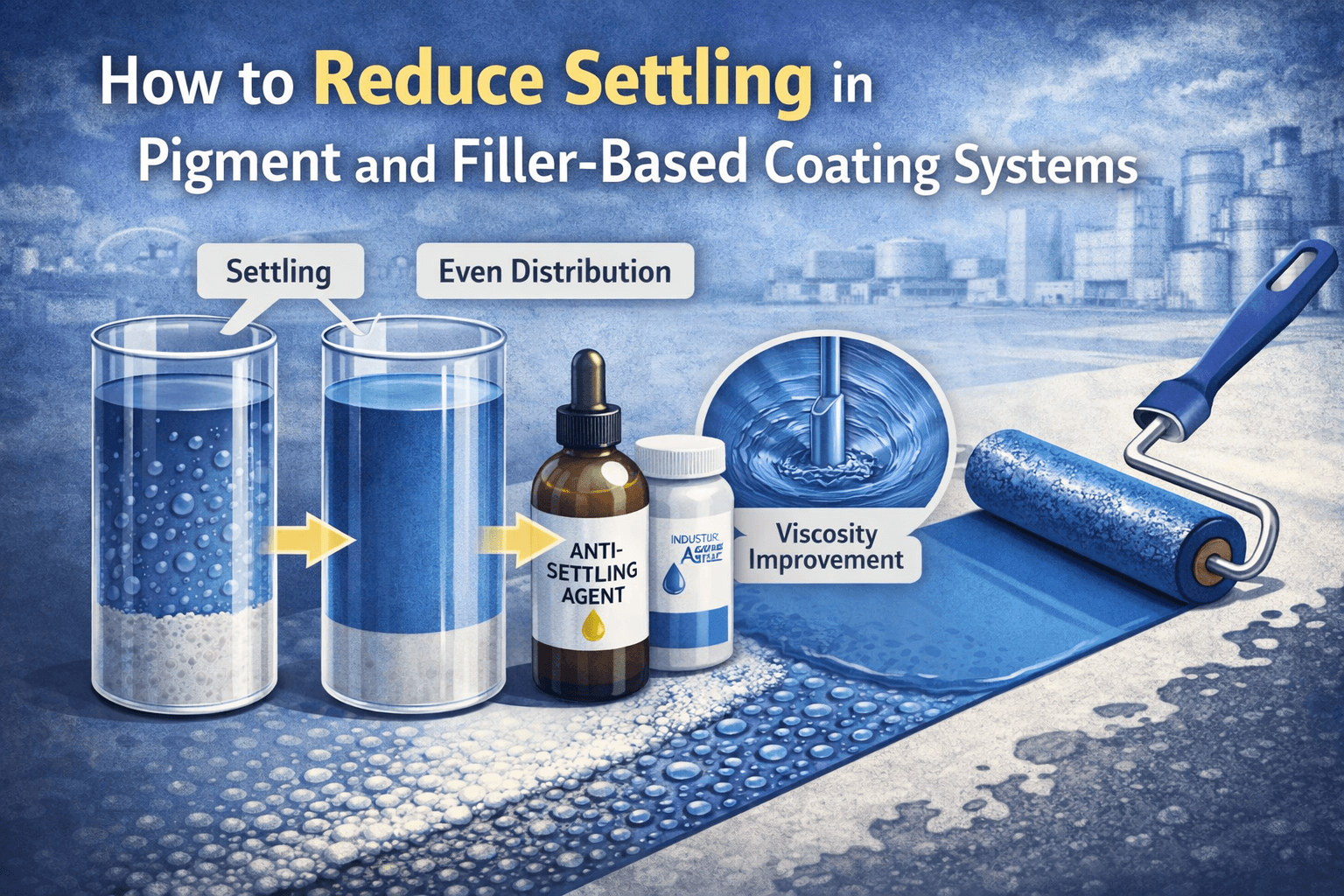
How to Reduce Settling in Pigment and Filler-Based Coating Systems
Settling is one of the most common problems in pigment and filler-rich coating systems. It can affect viscosity, application consistency, storage stability, and final product quality. This guide explains why settling happens, what makes it worse, and how the right additive strategy can help reduce settling in practical industrial coatings.
What this blog covers
Root causes of settling, common warning signs, and practical ways to improve storage stability in coating systems.
Who it is for
Formulators, coating manufacturers, plant chemists, and technical teams working with pigment and filler-based systems.
Main focus
Pigment settling, filler settling, hard sediment, redispersibility, rheology balance, and additive selection.
Core outcome
Better suspension stability, improved process consistency, and lower risk of storage-related coating defects.
Why settling is such a common problem in coating systems
Settling is a frequent challenge in coatings because many formulations contain dense solid materials such as pigments, extenders, fillers, and specialty powders. Over time, these solids can move downward under gravity if the liquid system is not able to keep them properly suspended. The result may be a soft deposit at the bottom of the container, a hard compact sediment, or a product that becomes inconsistent during storage.
While some level of settling may appear manageable, it often becomes a serious commercial issue when it affects viscosity consistency, shade uniformity, redispersibility, application quality, or customer acceptance. In many cases, the problem is not caused by one raw material alone. It usually results from the interaction between particle size, density, dispersion quality, rheology control, and overall formulation balance.
What settling looks like in practical coatings
Settling does not always appear in the same way. Some systems show only mild storage separation, while others develop severe hard sediment that is difficult to redisperse.
Soft settling
A loose deposit forms at the bottom but can usually be redispersed without major effort.
Hard settling
A dense, compact sediment forms that is difficult to break, remix, or restore uniformly.
Clear liquid separation
The upper portion of the coating may appear thinner or clearer as solids move downward during storage.
Batch inconsistency
The coating may behave differently during application because the solids are no longer evenly distributed.
Typical warning signs
- visible solid deposit at the bottom of the container
- hard stirring needed before use
- shade inconsistency after storage
- viscosity change between top and bottom portions
- poor redispersion after transport or long storage
Why pigments and fillers settle in coatings
Settling happens when solid particles are not adequately suspended within the liquid system. This may occur for several reasons, often in combination rather than in isolation.
High particle density
Many fillers and inorganic pigments are heavier than the liquid phase. If the suspension structure is weak, these particles move downward over time.
Weak dispersion quality
Poorly dispersed particles can form larger agglomerates, which settle faster than well-distributed particles.
Insufficient rheology support
If the coating does not have the right low-shear suspension structure, solids may not remain evenly suspended during storage.
Low compatibility between solids and system
Incompatible wetting or dispersing conditions can reduce particle stabilization and increase the chance of settling.
High pigment volume concentration
As solids loading rises, the system becomes more difficult to stabilize. Pigments and fillers start interacting more strongly, and the risk of instability increases.
Main formulation factors that make settling worse
A coating is more likely to settle when several formulation weaknesses exist at the same time. These are some of the most common contributing factors.
Why both dispersion and rheology matter for settling control
One of the most common mistakes in formulation troubleshooting is to treat settling as only a rheology problem. In reality, settling often begins with weak particle wetting or poor dispersion and then becomes worse because the system lacks the right suspension structure.
Good settling control usually depends on two things working together:
| Formulation Area | Role in Settling Control | What Can Happen if Weak |
|---|---|---|
| Wetting & dispersing | Helps distribute and stabilize particles properly | Flocculation, faster settling, poor consistency |
| Rheology control | Helps create suspension structure during storage | Solids sink, clear separation, hard sediment |
| Process control | Ensures the designed system is developed correctly | Batch variation, unstable dispersion, inconsistent storage performance |
How to reduce settling in pigment and filler-based coatings
Improving settling resistance usually requires a structured review of the full formulation rather than one quick correction.
1. Improve wetting of pigments and fillers
Better wetting helps the liquid phase spread over solid surfaces more effectively, which supports better initial dispersion and more stable particle behavior.
2. Use a suitable dispersing additive
The right dispersing additive can help keep particles better separated and reduce reflocculation that leads to denser settling.
3. Review rheology additive selection
Rheology control is important for building the suspension structure needed to hold solids during storage, especially in systems with heavier fillers and inorganic pigments.
4. Check solids loading and balance
Sometimes the formulation is simply too heavily loaded for its current additive package. Reviewing pigment and filler balance may improve stability.
5. Optimize process conditions
Mixing order, shear level, grinding efficiency, and let-down sequence all affect whether the designed formulation performs as expected.
6. Test aged storage stability
Fresh appearance alone is not enough. Settling control should be evaluated after storage to confirm real product stability.
Why hard sediment is more serious than soft settling
Soft settling can often be managed if the material redisperse easily and the product returns to its original state. Hard sediment, however, is much more damaging because it often indicates stronger particle compaction, poor stabilization, and weak redispersibility.
Hard sediment can lead to:
- difficult or incomplete remixing
- inconsistent shade or opacity
- wasted material during use
- customer complaints during storage or transport
- batch rejection or reformulation need
What formulators should review when settling persists
If settling continues despite small adjustments, the best approach is to review the system in a structured way rather than changing only one variable blindly.
Particle package
Check pigment/filler type, loading, density, and whether certain solids are driving instability more than others.
Dispersion stage
Review whether wetting and grinding are producing a stable, fine, and repeatable particle distribution.
Rheology profile
Evaluate whether the system has enough low-shear structure for storage without damaging application properties.
Storage testing
Assess settling behavior after practical aging conditions, not only immediately after production.
How Raj Speciality Additives supports settling control in coatings
At Raj Speciality Additives, we understand that settling problems in coatings are rarely solved by one-dimensional changes. Effective settling control often depends on the right combination of wetting, dispersing, rheology, and formulation compatibility.
Explore our related coating additive solutions:
Final thoughts
Settling in pigment and filler-based coating systems is a practical storage stability problem that can affect quality, consistency, and user confidence. It is usually not caused by one ingredient alone. Instead, it develops when dispersion quality, rheology support, solids balance, and system compatibility are not aligned properly.
A stronger formulation strategy can help reduce settling, improve redispersibility, and create more reliable coating performance from production through end use.
Need better settling control in your coating system?
Connect with Raj Speciality Additives to explore the right combination of wetting, dispersing, and rheology support for pigment and filler-based formulations.
Frequently Asked Questions
Pigments and fillers settle when the liquid system cannot keep dense solid particles properly suspended during storage. Poor dispersion, weak rheology support, and high solids loading can all contribute.
Soft settling forms a loose deposit that can usually be redispersed more easily. Hard settling forms a compact sediment that is much more difficult to break and remix.
Yes. A suitable dispersing additive can help keep particles better separated, reduce reflocculation, and improve overall dispersion stability, which can lower settling risk.
Rheology helps create the suspension structure that keeps particles from sinking too quickly during storage, especially in pigment and filler-rich systems.
No. Settling should also be evaluated after storage because many systems look fine immediately after production but develop stability issues later.
This blog should support Wetting & Dispersing Agents, Dispersing Additives, Rheology Additives, Hyperdispersant Additives, and the Coating Additives Manufacturer page.