
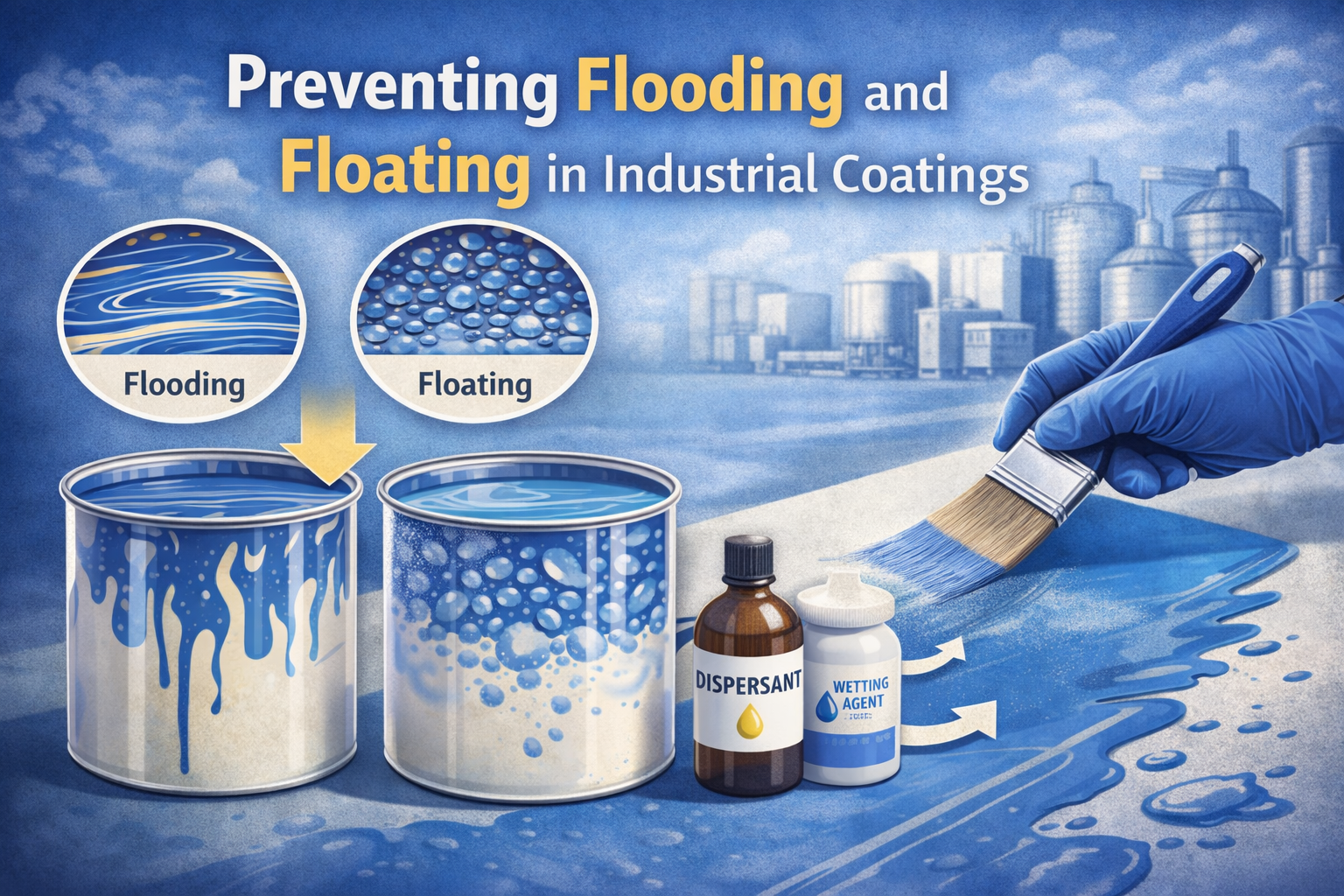
Preventing Flooding and Floating in Industrial Coatings with the Right Additives
Flooding and floating are common appearance defects in industrial coatings, especially in systems containing multiple pigments or difficult pigment combinations. These defects can affect shade uniformity, visual quality, and batch consistency. This guide explains why flooding and floating happen and how the right wetting, dispersing, and rheology strategy can help reduce them.
What this blog covers
What flooding and floating mean, why they happen, and how additive strategy can improve color uniformity.
Who it is for
Coating formulators, R&D teams, plant chemists, and manufacturers working with pigmented industrial systems.
Main focus
Multi-pigment systems, dispersion stability, surface defects, shade variation, and formulation balance.
Core outcome
Better shade consistency, stronger pigment control, and fewer visual defects in final coatings.
What are flooding and floating in coatings?
Flooding and floating are visual defects that occur when pigments in a coating system do not remain distributed evenly during drying or film formation. These problems are especially common in coatings containing multiple pigments with different particle size, density, or surface characteristics.
Although the two terms are often mentioned together, they do not mean exactly the same thing. Both are related to pigment instability, but they can appear differently in the final coating film.
Flooding vs floating: what is the difference?
These defects are connected, but understanding the distinction helps formulators troubleshoot more effectively.
| Defect | How It Appears | What It Usually Suggests |
|---|---|---|
| Flooding | Uneven color tone or shade concentration across the film | Pigments are redistributing unevenly during drying |
| Floating | Streaks, mottling, swirls, or separated color patterns | Pigments are moving or separating because of instability in the system |
In many practical cases, both effects may appear together because they come from related problems in pigment stabilization and flow behavior.
Why flooding and floating happen in industrial coatings
These defects usually develop when pigments in the formulation do not remain equally stabilized during application and drying. If certain pigments move faster, settle differently, or respond differently to the drying process, the final film can lose color uniformity.
Different pigment properties
Pigments may vary in particle size, density, surface chemistry, and dispersibility. In mixed pigment systems, this can create instability during drying.
Weak dispersing additive performance
If pigments are not stabilized properly, they may reflocculate or separate in the wet film, increasing the risk of flooding and floating.
Inadequate wetting
Poor wetting can leave certain pigments less uniformly distributed from the beginning, which affects final shade development.
Incorrect rheology balance
Flow behavior during application and drying also matters. If the rheology profile is not balanced, pigment movement inside the film can become more pronounced.
Drying conditions and film dynamics
Solvent evaporation, surface tension effects, and differences in pigment mobility can all contribute to final film defects.
Which coating systems are more prone to flooding and floating?
These defects can occur in many pigmented systems, but they are often more visible in formulations where multiple pigments must remain visually balanced in the final film.
Multi-color pigment systems
Shade blends with more than one color pigment are naturally more sensitive to pigment separation during drying.
Carbon black combinations
Carbon black is especially demanding and can create instability when combined with other pigments if dispersion is not controlled well.
Industrial coatings with tight appearance standards
Where uniform finish and shade consistency matter, even mild flooding or floating becomes unacceptable.
Systems with weak dispersion margins
If the formulation is already near its stability limit, visual defects are more likely to appear.
Main formulation causes behind these defects
Flooding and floating usually do not come from one single issue. They are often the result of multiple weaknesses in the formulation or process working together.
How the right additives help reduce flooding and floating
These defects are often reduced by improving the way pigments are wetted, dispersed, stabilized, and held within the coating film. That is why additive strategy plays such an important role.
Wetting additives
Good wetting improves the initial contact between liquid phase and pigment surface, helping pigments enter the system more uniformly.
Dispersing additives
A suitable dispersing additive helps maintain better separation and stability of pigment particles, reducing reflocculation and uneven movement.
Hyperdispersants in difficult systems
In demanding multi-pigment or carbon black systems, a stronger hyperdispersant approach may improve stability more effectively than a basic dispersant.
Rheology additives
Rheology control influences how the wet film behaves during application and drying. Better rheology balance can reduce pigment movement that leads to visual separation.
How to reduce flooding and floating more effectively
A structured troubleshooting approach usually works better than random small changes.
1. Review pigment combination and difficulty
Identify whether the system contains difficult pigments, especially carbon black or pigments with very different surface behavior.
2. Improve wetting and dispersion quality
Better pigment incorporation and stronger stabilization reduce the chance of pigment separation later in the film.
3. Check additive compatibility with all pigments
The same additive package may not behave equally across all pigments in a mixed system.
4. Review rheology and flow balance
Too much or too little structural control can influence how pigments migrate during application and drying.
5. Evaluate drying and application conditions
Film thickness, drying speed, and processing conditions can amplify these defects if the system is already unstable.
6. Compare alternative additive approaches side by side
It is often useful to benchmark a current dispersant package against a stronger wetting/dispersing or hyperdispersant strategy.
Why carbon black often makes flooding and floating more difficult
Carbon black is one of the most challenging pigments in coatings because of its fine particle size, high surface area, and strong influence on dispersion stability. When combined with other pigments, it can magnify visual defects if the additive strategy is not strong enough.
In such systems, formulators often need:
- better wetting and stabilization of carbon black
- stronger resistance to reflocculation
- improved dispersion control across all pigments in the blend
- better film uniformity during drying
What formulators should check during troubleshooting
If flooding or floating persists, it helps to review the system in a disciplined way rather than changing isolated variables.
| Area to Review | Why It Matters | What to Watch For |
|---|---|---|
| Pigment package | Different pigments behave differently in the same system | Shade instability, difficult combinations, carbon black sensitivity |
| Dispersion quality | Poor dispersion increases pigment separation risk | Reflocculation, weak color development, instability |
| Additive package | Wetting and dispersing balance affects final uniformity | Inadequate stabilization or poor compatibility |
| Rheology profile | Controls pigment movement in wet film | Mottling, streaks, shade movement |
| Drying conditions | Can amplify pigment separation in weak systems | Uneven appearance, floating patterns, color shift |
How Raj Speciality Additives supports industrial coating formulators
At Raj Speciality Additives, we understand that flooding and floating are not only appearance issues. They are signals that pigment stabilization, wetting, dispersion, or rheology balance may need improvement. The right additive approach can help reduce these defects and improve consistency in demanding industrial coatings.
Explore our related coating additive solutions:
Final thoughts
Flooding and floating in industrial coatings are usually the result of pigment instability rather than surface appearance alone. These defects often develop when pigments are not wetted, dispersed, stabilized, or controlled evenly during film formation.
A better additive strategy can help improve pigment compatibility, reduce visual defects, and create stronger shade consistency in multi-pigment industrial coating systems.
Need better shade stability in industrial coating systems?
Connect with Raj Speciality Additives to explore the right wetting, dispersing, hyperdispersant, and rheology strategy for reducing flooding and floating defects.
Frequently Asked Questions
Flooding is a visual defect where color tone or shade concentration becomes uneven across the coating film because pigments redistribute during drying.
Floating usually appears as streaks, mottling, or separated color patterns in the coating film because pigments move or separate unevenly during film formation.
They usually happen because pigments are not stabilized evenly in the system. Poor wetting, weak dispersion, rheology imbalance, and difficult pigment combinations can all contribute.
Yes. Suitable wetting and dispersing additives can help keep pigments better stabilized and reduce the separation that leads to shade inconsistency and visual defects.
Carbon black is difficult to stabilize because of its fine particle size and high surface area. In mixed pigment systems, it can increase the risk of flooding and floating if the additive package is not strong enough.
This blog should support Wetting & Dispersing Agents, Dispersing Additives, Hyperdispersant Additives, Rheology Additives, and the Coating Additives Manufacturer page.
References & Citations
The technical points in this article are supported by published coating literature and formulation references related to flooding, floating, pigment flocculation, color separation, dispersant performance, and film-flow-driven pigment redistribution in industrial coatings.
Evonik — Technical Background: Wetting and Dispersing Additives
Explains how floating and flooding develop in drying films, including pigment separation driven by solvent flow and density differences, and why effective wetting and dispersing additives are important for color stability.
View Source
Research Article — Flooding and Floating in Latex Paint
Discusses the difference between flooding and floating and investigates how pigments, fillers, additives, and processing conditions influence these color-separation defects in pigmented coating systems.
View Source
American Coatings Association — Convective Flow and Related Defects
Highlights how pigment flocculation contributes to cell formation, flooding, and floating, especially in multi-pigment coating systems where uneven redistribution can create visible color variation.
View Source
BASF — Dispersing Agents for Coatings
Notes that dispersing agents help prevent pigment settling, flooding, and floating while supporting color development, lower mill-base viscosity, and better stabilization in coating formulations.
View Source
BASF — Dispersing Agents Technical Booklet
Provides formulation guidance on dispersing-agent chemistry, color acceptance, flocculation prevention, and practical selection considerations for coating systems.
View Source
BASF — Industrial Coatings Brochure
Includes additive-performance references tied to prevention of pigment settling, flooding, and floating in industrial coatings, reinforcing the role of formulation balance and additive choice.
View Source