
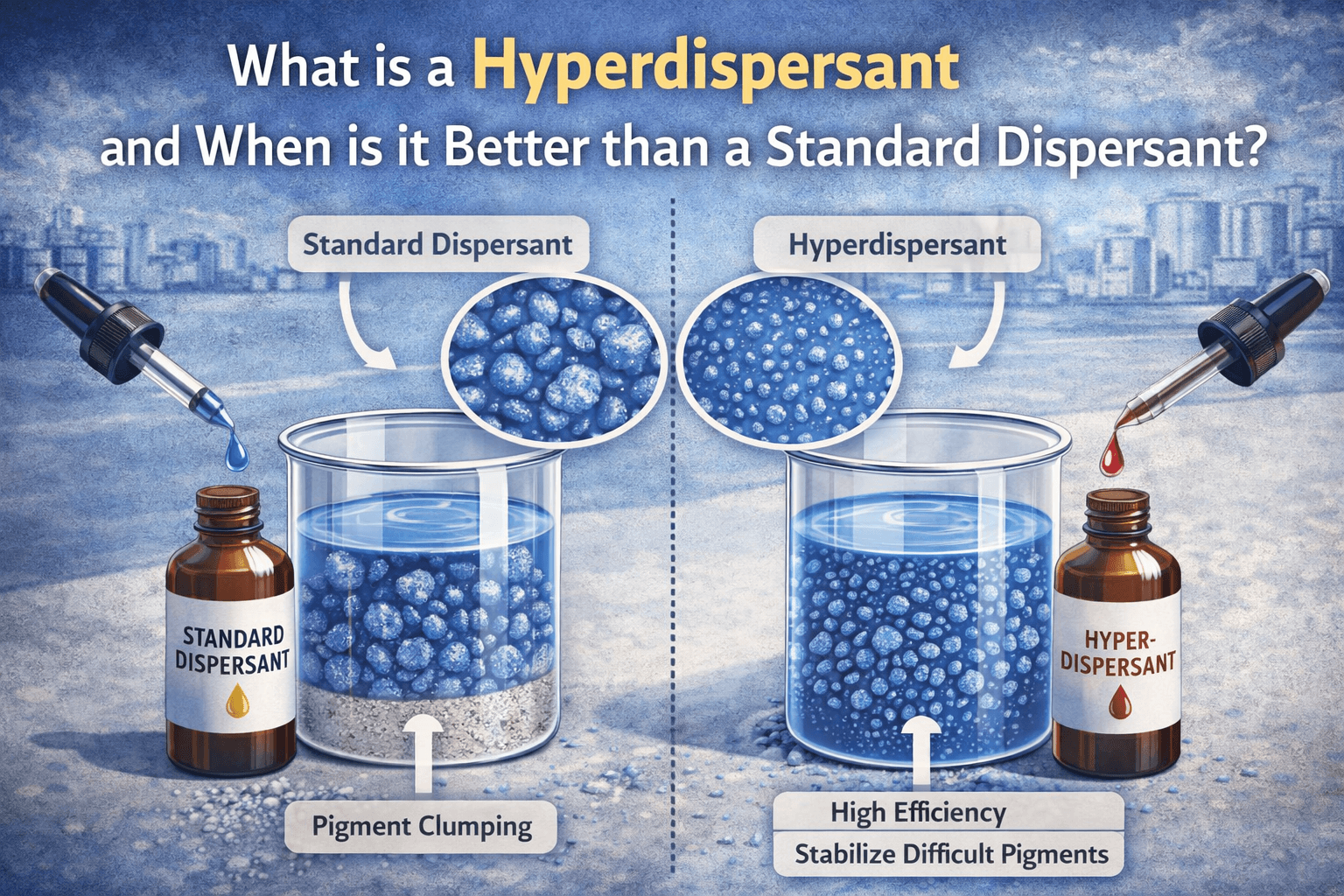
What Is a Hyperdispersant and When Is It Better Than a Standard Dispersant?
In modern coating formulations, not every pigment system can be handled efficiently with a basic dispersing additive. Hyperdispersants are often preferred in difficult pigment systems where stronger stabilization, lower viscosity, and better dispersion quality are required. This guide explains what a hyperdispersant is and when it offers a practical advantage over a standard dispersant.
What this blog covers
What hyperdispersants do, how they differ from standard dispersants, and where they are more effective.
Who it is for
Formulators, R&D teams, technical buyers, and coating manufacturers working with demanding pigment systems.
Main focus
Carbon black, organic pigments, difficult dispersions, viscosity control, and long-term pigment stabilization.
Core outcome
Clearer additive selection for better process efficiency, stronger dispersion stability, and improved coating performance.
What is a hyperdispersant?
A hyperdispersant is a high-performance dispersing additive designed to improve the wetting, separation, and stabilization of pigment particles in demanding coating systems. While a standard dispersant may provide acceptable performance in easier formulations, a hyperdispersant is typically used when the pigment package is more difficult to handle or when the coating requires better viscosity control, stronger color development, and improved long-term stability.
In practical terms, hyperdispersants are often selected when the formulator wants more than just basic dispersion support. They are especially valuable in systems containing carbon black, difficult organic pigments, high pigment loading, or conditions where reflocculation and viscosity rise create serious problems.
Why some coating systems need more than a standard dispersant
Not all pigment systems behave in the same way. Some are relatively easy to wet and stabilize, while others are much more demanding because of high surface area, strong particle interaction, or the need for better long-term stability.
Higher pigment surface area
Difficult pigments such as carbon black and many organic pigments usually create higher additive demand.
Viscosity rise during dispersion
Standard dispersants may not reduce or stabilize viscosity enough in more concentrated systems.
Reflocculation after grinding
A system may look fine initially but lose performance later if stabilization is not strong enough.
Need for better final appearance
Gloss, blackness, transparency, color strength, and consistency often improve with better pigment stabilization.
Where this becomes especially important
- carbon black dispersions
- high-strength organic pigment systems
- high pigment loading coatings
- systems with strong viscosity sensitivity
- formulations requiring long-term storage stability
Hyperdispersant vs standard dispersant: what is the difference?
Both types of additives support pigment wetting and dispersion, but they are not always equal in performance. A standard dispersant may be enough for simpler systems, while a hyperdispersant is usually selected for stronger stabilization and better control in difficult formulations.
| Comparison Area | Standard Dispersant | Hyperdispersant |
|---|---|---|
| Typical use | Basic to moderate pigment systems | Difficult or high-demand pigment systems |
| Stabilization strength | Moderate | Usually stronger |
| Carbon black suitability | May be limited | Often preferred |
| Organic pigment performance | Depends on pigment difficulty | Often better in demanding shades |
| Viscosity control at higher loading | Can be limited | Usually better |
| Long-term stability | Variable | Often stronger |
When is a hyperdispersant better than a standard dispersant?
A hyperdispersant becomes the better choice when the formulation is more demanding and the standard option cannot deliver enough stability or process efficiency.
Why hyperdispersants are often preferred for carbon black
Carbon black is one of the toughest pigment classes to stabilize in many coating systems. Its very fine particle size and high surface area can cause major viscosity increase, poor jetness, and instability if the additive is not strong enough.
In these systems, hyperdispersants are often used to help:
- reduce millbase viscosity
- improve blackness and color strength
- reduce reflocculation risk
- improve gloss and appearance consistency
- maintain better stability over storage
Why hyperdispersants can perform better in difficult organic pigment systems
Many organic pigments are more demanding than standard inorganic pigments because of their smaller particle size and greater need for stabilization. In bright shades or high-performance color formulations, a standard dispersant may not always provide enough control.
A hyperdispersant may help improve:
- tint strength
- shade consistency
- dispersion stability
- gloss and visual appearance
- resistance to flooding and floating
Is a hyperdispersant always the right choice?
Not necessarily. A hyperdispersant is not automatically required in every formulation. In simpler pigment systems or less demanding applications, a standard dispersant may be sufficient. The best choice should always depend on the pigment system, processing conditions, target properties, and commercial requirements.
A standard dispersant may still be suitable when:
- the pigment package is relatively easy to handle
- loading levels are moderate
- the system does not show strong reflocculation tendency
- viscosity is already well controlled
- premium performance is not required
How to decide whether to move from a standard dispersant to a hyperdispersant
A good decision is usually based on both technical signs and practical formulation results.
Consider re-evaluating your current additive if you see:
- high viscosity during or after dispersion
- poor blackness in carbon black systems
- weak color development in organic pigment systems
- reflocculation after storage
- loss of gloss or appearance consistency
- batch-to-batch instability
What practical benefits can a hyperdispersant deliver?
When matched correctly to the pigment and system, a hyperdispersant can improve both technical performance and process reliability.
Lower viscosity
Can support easier grinding, better flow, and improved pigment loading capability.
Better stability
Helps reduce reflocculation, settling-related issues, and long-term inconsistency.
Improved appearance
Can improve gloss, transparency, blackness, and color strength in demanding systems.
Better process reliability
Supports more predictable batch quality and fewer formulation compromises.
How Raj Speciality Additives supports hyperdispersant selection
At Raj Speciality Additives, we understand that difficult pigment systems require more than basic additive support. Whether the challenge involves carbon black, demanding organic pigments, or higher pigment loading, the right hyperdispersant strategy can help improve viscosity control, pigment stabilization, and final coating quality.
Explore our related coating additive solutions:
Final thoughts
A hyperdispersant is not simply a premium version of a standard dispersant. It is a more capable option for situations where pigment stabilization, viscosity control, and long-term consistency are harder to achieve.
In easier systems, a standard dispersant may still perform well. But in difficult formulations involving carbon black, demanding organic pigments, or higher pigment loading, a hyperdispersant often becomes the better practical choice.
The smartest way to decide is to evaluate both options under real formulation conditions and compare the effect on dispersion quality, stability, and final coating performance.
Need a better dispersing solution for difficult pigment systems?
Connect with Raj Speciality Additives to explore the right hyperdispersant strategy for carbon black, organic pigments, and high-performance coating formulations.
Frequently Asked Questions
A hyperdispersant is a high-performance dispersing additive used to improve pigment wetting, separation, and long-term stabilization in demanding coating systems.
A standard dispersant may be enough for simpler systems, while a hyperdispersant is generally preferred when stronger stabilization, lower viscosity, and better performance are needed in difficult pigment systems.
A hyperdispersant should be considered when the formulation contains carbon black, difficult organic pigments, high pigment loading, or when the current dispersant does not provide enough stability or viscosity control.
No. In simpler systems, a standard dispersant may be sufficient. The right choice depends on the pigment package, process conditions, and desired performance level.
Carbon black is difficult to stabilize because of its fine particle size and high surface area. Hyperdispersants are often preferred because they can improve viscosity control, blackness, and long-term stability.
This blog should most strongly support the Hyperdispersant Additives for Coatings page, while also supporting Dispersing Additives and Wetting & Dispersing Agents pages.
References & Citations
The technical points in this article are supported by published literature and formulation references related to polymeric dispersants, pigment stabilization, inter-particle attraction reduction, and high-efficiency dispersion in coatings.
Coatings (MDPI) — Comb-Like Structure Polymeric-Based Hyperdispersants and Their Application in Aqueous Pigment Dispersions
Explains that hyperdispersants are polymeric dispersants designed to inhibit pigment agglomeration, reduce viscosity, and create stable, uniform suspensions through anchoring groups and solvated chains.
View Source
Lubrizol — Dispersants Technology and Benefits
Describes the role of hyperdispersants in coatings, including improved pigment dispersion, reduced inter-particulate attraction, smaller particle size, narrower particle size distribution, and improved stability.
View Source
Lubrizol — Dispersant Technology eBook
Provides formulation-level background on why hyperdispersants can outperform more conventional dispersants in demanding pigment systems by improving dispersion efficiency and stability.
View Source
Evonik — An Efficient Approach to Dispersing Pigments
Supports the importance of harmonizing pigment surface chemistry and dispersant structure, and explains why advanced polymeric dispersant technologies can improve wetting, stabilization, and resistance to flocculation.
View Source
Evonik TEGO® Dispers 695 — Fact Sheet
Notes that hyperdispersants are especially suited for fast pigment wetting and high efficiency, particularly with organic pigments and carbon black, and can help in difficult high-loading dispersions.
View Source
European Coatings — Essentials of Efficient Pigment Dispersion
Industry reference material covering dispersion efficiency, stabilization, pigment wetting, and practical factors affecting pigment performance in coatings.
View Source