
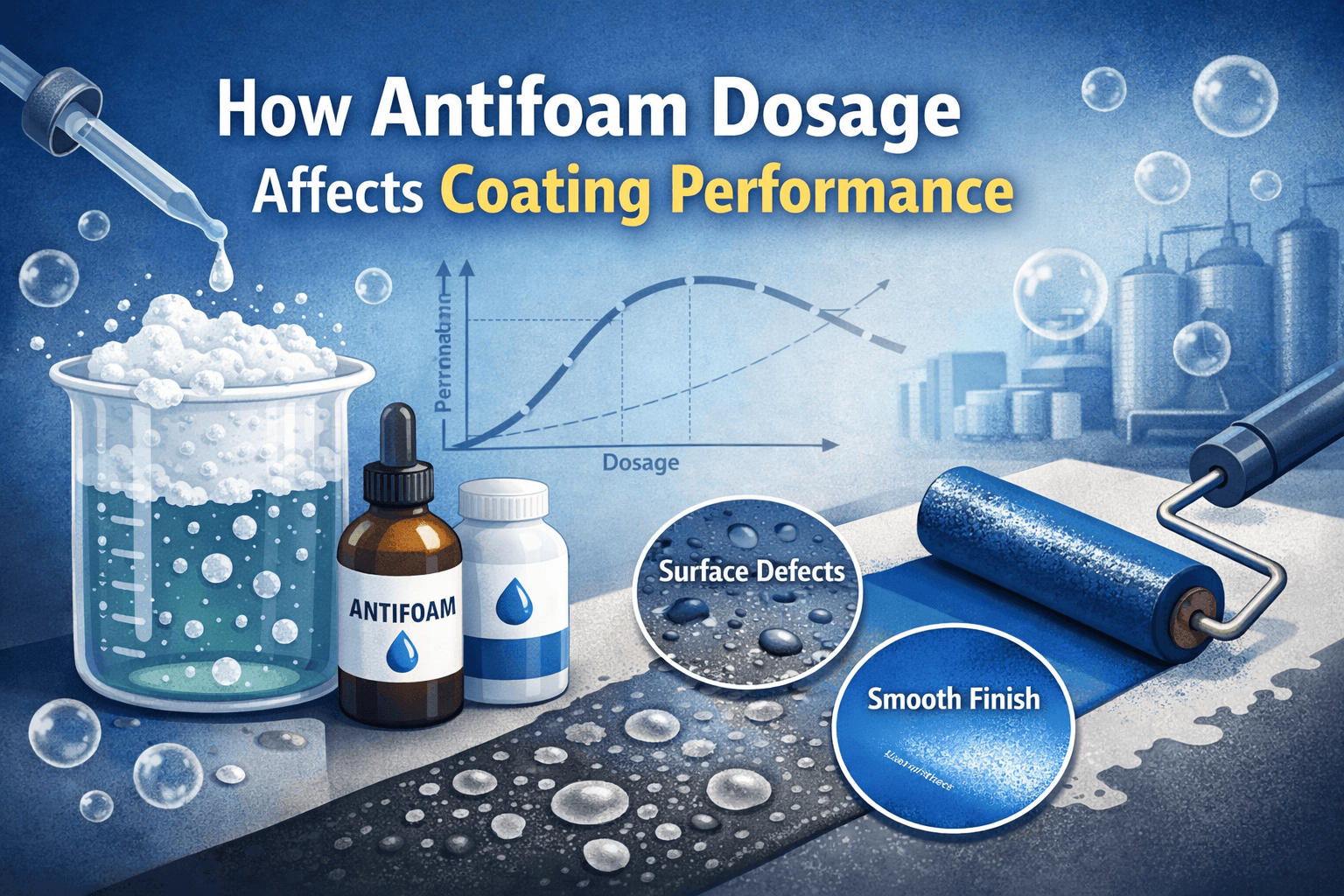
How Antifoam Dosage Affects Coating Performance and Common Overdose Problems
Antifoams are essential for controlling foam during manufacturing, filling, and application of coatings. But the right product alone is not enough. Dosage plays a major role in how well an antifoam performs and whether it introduces side effects into the coating system. This guide explains how antifoam dosage affects coating performance and what can happen when the dosage is too low or too high.
What this blog covers
How antifoam dosage influences foam control, coating appearance, process stability, and overdose-related defects.
Who it is for
Coating formulators, production teams, plant chemists, and technical buyers dealing with foam issues in liquid coatings.
Main focus
Foam control, dosage balance, overdose risks, film defects, and formulation troubleshooting.
Core outcome
Better antifoam selection and dosage control for stable processing and better finished coating quality.
Why antifoam dosage matters in coatings
Foam can create serious problems in coatings, including defects during production, poor filling efficiency, unstable appearance, and surface issues in the final applied film. Antifoams are added to control these problems, but their performance depends heavily on correct dosage.
If the dosage is too low, the coating may continue to foam during mixing, pumping, filling, or application. If the dosage is too high, the system may develop new problems such as surface defects, compatibility issues, craters, haze, or appearance inconsistency. This is why antifoam performance should be viewed as a balance problem rather than a simple “more is better” decision.
What antifoam dosage actually influences
Antifoam dosage does more than control visible bubbles. It can affect several parts of coating performance, both during manufacturing and after application.
Manufacturing foam control
Correct dosage helps reduce foam during mixing, grinding, transfer, and filling operations.
Air release behavior
It influences how quickly entrained air leaves the coating after processing or application.
Surface appearance
Dosage can affect the final film by helping or harming surface smoothness, gloss, and uniformity.
System compatibility
Higher-than-needed levels can disturb the balance of the formulation and introduce defects.
What happens when antifoam dosage is too low?
Under-dosing is one of the most common foam-control problems in coatings. The antifoam may be technically suitable, but the amount present is not enough to control foam consistently across the process.
Typical signs of low dosage
- persistent foam during mixing or let-down
- foam returning after initial control
- air entrapment in the liquid coating
- microfoam remaining in the system
- pinholes or foam-related defects after application
- slower production because of foam overflow or filling issues
In such cases, the formulator may think the antifoam chemistry is wrong when the actual issue is that the dosage is simply not sufficient for the formulation’s foam demand.
What happens when antifoam dosage is too high?
Overdosing an antifoam can be just as problematic as under-dosing. Excess antifoam may disturb the surface behavior of the coating and create compatibility-related issues.
| Possible Overdose Problem | How It May Appear | Why It Matters |
|---|---|---|
| Craters or surface defects | Small circular defects or disturbed film areas | Reduces final appearance quality |
| Haze or clarity loss | Film looks less clean or less uniform | Can hurt visual performance |
| Gloss reduction | Surface appears duller than expected | Affects premium appearance |
| Intercoat or compatibility issues | Surface balance becomes unstable | Can affect downstream performance |
| Poor recoat or application behavior | Coating behaves differently than intended | Creates process inconsistency |
Common signs that an antifoam may be overdosed
Overdose symptoms are not always obvious at first, especially if the main foam problem seems to be solved. However, several warning signs may indicate that the level is too high for the system.
Why correct dosage is a balance, not a maximum
The most effective antifoam program is usually not the one with the highest addition level. Instead, it is the one that controls foam at the lowest effective dosage while maintaining compatibility with the full coating system.
Antifoam dosage should be balanced against:
- type and intensity of foam problem
- resin and binder system
- pigment and filler load
- application method
- surface appearance requirements
- air release and film formation needs
How to optimize antifoam dosage more effectively
A practical dosage decision should be based on both process foam control and final film evaluation.
1. Define where the foam problem is occurring
Foam during grinding, let-down, filling, or application may not behave the same way. Understanding the stage helps choose both product and dosage better.
2. Start with controlled dosage comparison
Compare low, medium, and slightly higher levels rather than jumping directly to a high-dose correction.
3. Check both immediate and delayed effects
Some antifoam problems only become visible after application, drying, or storage, so a dosage should not be judged only in the vessel.
4. Evaluate foam control and appearance together
The winning dosage is the one that reduces foam while protecting gloss, film smoothness, and coating uniformity.
5. Review compatibility with the full formulation
Pigments, fillers, wetting agents, dispersants, rheology additives, and binder chemistry all influence how an antifoam behaves.
Why the right antifoam product still needs the right dosage
A suitable antifoam chemistry can fail if it is added at the wrong level. This is why product selection and dosage optimization should always go together.
Right product, low dosage
Foam control may be incomplete even though the chemistry is compatible.
Right product, high dosage
Foam may reduce, but coating appearance or surface quality may suffer.
Wrong product, low dosage
The system may show poor defoaming and no clear performance benefit.
Right product, right dosage
This is where stable foam control and good final film quality come together.
When formulators should review antifoam dosage again
Even a once-stable dosage may need review if the formulation or process changes.
Review dosage when:
- pigment or filler package changes
- binder system changes
- mixing conditions change
- application method changes
- new surface defects appear
- production scale is different from lab scale
How Raj Speciality Additives supports foam control in coatings
At Raj Speciality Additives, we understand that successful foam control is not only about choosing an antifoam. It is also about using the right dosage for the specific coating system, process conditions, and appearance requirements.
Explore our related coating additive solutions:
Final thoughts
Antifoam dosage has a direct effect on coating performance. Too little can leave foam uncontrolled, while too much can create surface defects, appearance loss, and compatibility problems.
The best dosage is usually the minimum effective level that controls foam reliably without disturbing film quality. A more structured approach to dosage optimization can help coating manufacturers reduce trial-and-error work and achieve more stable process performance.
Need better foam control without film defects?
Connect with Raj Speciality Additives to identify the right antifoam strategy and dosage balance for your coating system.
Frequently Asked Questions
Antifoam dosage is important because too little may fail to control foam, while too much can create surface defects, gloss loss, and compatibility issues in the coating.
Low dosage can lead to persistent foam, microfoam, air entrapment, filling issues, and foam-related defects after application.
High dosage may cause craters, haze, gloss reduction, compatibility issues, and other film appearance defects even if vessel foam seems controlled.
A common sign is when foam control improves in the vessel but the applied film starts showing craters, disturbed surface appearance, or gloss reduction.
It should be optimized by comparing controlled dosage levels and evaluating both foam control and final film quality, not only vessel defoaming performance.
This blog should support Antifoam for Coatings, the foam-related blog, Wetting & Dispersing Agents, Rheology Additives, and the Coating Additives Manufacturer page.
References & Citations
The points covered in this article are supported by published technical literature, supplier documentation, and formulation guidance related to defoamers, air release additives, foam control mechanisms, and dosage performance in coating systems.
Albert Frank & Wilfried Scholz — Defoamers in the Coatings Industry
A technical publication discussing foam stabilization, defoamer mechanisms, major defoamer classes, and their practical use in coating formulations.
View Source
Evonik TEGO® Foamex 1488 — Technical Data Sheet
Includes a typical recommended addition level of 0.1–1.0% on total formulation and notes that final performance depends on the coating system and should be verified through formulation-specific testing.
View Source
Evonik TEGO® Foamex 3062 — Technical Data Sheet
Includes a typical recommended addition level of 0.05–0.5% on total formulation and highlights that incorporation and processing conditions influence defoamer performance.
View Source
BASF — A Practical Guide to Defoamers
Provides practical guidance on defoamer selection, formulation considerations, testing, and performance evaluation in paints and coatings.
View Source
Dow — Foam Control in Waterborne Coatings
Covers the causes of foam in waterborne systems and outlines formulation and additive-related factors that influence effective foam control.
View Source
European Coatings Journal / Industry Technical Literature
Widely used industry reference material for coating formulation, additive behavior, foam defects, and defoamer evaluation in practical paint systems.