
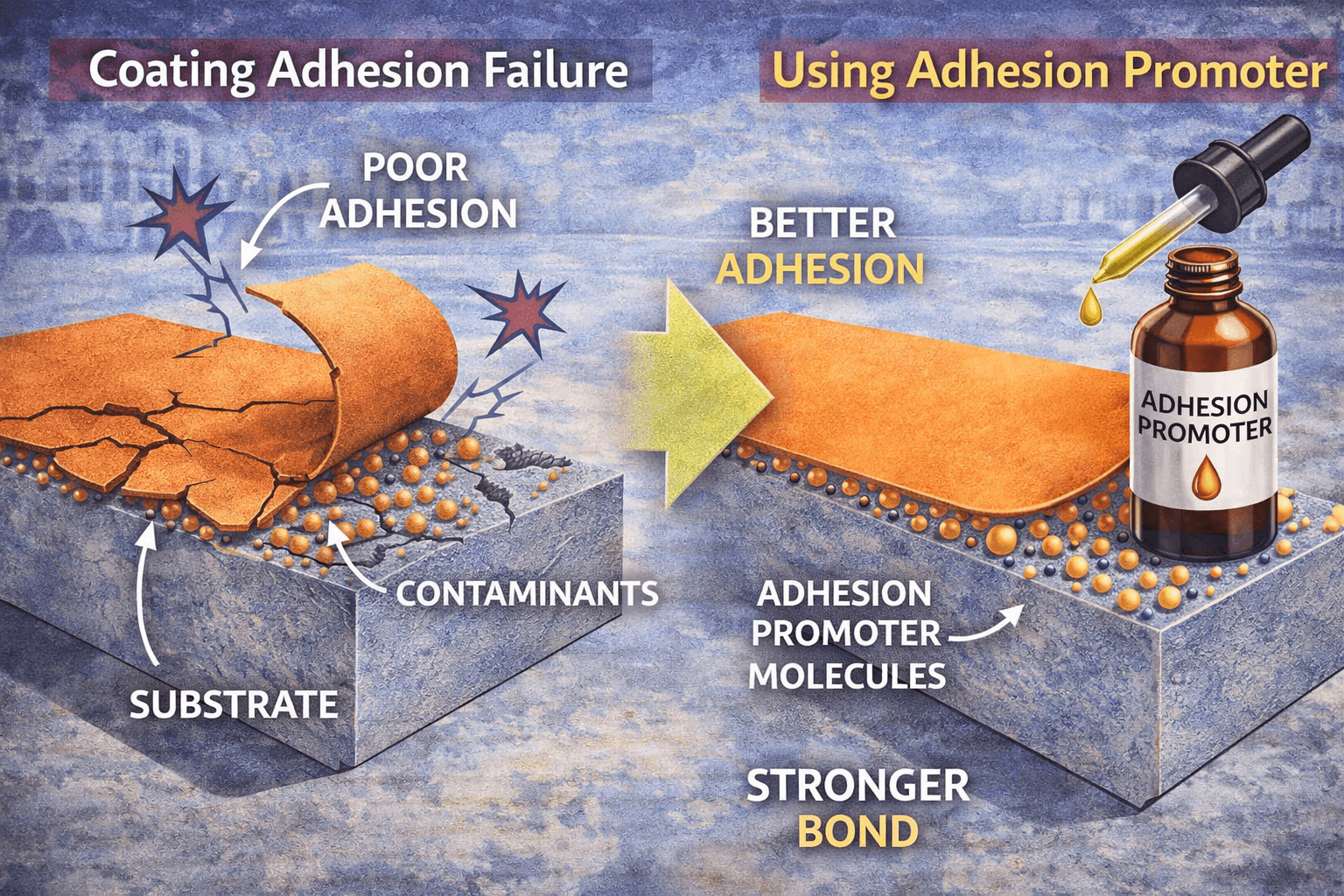
Why Coating Adhesion Failure Happens and How Adhesion Promoters Help
Coating adhesion failure is one of the most common and costly issues in industrial finishing. This blog explains why adhesion problems happen, what symptoms formulators should watch for, and how adhesion promoters can help support better coating performance.
In industrial coatings, adhesion is one of the most fundamental performance requirements. If the coating film does not bond properly to the substrate or to the previous layer, the entire coating system can fail long before its intended service life. This is why coating adhesion failure remains a major concern for formulators, manufacturers, and end users across metal coatings, industrial finishes, protective coatings, and multi-layer systems.
Adhesion problems do not always come from one obvious source. In many cases, failure is influenced by a combination of poor surface preparation, low surface energy, inadequate wetting, formulation incompatibility, curing imbalance, intercoat mismatch, or mechanical stress. Because of this, coating adhesion should be viewed as a system-level issue rather than a single-ingredient problem.
One of the most practical ways to support adhesion performance is to evaluate whether the formulation needs an adhesion promoter for coatings. These additives may help improve bonding, substrate interaction, and coating durability where standard formulations struggle to anchor properly.
What does coating adhesion failure look like?
Coating adhesion failure may show up in different ways depending on the formulation, substrate, and service conditions. In some cases, the issue becomes visible immediately after drying or curing. In others, it appears later under stress, weathering, flexing, handling, or chemical exposure.
Common visible symptoms
- Peeling or flaking from the substrate
- Chipping around edges, corners, or impact points
- Delamination between coating layers
- Weak cross-hatch or tape test performance
- Loss of film integrity after environmental exposure
Not every visible failure is caused by the same mechanism. For example, a film separating from bare metal is different from a topcoat detaching from a primer. Both are adhesion failures, but the root cause and solution path may differ significantly.
Why coating adhesion failure happens
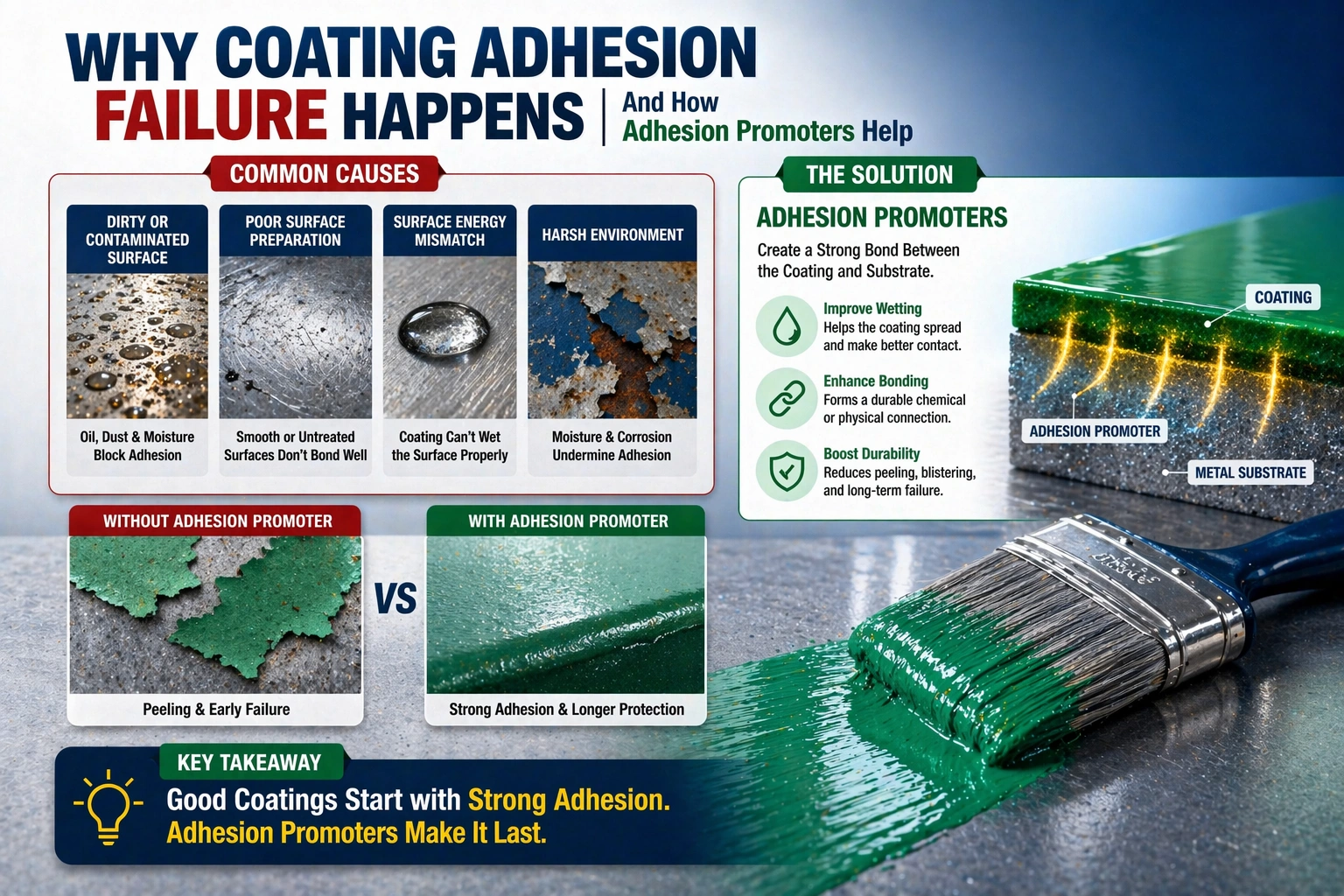
Adhesion failure in industrial coatings usually happens when the coating system is unable to build or maintain a strong interfacial bond. That weakness may begin at the substrate surface, inside the formulation, or during film formation and cure.
1. Poor surface cleanliness or contamination
Oil, dust, moisture, release agents, oxidation, and residual contaminants can interfere with coating-substrate contact. Even a technically good coating may fail if it is applied over a contaminated surface.
2. Low surface energy substrates
Some plastic and treated surfaces are naturally difficult to wet and bond to. If the coating does not spread and interact properly at the interface, anchorage will be weak from the beginning.
3. Insufficient substrate wetting
Surface wetting is closely linked to adhesion. If the coating fails to wet the substrate well, the real contact area becomes limited. This can reduce mechanical anchorage and interfacial interaction. That is why wetting-related additives often work alongside adhesion-focused solutions. You can explore this further in RSA’s blog on wetting vs dispersing agents in coatings.
4. Incompatible formulation components
Resins, pigments, solvents, fillers, and additives must work together as a balanced system. Poor compatibility between ingredients may weaken the film structure or reduce its ability to bond reliably.
5. Improper curing or film formation
If the coating cures too fast, too slowly, or unevenly, adhesion may suffer. Cure imbalance can change internal stress, solvent release, film continuity, and bonding behavior at the interface.
6. Intercoat adhesion mismatch
In multi-layer systems, even if the primer bonds well to the substrate, the next layer may still fail if there is weak compatibility, recoat timing issues, or insufficient intercoat anchorage.
Adhesion is not only about sticking — it is about staying bonded under real service conditions
A coating that appears attached right after application may still fail later if the interface is weak. Good adhesion must survive handling, curing stress, thermal change, moisture, chemicals, and long-term environmental exposure. That is why formulators should evaluate adhesion as a durability issue, not just an initial application result.
How surface and substrate conditions influence adhesion
The substrate itself plays a major role in whether the coating will bond properly. Metals, plastics, glass, composites, and previously coated surfaces all behave differently. Surface energy, roughness, cleanliness, and reactivity affect how the coating spreads, anchors, and ultimately performs.
For example, adhesion on metal may be influenced by oxidation, smoothness, pretreatment quality, and moisture. On plastics, low surface energy and poor wetting can be the dominant challenge. In primer-topcoat systems, intercoat adhesion may depend on recoat window, cure stage, and layer compatibility rather than the base substrate alone.
This is why solving adhesion failure often requires looking beyond one additive and understanding the full substrate-coating interaction.
How adhesion promoters help in coatings
Adhesion promoters in coatings are used to support the bonding relationship between the coating and the surface, or between different layers in the coating system. They are especially relevant when the base formulation needs stronger anchorage, better compatibility at the interface, or improved durability against adhesion-related failure.
What an adhesion promoter may help with
- Improving film-to-substrate interaction
- Supporting better anchorage on difficult surfaces
- Reducing the risk of peeling or delamination
- Helping multi-layer coating systems maintain intercoat bonding
- Strengthening overall coating reliability in demanding environments
Adhesion promoters are not a substitute for proper formulation work or good surface preparation. However, when the coating system needs additional support at the interface, they may become an important part of the solution strategy.
What formulators should evaluate before selecting an adhesion promoter
When facing industrial coating adhesion problems, it is important to define the actual failure mode before adjusting the additive package. A clear diagnosis helps avoid treating the symptom while missing the real cause.
- Identify the failure location: Is the film separating from the substrate or between layers?
- Review surface preparation: Was contamination, oxidation, or insufficient pretreatment present?
- Check wetting and application behavior: Did the coating spread properly before cure?
- Assess formulation balance: Are resin, pigment, solvent, and additive interactions stable?
- Examine curing conditions: Was the film formed and cured in a way that supports adhesion?
Once these questions are answered, the role of an adhesion promoter becomes much clearer. In some cases, it can directly strengthen substrate bonding. In others, it may be part of a broader formulation improvement program involving wetting, dispersion, and surface defect control.
For broader additive context, RSA also covers related topics such as flooding and floating in industrial coatings and antifoam for coatings, since final film performance is influenced by several connected formulation factors.
Conclusion
Coating adhesion failure is rarely random. It is usually the result of weak interaction at the interface caused by substrate difficulty, poor wetting, contamination, formulation imbalance, cure issues, or intercoat mismatch. Because the causes are often interconnected, the solution must be approached systematically.
For industrial coating systems that need stronger bonding and better long-term film reliability, evaluating an adhesion promoter for coatings can be an important step. When used in the right formulation context, adhesion promoters may help improve anchorage, reduce failure risk, and support more consistent coating performance.
FAQs
What causes coating adhesion failure?
Coating adhesion failure may be caused by contamination, poor substrate wetting, low surface energy, improper curing, formulation incompatibility, weak intercoat bonding, or inadequate surface preparation.
What are the common signs of poor adhesion in coatings?
Common signs include peeling, flaking, chipping, delamination, weak tape test performance, and premature film breakdown during service.
How do adhesion promoters help in coatings?
Adhesion promoters help support the bond between the coating and the substrate, or between coating layers, especially where stronger anchorage and more reliable adhesion are needed.
Are adhesion promoters useful for difficult substrates?
Yes, they may be particularly useful where the surface is hard to wet or where the substrate is difficult for the coating to anchor to effectively.
Can wetting problems lead to adhesion failure?
Yes. If a coating does not wet the substrate properly, the interfacial contact can be poor, which may contribute to weak adhesion and lower long-term durability.
Is adhesion failure always solved by adding one additive?
No. Adhesion failure often has multiple root causes. Additive selection helps, but surface preparation, substrate type, formulation balance, and curing conditions must also be considered.
References & Citations
The technical points in this article are supported by coating-industry literature and formulation references related to surface contamination, surface preparation, adhesion failure, adhesion promoters, difficult substrates, and adhesion testing in industrial coatings.
American Coatings Association — The Two Pillars of Surface Preparation
Explains why inadequate removal of mill oils, greases, fingerprints, oxides, mill scale, molding release compounds, and other contaminants can lead to pretreatment failure and coating delamination.
View Source
|
Visit Website
Evonik — Dynasylan® for Paints and Coatings
Supports the use of silane-based adhesion promoters in coatings and notes improved adhesion on challenging substrates such as glass, aluminum, steel, and concrete.
View Source
|
Visit Website
Evonik — The Coatings Expert 2019
Discusses adhesion promoters for coatings and shows how specific adhesion-promoter technologies help improve bonding and reduce adhesion-related failures in industrial coating systems.
View Source
|
Visit Website
ASTM D3359 — Standard Test Methods for Rating Adhesion by Tape Test
Standard reference for tape-test evaluation of coating adhesion, widely used to assess adhesion performance and compare coating-to-substrate bonding.
View Source
|
Visit Website
American Coatings Association — Guide to Adhesion Measurement
Provides broader technical background on coating adhesion, failure modes, and why adhesion measurement methods are important when diagnosing delamination problems.
View Source
|
Visit Website
Evonik — Dynasylan® Silanes for Metal Treatment
Gives technical background on how silane systems help improve interfacial bonding and promote adhesion to subsequent coating layers on metal substrates.
View Source
|
Visit Website
Need support for adhesion-related coating problems?
Explore RSA’s adhesion promoter page or contact the team for technical discussion around coating adhesion, difficult substrates, and formulation support.