
Adhesion Promoters for Metal, Plastic, and Difficult Substrates in Industrial Coatings
Different substrates create different coating challenges. This blog explains why metal, plastic, and other difficult surfaces often need better adhesion support, and how adhesion promoters can help improve coating reliability in industrial systems.
In industrial coatings, not every surface behaves the same way. A coating that performs well on one substrate may show weak adhesion, early peeling, or interfacial failure on another. This is why formulators working with metal coatings, plastic coatings, and other difficult surfaces often need a more substrate-aware approach.
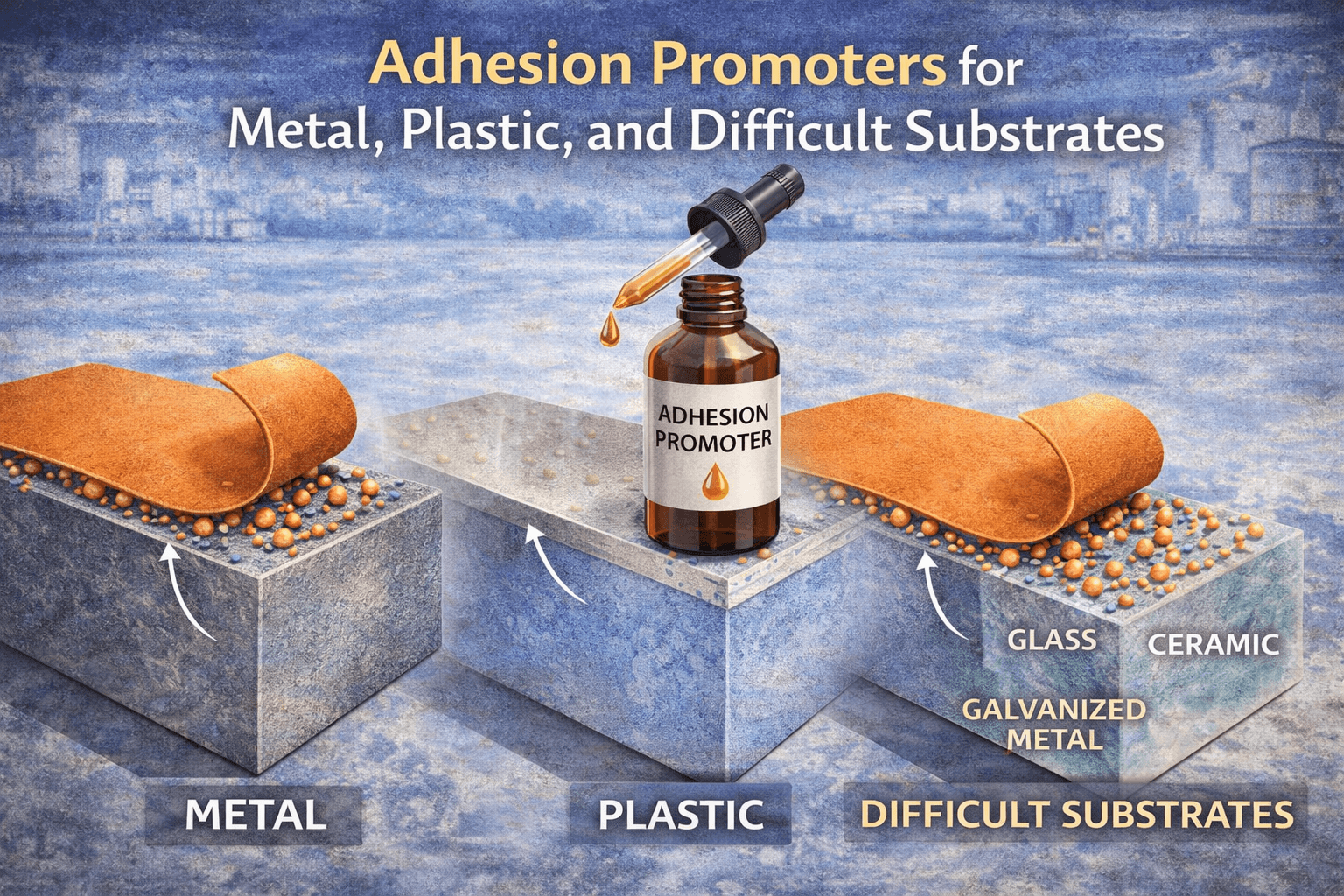
The challenge is that adhesion depends on more than just the coating itself. Surface energy, cleanliness, pretreatment, film formation, intercoat compatibility, and substrate chemistry all influence how well the coating can anchor. In many cases, the formulation may benefit from an adhesion promoter for coatings to improve bonding and help the film perform more reliably.
This is especially important in industrial environments where coated parts are exposed to handling, thermal change, moisture, chemicals, mechanical stress, and long service conditions. A weak interface may not be visible immediately, but it often becomes a durability problem later.
Adhesion challenges in metal coatings
Metal is one of the most common coating substrates in industrial applications, but that does not mean adhesion is automatically easy. Strong performance depends heavily on the metal surface condition and the way the coating interacts with it.
Common reasons metal coatings may lose adhesion
- Oxidation, corrosion, or surface contamination
- Insufficient pretreatment or cleaning
- Very smooth metal surfaces with limited anchorage
- Moisture or residue before application
- Intercoat mismatch in primer-topcoat systems
Even on metal, poor wetting can limit true contact between the coating and the surface. This affects the interface and can reduce long-term film performance. When a coating is expected to resist weathering, handling, or industrial service exposure, metal adhesion must be treated as a full system requirement rather than a basic assumption.
Adhesion challenges in plastic coatings
Plastic substrates are often more difficult than metal because many plastics have low surface energy. This means the coating may struggle to spread, wet, and build a strong bond at the interface. As a result, adhesion promoters for plastic coatings are frequently considered where direct coating performance is weak or inconsistent.
Why plastics are more challenging
- Low surface energy can reduce wetting and anchorage
- Mold release agents or processing residues may remain on the surface
- Substrate flexibility can stress the film after cure
- Plastic chemistry varies significantly from one material to another
- Thermal expansion differences may increase interfacial stress
Because plastics vary so widely, the same formulation may not behave consistently across all plastic parts. This makes adhesion promoter selection and substrate-specific testing important when coating reliability matters.
What are difficult substrates in industrial coatings?
A difficult substrate is any surface where the coating cannot easily wet, anchor, or remain bonded over time. These may include certain plastics, treated surfaces, composites, smooth metals, previously coated parts, or surfaces with contamination and inconsistent surface energy.
| Substrate Type | Typical Adhesion Challenge | Why It Matters |
|---|---|---|
| Metal | Oxidation, smoothness, contamination, pretreatment issues | Can reduce coating anchorage and long-term film durability |
| Plastic | Low surface energy, residues, flexibility | Can cause poor wetting, peeling, or weak bond formation |
| Previously coated surface | Intercoat incompatibility or recoat timing problems | May lead to layer separation rather than substrate failure |
| Composite / specialty surface | Variable chemistry and surface behavior | May need tailored additive and application support |
In many cases, the problem is not just “poor sticking.” It is a combination of weak wetting, inconsistent surface interaction, formulation imbalance, and stress at the interface. That is why difficult substrates often require more targeted additive support.
The harder the substrate is to wet, the more carefully adhesion should be evaluated
Wetting and adhesion are closely connected. If a coating cannot spread and establish real contact with the surface, it is much harder to build durable bonding. This is why adhesion-related issues are often linked to wetting performance as well. RSA’s blog on wetting vs dispersing agents in coatings is also relevant when diagnosing substrate-related coating failure.
How adhesion promoters help on metal, plastic, and difficult surfaces
Adhesion promoters in industrial coatings are used to support bonding where the base system may not anchor strongly enough on its own. Their role becomes especially useful when the coating needs help interacting with the substrate or maintaining stronger interfacial performance over time.
Where adhesion promoters may add value
- Coatings on difficult-to-wet plastic surfaces
- Metal systems requiring stronger bond consistency
- Coatings exposed to handling, stress, or demanding service conditions
- Primer-topcoat systems with intercoat adhesion risk
- Formulations where substrate variability affects performance
An adhesion promoter is not a replacement for surface cleaning, pretreatment, or sound formulation work. However, when selected properly, it may help strengthen interface performance and reduce the risk of peeling, delamination, or early coating failure.
What formulators should evaluate before selecting an adhesion promoter
When working with difficult substrates in industrial coatings, additive selection should begin with a structured review of the failure mechanism. This helps ensure that the promoter is chosen for the real challenge rather than the visible symptom.
Key evaluation points
- Substrate identity: Metal, plastic, treated surface, previously coated surface, or composite.
- Surface condition: Cleanliness, residue, pretreatment, oxidation, and roughness.
- Wetting behavior: How well the coating spreads before cure.
- Layer structure: Single coat system or multi-layer coating build.
- Curing profile: Whether cure conditions may create stress or incomplete bonding.
- End-use stress: Heat, moisture, chemicals, impact, flexing, or outdoor exposure.
These factors are important because the best adhesion solution is often linked to the full formulation and application environment. In many systems, coating defects like foam, poor leveling, flooding, or incompatible dispersion may also influence the final film and indirectly affect adhesion quality.
That broader formulation context is why RSA also connects adhesion topics with related pages such as antifoam for coatings and blogs such as preventing flooding and floating in industrial coatings.
Conclusion
Coating performance depends heavily on substrate behavior. Metal surfaces may fail because of contamination, oxidation, or pretreatment gaps, while plastic and other difficult substrates often create wetting and low-energy challenges that weaken the bond from the start.
For formulators addressing coating adhesion on metal, coating adhesion on plastic, or other demanding industrial surfaces, adhesion promoters can be an important part of the solution. When evaluated in the right system context, they may help improve substrate anchorage, reduce coating failure risk, and support stronger long-term performance.
FAQs
Why do metal coatings lose adhesion?
Metal coatings may lose adhesion because of contamination, oxidation, poor pretreatment, surface smoothness, moisture, or weak intercoat compatibility in layered systems.
Why are plastic substrates harder to coat?
Many plastics have low surface energy, which makes them harder to wet and bond to. Residues, flexibility, and thermal movement can also contribute to weaker coating adhesion.
What is a difficult substrate in industrial coatings?
A difficult substrate is a surface where the coating struggles to wet, anchor, or remain bonded over time. This may include certain plastics, smooth metals, composites, and previously coated parts.
How do adhesion promoters help on metal and plastic?
Adhesion promoters help support the interaction between the coating and the substrate, which may improve bonding, reduce peeling risk, and support better film durability.
Are adhesion promoters enough by themselves?
No. Surface cleaning, pretreatment, wetting, formulation balance, and curing conditions must also be evaluated. Adhesion promoters are most effective as part of a broader formulation strategy.
Can wetting affect adhesion on difficult substrates?
Yes. If the coating does not wet the surface properly, the interface may remain weak, which can reduce long-term bonding and increase the risk of adhesion failure.
References & Citations
The technical points in this article are supported by coating-industry literature and formulation references related to surface preparation, adhesion promoters, silane chemistry, difficult substrates, and adhesion testing in industrial coatings.
Evonik — Dynasylan® for Paints and Coatings
Supports the use of silane-based adhesion promoters to improve adhesion on challenging substrates such as glass, aluminum, steel, and concrete in coating systems.
View Source
|
Visit Website
Evonik — The Coatings Expert 2019
Describes TEGO® AddBond adhesion promoters as modified polyester resins designed to enhance adhesion to difficult substrates across different coating chemistries.
View Source
|
Visit Website
American Coatings Association — The Two Pillars of Surface Preparation
Explains why contaminants such as oils, greases, fingerprints, oxides, mill scale, and mold-release compounds can prevent proper adhesion and lead to paint delamination.
View Source
|
Visit Website
American Coatings Association — ACA Technology Roadmap #3
Notes that waterborne coating adhesion can be especially challenging on damp, dirty, oily, or greasy substrates and that some substrates need additional preparation or priming for reliable adhesion.
View Source
|
Visit Website
ASTM D3359 — Standard Test Methods for Rating Adhesion by Tape Test
Standard reference for tape-test evaluation of coating adhesion, commonly used to assess adhesion performance on coated substrates.
View Source
|
Visit Website
ASTM Committee D01 — Paint and Related Coatings Standards Overview
Provides committee-level standards context for coatings evaluation, including adhesion testing methods relevant to industrial coating performance verification.
View Source
|
Visit Website
Need help with coating adhesion on difficult substrates?
Explore RSA’s adhesion promoter page or connect with the team to discuss metal, plastic, and substrate-specific coating challenges.