
RSA • Dispersing Additives • Industrial & Global Coating Additives
Dispersing Additive for Coatings – Stable Pigment Dispersion for Consistent Paint Performance
Dispersing additives are essential components in paint and coating formulations, designed to stabilize pigments and fillers after wetting and grinding. Their primary role is to prevent re-agglomeration of particles, maintain uniform dispersion, and support consistent color, viscosity, and performance throughout processing, application, and storage.
RSA supplies dispersing additives for coatings formulated for solvent-based, high-solids, and industrial coating systems, as well as water-based coatings, with a focus on formulation compatibility, dispersion stability, and repeatable performance. RSA supplies globally including Saudi Arabia, UAE, South Africa, Vietnam, and India.
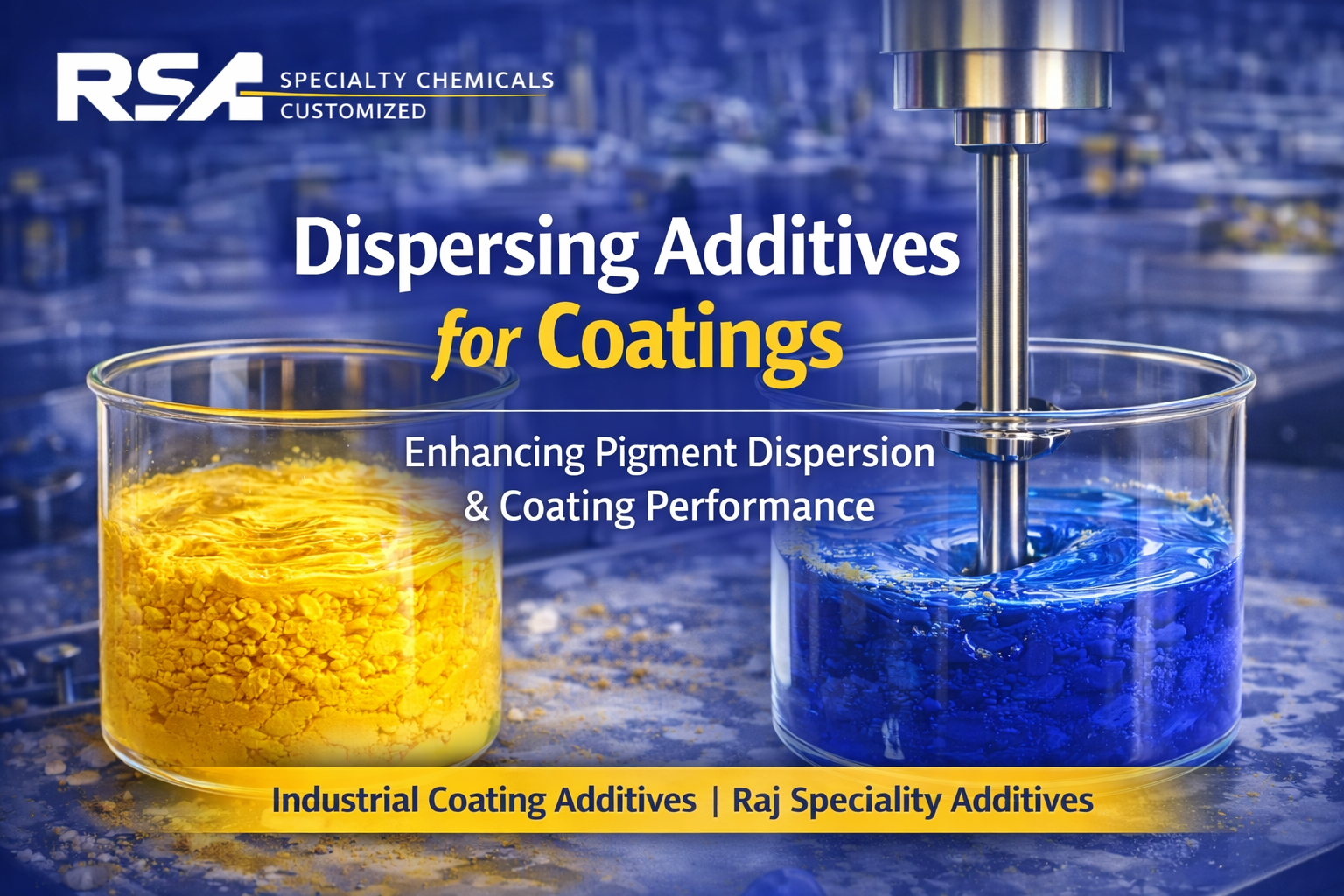
Role of Dispersing Additives in Coating Formulations
Once pigments and fillers are wetted and mechanically dispersed, dispersing additives adsorb onto particle surfaces and help keep them separated within the liquid medium. Without effective dispersing additives, pigment particles tend to re-agglomerate, leading to instability and performance issues.
Dispersing additives therefore play a critical role in ensuring long-term dispersion stability and predictable coating behavior, especially in industrial and solvent-based systems where process consistency is essential.
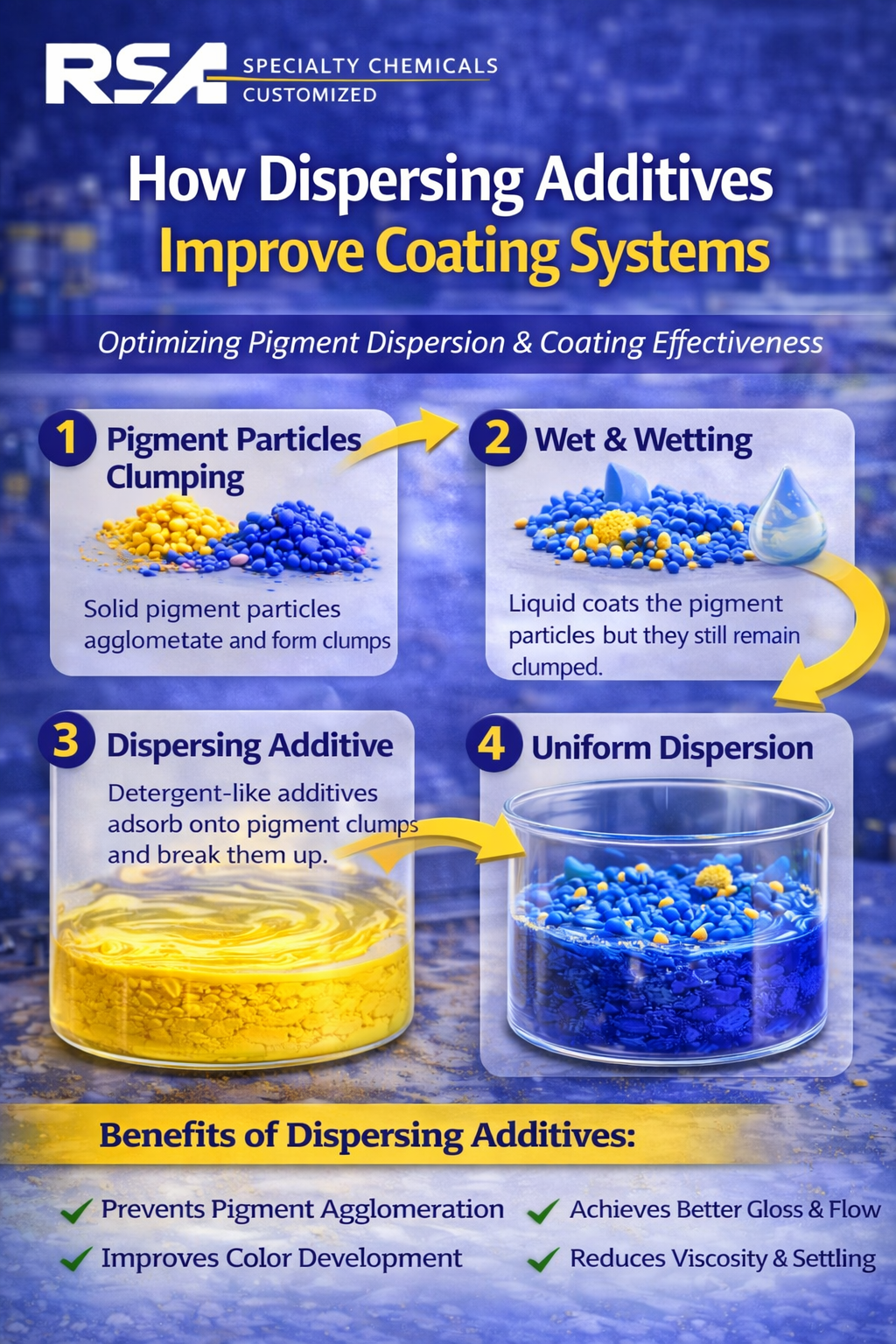
Difference Between Dispersing Additives and Wetting Agents
Wetting agents primarily assist in reducing interfacial tension to allow liquid penetration into pigment agglomerates. Dispersing additives, by contrast, stabilize the dispersed particles and prevent flocculation.
In many formulations, both additive types are used together to achieve efficient dispersion and long-term stability.
Mechanisms of Dispersion Stabilization
Dispersing additives stabilize pigments through:
- Electrostatic stabilization – creating repulsive charges between particles
- Steric stabilization – forming a physical barrier around particles
The dominant mechanism depends on additive chemistry, pigment type, and coating system. Advanced dispersing additives and hyperdispersants often rely on steric stabilization for enhanced performance.
Illustration 1: Particle Separation
Pigment particles are held apart after grinding, reducing the chance of re-agglomeration.
Illustration 2: Viscosity Stability
Better dispersion control helps maintain more stable viscosity during storage and application.
Illustration 3: Color Consistency
Stable dispersion improves pigment distribution and supports more uniform color development.
Dispersing Additives in Solvent-Based and High-Solids Coatings
For solvent-based and high-solids systems, dispersing additives are selected based on solvent polarity, resin chemistry, and pigment characteristics. Performance objectives include stable dispersion at high pigment loading, viscosity control, and resistance to flocculation under shear and temperature variation.
Since RSA primarily focuses on solvent-based and industrial coating systems, dispersing additives in this segment are especially important for maintaining processing stability and repeatable quality.
Dispersing Additives in Water-Based Coatings
In water-based coatings, dispersing additives must function effectively in the presence of surfactants, electrolytes, and polar binders. Key considerations include prevention of flocculation and settling, control of viscosity drift over time, compatibility with antifoams and rheology modifiers, and minimization of foam side-effects.
Pigment and Filler Considerations
Different pigments and fillers exhibit different dispersion behavior:
- Organic pigments – high surface area, strong flocculation tendency
- Inorganic pigments – require efficient wetting and stabilization
- Extenders and fillers – influence rheology and settling behavior
Dispersing additive selection should account for particle size, surface chemistry, and formulation context.
Common Dispersion-Related Defects Addressed
- Flocculation and hard settling
- Flooding and floating
- Color inconsistency
- Increased viscosity or viscosity drift
- Reduced gloss and surface appearance defects
Interaction With Other Additives
Dispersing additives interact closely with wetting agents, hyperdispersants, antifoams, rheology modifiers, and flow and leveling additives.
Selecting the Right Dispersing Additive
Selection criteria include:
- Coating system type (solvent-based or water-based)
- Pigment and filler type
- Binder and resin chemistry
- Target dispersion stability and viscosity
- Processing conditions and shear levels
Formulation trials are recommended to validate performance under real conditions.
Industries and Applications
Dispersing additives supplied by RSA are used in:
- Industrial and protective coatings
- Decorative and architectural paints
- Automotive and specialty coatings
- Wood coatings
- Construction chemicals, adhesives, and specialty industrial applications
These applications are relevant across global markets including Saudi Arabia, UAE, South Africa, Vietnam, and India.
Packaging industry mention intentionally removed as per approved client feedback.
Frequently Asked Questions
Q: What happens if dispersing additives are not used?
A: Pigments may flocculate, leading to poor stability, color inconsistency, and viscosity issues.
Q: Are dispersing additives the same as hyperdispersants?
A: Hyperdispersants are advanced dispersing additives designed for more demanding systems and higher performance requirements.
Q: Do dispersing additives affect viscosity?
A: Proper dispersion often improves viscosity control and long-term stability.
Q: Can dispersing additives increase foam?
A: Some additives may influence foam, which is why compatibility with antifoams is important.
Q: Are dispersing additives suitable for water-based coatings?
A: Yes, grades are available for both water-based and solvent-based systems, with strong relevance in industrial and solvent-based applications.
Need support for dispersion stability and pigment control?
Connect with RSA for discussions on solvent-based, high-solids, industrial, or water-based coating formulations and bulk additive supply.