
Home›Technical insights›Coating additive selection guide Formulation resource · Paints & coatings Coating Additive Selection Guide: Problem → Additive Type → TDS Request A practical starting point for paint manufacturers and formulation teams: identify the real defect, shortlist the right additive function, and request the technical information you need before a plant or laboratory trial. Start […]
Home/Technical blogs/Defoamers vs air-release additives Coatings technology / Additive selection Defoamers vs Air-Release Additives: Selection Factors for Coatings Foam on the surface and microscopic air trapped inside a paint film require different diagnostic approaches. Learn how to select a defoamer for paint manufacturing—and when an air-release additive matters more. Manufacturing foamEntrained microairFilm quality Find the […]
Home/Technical blogs/Water-based dispersant selection Paint formulation / Technical guide How to Choose a Dispersant for Water-Based Paint Formulations A practical decision framework for formulators selecting a wetting and dispersing agent for water based paint—from pigment chemistry and binder compatibility to mill-base performance and storage stability. Explore selection matrix ↗Ask RSA technical team → Formulation-focusedWaterborne paintsTechnical […]
Pigment Dispersion Troubleshooting Guide Why Pigment Dispersion Viscosity Increases During Storage—and How to Fix It Pigment Dispersion Viscosity can remain stable immediately after milling but increase after several days or weeks of storage. Reflocculation, insufficient pigment stabilization, pH changes, rheology development, temperature and additive interactions are among the areas formulators should investigate. Technical Troubleshooting Pigment […]
Water-Based Coating Stability Guide How to Improve Storage Stability in Water-Based Paints and Coatings A water-based coating can meet its initial viscosity, color and application targets yet still change during storage. Pigment flocculation, settling, rheology drift, pH movement, foam and additive incompatibility can all reduce long-term consistency. Technical Guide Water-Based Coatings Storage Stability Explore Coating […]
Wetting & Dispersion Guide Wetting & Dispersing Additives for Water-Based vs Solvent-Based Coatings A dispersing additive that works well in a water-based coating may not provide the same performance in a solvent-based system. Pigment surface chemistry, binder compatibility and the polarity of the liquid phase all influence wetting and stabilization. Technical Guide Water-Based Coatings Solvent-Based […]
Advanced Pigment Dispersion Hyperdispersant Additives for Carbon Black and Difficult Organic Pigments Carbon black and many organic pigments can be challenging to disperse because of their high surface area and strong tendency toward particle interaction. Hyperdispersant additives can help formulators stabilize these demanding pigment systems while managing viscosity, color development and pigment loading. Technical Guide […]
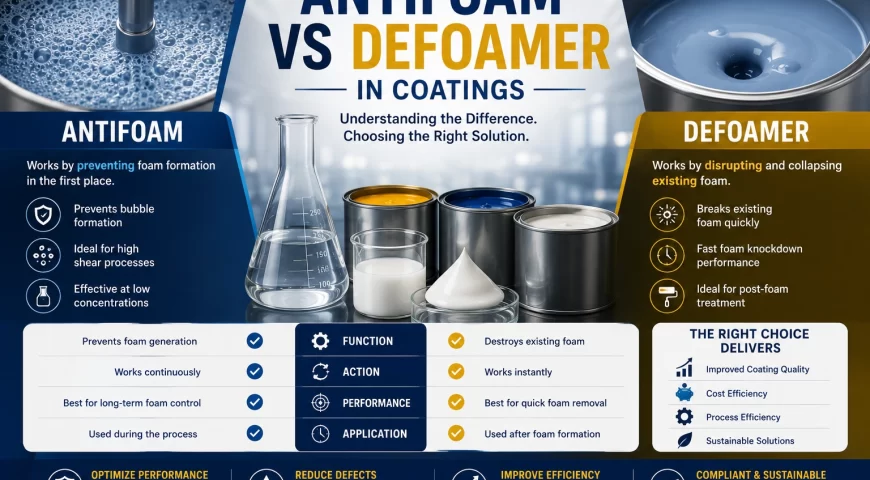
Foam Control Additives Antifoam vs Defoamer: What Is the Difference in Coatings? Foam is one of the most common formulation and application problems in paints and coatings. Understanding the difference between antifoam and defoamer additives helps coating manufacturers choose the right foam control solution for better surface finish, processing stability and coating quality. Request Product […]