
RSA • Hyperdispersant Additives • Industrial & Global Coating Additives
Hyperdispersant Additives for High-Performance Paint & Coating Formulations
Hyperdispersant additives are advanced dispersing agents designed to deliver strong and long-lasting dispersion stability in demanding paint and coating formulations. They are typically used where conventional wetting and dispersing agents are insufficient, such as in high pigment loading, specialty pigments, or high-performance industrial coatings.
RSA develops hyperdispersant additives for formulators who require improved color strength, reduced viscosity, enhanced stability, and consistent performance across solvent-based and industrial coating systems, as well as water-based coatings. RSA supplies globally including Saudi Arabia, UAE, South Africa, Vietnam, and India.
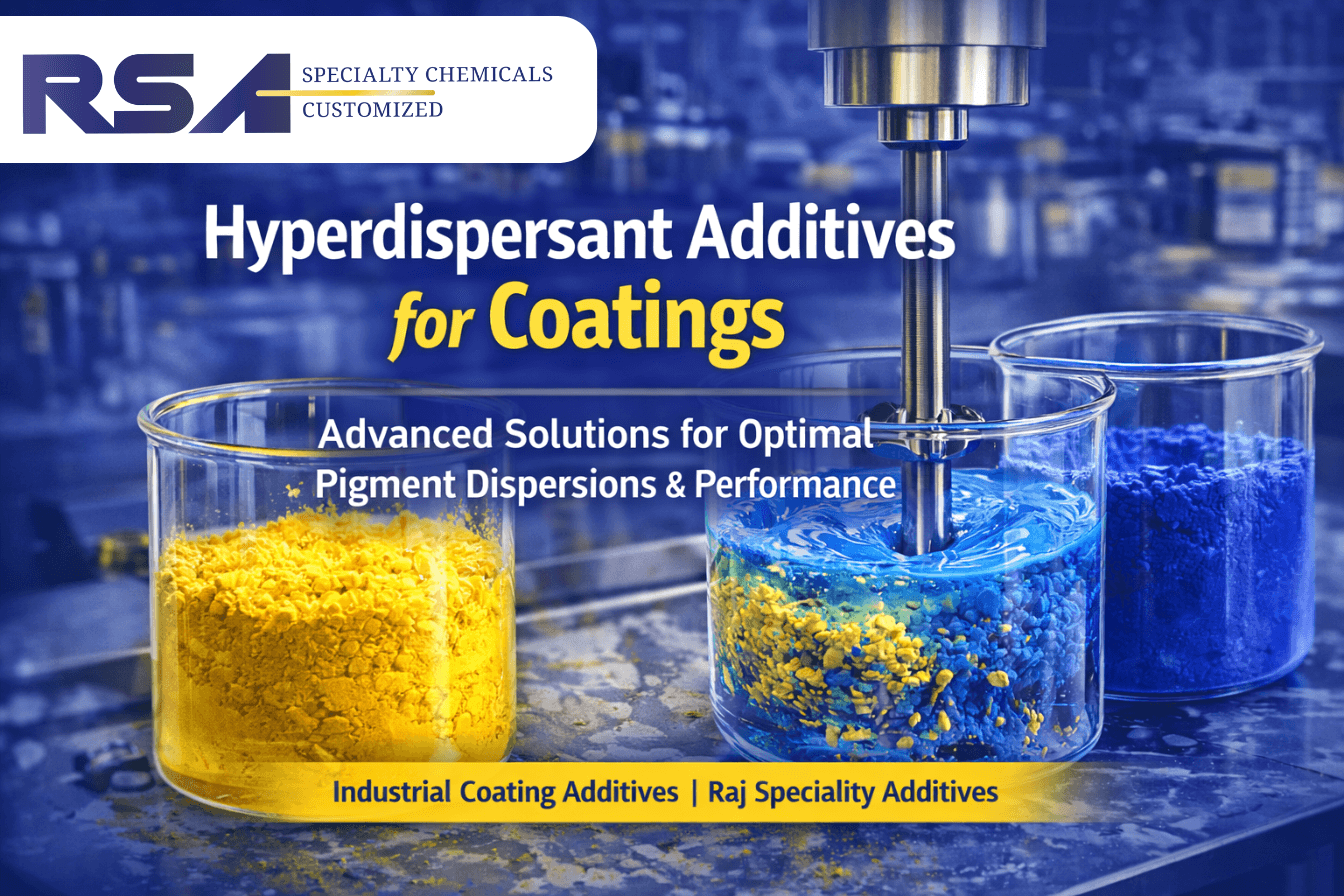
What Are Hyperdispersant Additives
Hyperdispersants are polymeric dispersing agents that adsorb strongly onto pigment surfaces and provide steric stabilization. This mechanism creates a physical barrier around pigment particles, preventing re-agglomeration and flocculation over time.
Compared to standard dispersing agents, hyperdispersants are typically more effective at stabilizing difficult-to-disperse pigments and maintaining dispersion stability under demanding processing and storage conditions.
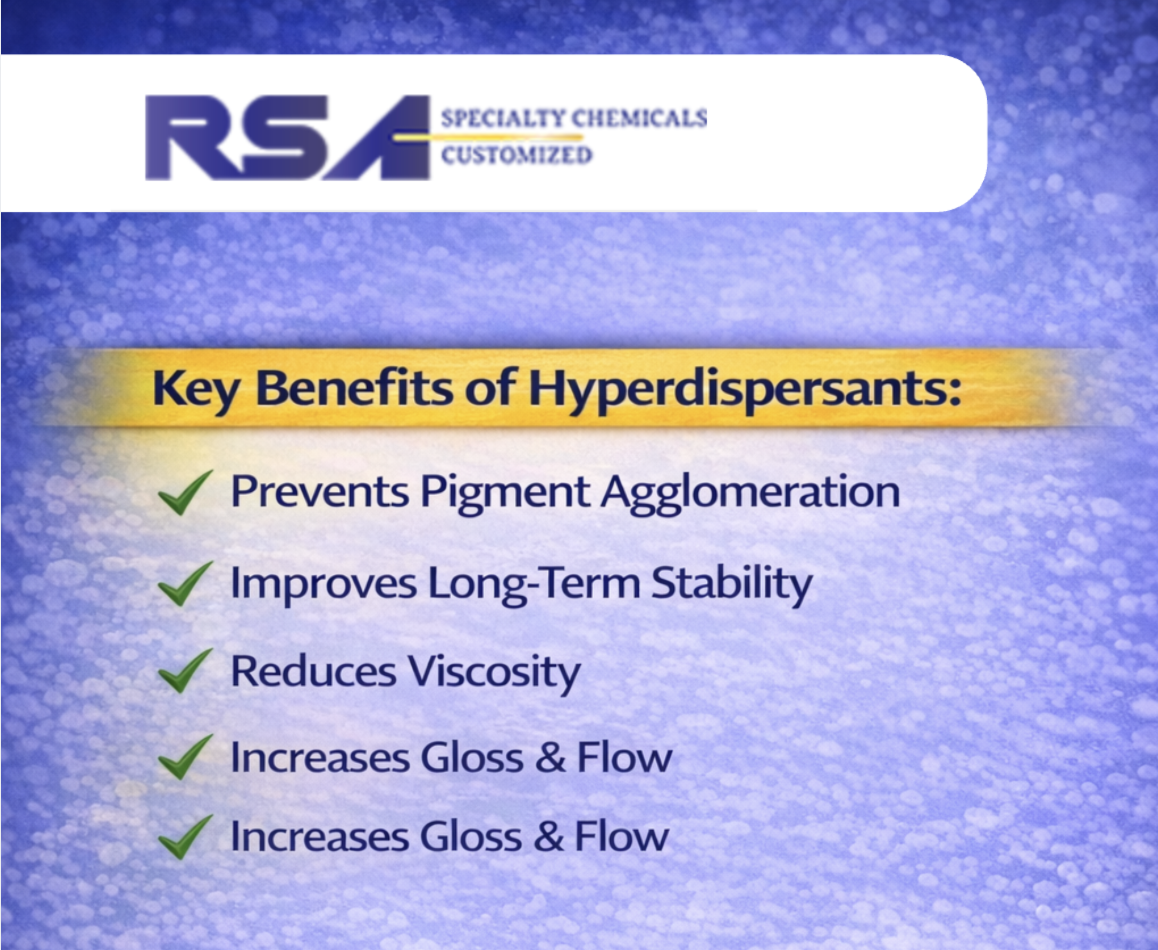
Why Hyperdispersants Are Used in Coatings
In modern coating formulations, increasing performance requirements and pigment complexity often exceed the capabilities of conventional dispersants. Hyperdispersants are used to address challenges such as:
- High pigment volume concentration (PVC)
- Difficult organic or effect pigments
- Long-term storage stability
- Improved color development and consistency
Mechanism of Steric Stabilization
Steric stabilization occurs when polymer chains attached to the hyperdispersant molecule extend into the surrounding medium, creating a physical barrier that prevents pigment particles from approaching each other closely.
This mechanism is particularly effective in systems where electrostatic stabilization alone is insufficient, such as non-aqueous coatings.
Illustration 1: Pigment Surface Adsorption
The hyperdispersant anchors strongly to the pigment surface and remains attached during processing.
Illustration 2: Steric Barrier
Polymer chains form a physical barrier around particles to reduce re-agglomeration.
Illustration 3: Stable Dispersion
Improved particle separation supports lower viscosity and more stable high-pigment systems.
Hyperdispersants in Solvent-Based Coatings
In solvent-based systems, hyperdispersants support efficient dispersion at high pigment loading while maintaining low viscosity and good flow. Compatibility with solvent polarity and resin chemistry is critical to avoid separation or instability.
Since RSA primarily focuses on solvent-based and industrial coatings, this is a key application area where hyperdispersants help support more demanding performance expectations.
Hyperdispersants in Water-Based Coatings
In water-based systems, hyperdispersants help stabilize organic and inorganic pigments while minimizing flocculation and viscosity drift. They are often used in combination with wetting agents and antifoams to balance dispersion efficiency and foam control.
Careful selection ensures compatibility with binders and surfactants commonly used in waterborne paints.
Pigment Types and Dispersion Challenges
Different pigment types present varying dispersion challenges:
- Carbon black – extremely high surface area and strong agglomeration tendency; one of the most difficult pigments to disperse and requires highly efficient dispersants or hyperdispersants.
- Organic pigments – igh surface area with a strong tendency to flocculate if not properly stabilized.
- Inorganic pigments – require efficient wetting and stabilization to ensure uniform dispersion.
- Effect pigments – sensitive to shear forces and particle orientation during dispersion.
Hyperdispersants are often selected based on pigment surface chemistry and formulation requirements.
Benefits of Using Hyperdispersant Additives
- Improved dispersion quality and stability
- Reduced grinding time and energy consumption
- Enhanced color strength and consistency
- Improved storage stability
Interaction With Other Additives
Hyperdispersants interact with other additives such as wetting agents, antifoams, rheology modifiers, and flow and leveling additives. Balanced formulation design ensures that dispersion improvements do not negatively affect foam control or surface appearance.
Selecting the Right Hyperdispersant
Selection criteria typically include:
- Coating system type (solvent-based or water-based)
- Pigment type and loading
- Binder and resin chemistry
- Processing conditions and shear levels
- Target viscosity and stability requirements
Formulation trials are recommended to confirm performance.
Industries and Applications
Hyperdispersant additives supplied by RSA are used in:
- Industrial and protective coatings
- Automotive and specialty coatings
- Decorative paints
- High-performance and functional coatings
These applications are relevant across global markets including Saudi Arabia, UAE, South Africa, Vietnam, and India.
Packaging industry mention intentionally excluded as per approved client feedback.
Frequently Asked Questions
Q: When should hyperdispersants be used instead of standard dispersants?
A: Hyperdispersants are typically used when higher dispersion stability, difficult pigment handling, or higher pigment loading is required.
Q: Do hyperdispersants reduce viscosity?
A: In many formulations, improved dispersion can result in lower viscosity at the same solids level.
Q: Are hyperdispersants suitable for water-based coatings?
A: Yes, grades are available for both water-based and solvent-based systems.
Q: Can hyperdispersants affect foam behavior?
A: They may influence foam, which is why compatibility with antifoams is considered during formulation development.
Q: Do hyperdispersants improve long-term storage stability?
A: Proper selection helps maintain dispersion stability over extended storage periods.
Need support for high-performance pigment dispersion?
Connect with RSA for discussions on solvent-based industrial, or water-based coating formulations and bulk hyperdispersant supply.