
RSA • Rheology Additives • Industrial & Global Coating Additives
Rheology Additives for Coatings – Viscosity Control and Application Stability for Paint Formulations
Rheology additives are used in paint and coating formulations to control viscosity, flow behavior, sag resistance, settling stability, and application performance. They help formulators achieve the right balance between storage stability and ease of application across different coating technologies.
RSA supplies rheology additives for solvent-based, high-solids, and industrial coating systems, as well as water-based coatings, with focus on formulation compatibility, processing stability, and repeatable performance. RSA supplies globally including Saudi Arabia, UAE, South Africa, Vietnam, and India.
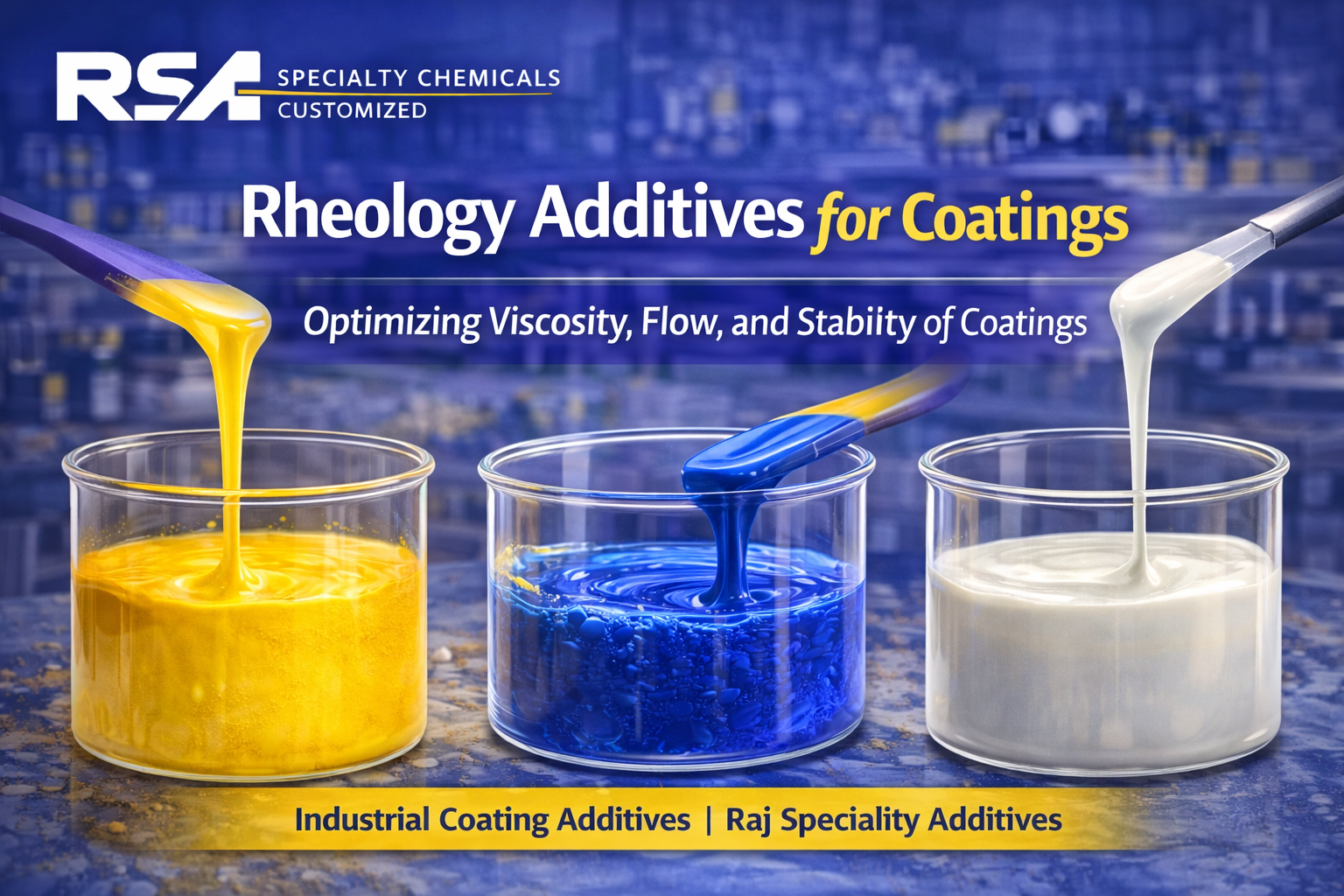
Why Rheology Matters in Coatings
Rheology determines how a coating behaves under storage, mixing, pumping, and application conditions. Proper rheology control helps maintain pigment suspension, reduce settling, improve sag resistance, and support uniform film build.
In industrial and solvent-based coatings, rheology control is especially important because viscosity behavior directly affects application consistency, edge coverage, leveling, and final appearance.
Functions of Rheology Additives in Coating Formulations
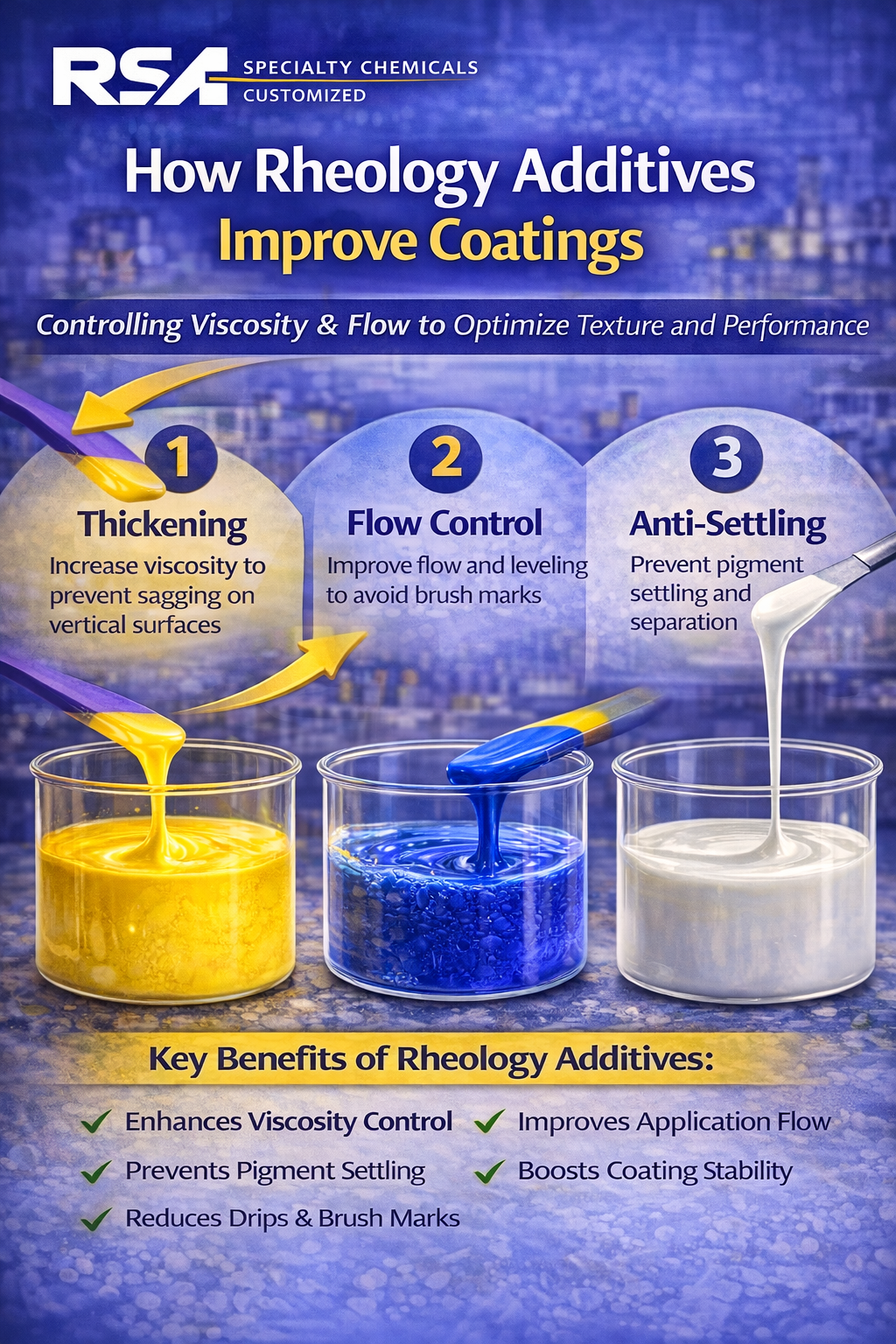
Rheology additives are commonly used to support:
- Viscosity control during storage and application
- Sag resistance on vertical surfaces
- Settling control for pigments and fillers
- Better application stability during spray, brush, or roller use
- Improved film build and uniformity
Rheology Additives in Solvent-Based and High-Solids Coatings
In solvent-based and high-solids coating systems, rheology additives are selected based on solvent polarity, resin compatibility, target viscosity profile, and application method. The goal is to achieve controlled flow without excessive sagging or instability.
Since RSA primarily focuses on solvent-based and industrial coatings, rheology additives in this area support production consistency, application control, and better performance in demanding environments.
Illustration 1: Storage Stability
Rheology additives help reduce pigment settling and maintain a more stable coating during storage.
Illustration 2: Sag Resistance
Proper viscosity structure helps the wet film resist sagging on vertical or complex surfaces.
Illustration 3: Application Control
Balanced rheology supports smoother spray, brush, or roller application and more even film build.
Rheology Additives in Water-Based Coatings
In water-based coatings, rheology additives help control viscosity while balancing flow, leveling, and storage stability. Selection must consider compatibility with binders, dispersing agents, surfactants, and defoamers to avoid issues such as poor leveling, foam sensitivity, or instability.
Common Defects Addressed by Rheology Additives
- Pigment settling and hard sedimentation
- Sagging on vertical surfaces
- Poor edge coverage
- Viscosity drift
- Uneven film build
- Application instability
Proper rheology additive selection helps reduce these issues while improving the balance between storage stability and application behavior.
Selecting the Right Rheology Additive
Selection is typically guided by:
- Coating system type (solvent-based or water-based)
- Binder and resin chemistry
- Target viscosity profile
- Application method and film build requirement
- Pigment volume concentration and settling tendency
Laboratory evaluation and application testing are recommended to confirm compatibility and performance.
Interaction With Other Additives
Rheology additives work alongside dispersing agents, antifoams, flow and leveling additives, and adhesion promoters. Balanced formulation design is important so that viscosity control does not negatively affect surface appearance, foam behavior, or pigment stability.
Industries and Applications
Rheology additives supplied by RSA are used in:
- Industrial and protective coatings
- Decorative and architectural paints
- Automotive coatings
- Wood coatings
- Specialty industrial and functional coatings
These applications are relevant across global markets including Saudi Arabia, UAE, South Africa, Vietnam, and India.
Packaging industry mention intentionally excluded as per approved client feedback.
Frequently Asked Questions
Q: What do rheology additives do in coatings?
A: Rheology additives help control viscosity, improve sag resistance, reduce settling, and support better application stability and film build.
Q: Are rheology additives important in solvent-based coatings?
A: Yes. They are highly relevant in solvent-based and industrial coatings where controlled viscosity and application performance are important.
Q: Can rheology additives affect flow and leveling?
A: Yes. Rheology control influences how the coating behaves during application, so compatibility with flow and leveling additives must be considered.
Q: Do rheology additives help reduce pigment settling?
A: Properly selected rheology additives can help reduce settling and improve storage stability.
Q: Are rheology additives suitable for water-based coatings?
A: Yes. Rheology additives are used in both water-based and solvent-based coatings, depending on system requirements and compatibility needs.
Need support for viscosity control and coating stability?
Connect with RSA for discussions on solvent-based, high-solids, industrial, or water-based coating formulations and bulk rheology additive supply.