
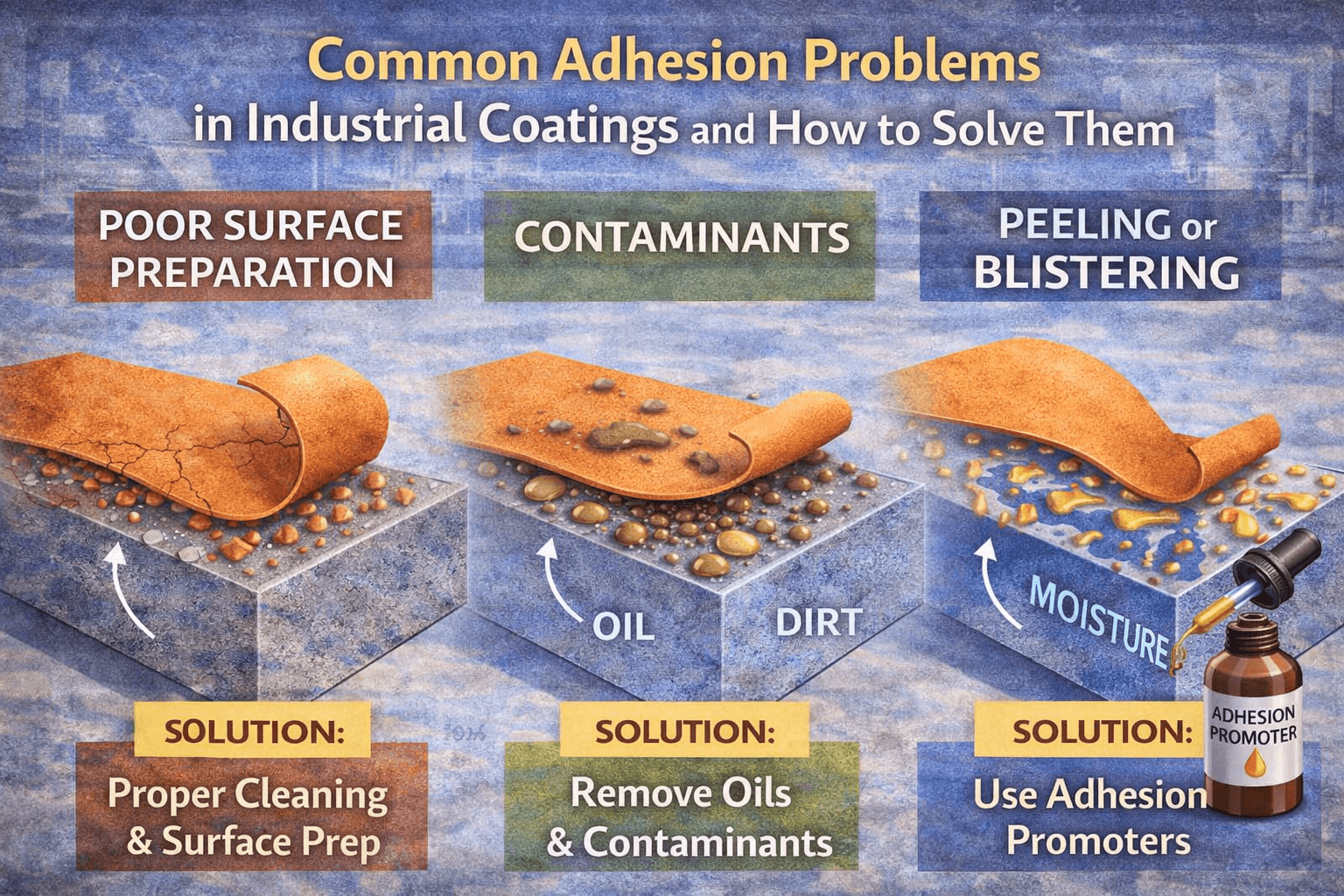
Common Adhesion Problems in Industrial Coatings and How to Solve Them
Adhesion problems in industrial coatings can lead to peeling, flaking, delamination, and early coating failure. This blog breaks down the most common adhesion issues, why they happen, and how formulators can approach practical solutions.
In industrial coatings, adhesion is one of the most important performance foundations. A coating may look visually acceptable at first, but if the bond between the film and the substrate is weak, failure often appears later during curing, handling, environmental exposure, or actual service use. This is why industrial coating adhesion problems deserve immediate attention during formulation and application review.
The challenge is that adhesion problems rarely come from one single cause. Poor surface cleaning, low surface energy, improper wetting, cure imbalance, intercoat incompatibility, and difficult substrates may all contribute to peeling, flaking, or delamination. Because of this, the best way to solve coating bonding problems is to diagnose the exact failure mode first and then correct the relevant formulation or process factor.
In many situations, a formulation may also benefit from an adhesion promoter for coatings to support better substrate bonding and more reliable film performance.
Most common adhesion problems in industrial coatings
Adhesion-related coating failures may appear in several forms. Some are easy to identify visually, while others require closer testing or observation after service exposure.
| Adhesion Problem | What It Looks Like | Why It Is Serious |
|---|---|---|
| Peeling | Film lifts away from the substrate in sheets or edges | Indicates weak substrate bonding and major protection loss |
| Flaking | Small pieces of coating detach from the surface | Leads to appearance issues and reduced durability |
| Delamination | One coating layer separates from another | Shows intercoat adhesion weakness in multi-layer systems |
| Chipping | Film breaks away under impact or around edges | May point to poor adhesion or weak film anchorage |
| Weak test results | Poor tape or cross-hatch performance | Suggests the bond is not reliable under stress |
Although these failures may look similar, they do not always come from the same root cause. A coating peeling from bare metal is different from a topcoat separating from a primer. The correct solution depends on understanding exactly where the failure is happening.
What causes common adhesion problems in coatings?
1. Inadequate surface preparation
Dust, oil, grease, moisture, corrosion, release agents, and other contaminants can prevent the coating from making proper contact with the substrate. This is one of the most frequent reasons for poor adhesion.
2. Low surface energy or difficult substrates
Some plastics, smooth surfaces, and treated materials are naturally harder to wet and coat. Without good substrate interaction, the coating may not build enough interfacial strength.
3. Poor wetting
Wetting is closely connected to adhesion. If the coating does not spread effectively on the surface, the contact area is limited, which can reduce bond strength. This is why RSA also connects adhesion work with topics like wetting vs dispersing agents in coatings.
4. Intercoat incompatibility
In multi-layer systems, layers may fail to bond properly because of recoat timing, cure stage mismatch, surface contamination between coats, or chemical incompatibility between the layers.
5. Improper curing or film formation
If the coating cures under unsuitable conditions, internal stress, poor solvent release, or weak film development may reduce adhesion performance.
6. Formulation imbalance
Resins, pigments, solvents, fillers, and additives must work as a balanced system. If one part of the formulation disturbs film integrity or interface behavior, adhesion issues may appear.
Not every adhesion problem starts at the substrate
Some coating failures are true substrate-adhesion problems, but others are intercoat adhesion failures between primer, intermediate coat, and topcoat. This distinction matters because the solution path is different. Before choosing an additive or making formulation changes, it is important to identify exactly where separation occurs.
How to solve adhesion problems in industrial coatings
Solving coating adhesion failure usually requires a structured review rather than a trial-and-error approach. The most effective solutions come from matching the correction to the real source of failure.
Improve surface preparation
- Remove contaminants before application
- Review pretreatment quality
- Control moisture, dust, and residue on the line
Review substrate wetting
- Check whether the coating spreads properly before cure
- Assess whether the surface is too difficult to wet
- Consider whether wetting support is needed in the formulation
Check multi-layer compatibility
- Review primer-to-topcoat interaction
- Evaluate recoat windows and curing sequence
- Confirm that intermediate layers are not causing separation
Reassess formulation balance
- Review resin and additive compatibility
- Check whether pigments or fillers are affecting film formation
- Consider whether surface defects are indirectly affecting final adhesion
Problems such as foam, flooding, floating, poor leveling, and unstable dispersion can influence the final film condition and may indirectly contribute to adhesion weakness. That broader context matters when diagnosing coating failures.
What role do adhesion promoters play?
Adhesion promoters for coatings are used to support stronger bonding between the coating and the substrate, or between coating layers where interfacial weakness exists. Their role becomes valuable when the base formulation needs additional support for difficult surfaces, variable substrates, or demanding service conditions.
How adhesion promoters can help
- Support better film-to-substrate interaction
- Improve bonding on difficult or low-energy surfaces
- Reduce the risk of peeling or delamination
- Help strengthen intercoat adhesion in layered systems
- Contribute to more reliable long-term film performance
Adhesion promoters are not a substitute for good cleaning, pretreatment, or cure control. However, once the real failure mechanism is understood, they may become an important part of the final solution.
Practical checklist for formulators facing adhesion problems
- Find the failure location: substrate interface or intercoat interface.
- Inspect the surface condition: contamination, oxidation, residue, or moisture.
- Evaluate wetting: did the coating spread and contact the surface properly?
- Review formulation balance: resin, pigment, filler, and additive interaction.
- Check curing conditions: was the film formed under the right process conditions?
- Assess service exposure: impact, chemicals, heat, moisture, or movement.
- Consider targeted additive support: including an adhesion promoter where appropriate.
For broader formulation support, RSA’s related content on antifoam for coatings and preventing flooding and floating in industrial coatings can also help diagnose performance issues affecting final film quality.
Conclusion
Common adhesion problems in industrial coatings — such as peeling, flaking, chipping, delamination, and weak test results — are usually symptoms of deeper issues at the interface. The real cause may lie in the surface condition, substrate type, wetting behavior, cure profile, intercoat compatibility, or formulation balance.
The best way to solve these problems is to diagnose the exact failure mode first and then correct the relevant factor. Where stronger interface support is needed, an adhesion promoter for coatings may help improve bonding and support more reliable long-term coating performance.
FAQs
What are the most common adhesion problems in industrial coatings?
The most common problems include peeling, flaking, delamination, chipping, and weak adhesion test performance.
What causes peeling in industrial coatings?
Peeling may be caused by weak substrate bonding, contamination, low surface energy, poor wetting, curing issues, or insufficient surface preparation.
What is the difference between peeling and delamination?
Peeling usually refers to the coating lifting from the substrate, while delamination often refers to one coating layer separating from another in a multi-layer system.
How can adhesion promoters help solve coating bonding problems?
Adhesion promoters help support the bond at the interface, which may improve film anchorage, reduce failure risk, and improve coating reliability on difficult surfaces or in layered systems.
Can poor wetting cause coating adhesion failure?
Yes. If the coating does not wet the surface properly, the interfacial contact is weaker, which can reduce bond strength and increase the risk of adhesion failure.
Is surface preparation still important when using adhesion promoters?
Yes. Adhesion promoters are useful, but they do not replace proper cleaning, pretreatment, curing control, and formulation balance.
References & Citations
The technical points in this article are supported by coating-industry literature and formulation references related to surface contamination, surface preparation, adhesion promoters, difficult substrates, and adhesion testing in industrial coatings.
American Coatings Association — The Two Pillars of Surface Preparation
Explains why inadequate removal of oils, greases, oxides, mill scale, mold-release residues, and other contaminants can lead to coating delamination and poor long-term adhesion.
View Source
|
Visit Website
Evonik — The Coatings Expert 2019
Discusses coating adhesion failure and how adhesion promoters can help improve adhesion and reduce delamination-related performance problems in industrial coating systems.
View Source
|
Visit Website
Evonik — Dynasylan® for Paints and Coatings
Supports the use of silane-based adhesion promoters for improving adhesion on challenging substrates such as glass, aluminum, steel, and concrete.
View Source
|
Visit Website
ASTM D3359 — Standard Test Methods for Rating Adhesion by Tape Test
Standard reference for cross-hatch/tape testing used to assess the adhesion of coating films on substrates in laboratory and field evaluation.
View Source
|
Visit Website
American Coatings Association — Guide to Adhesion Measurement for the Layman
Provides broader technical background on coating adhesion, delamination behavior, and why adhesion measurement matters when diagnosing coating failures.
View Source
|
Visit Website
American Coatings Association — Waterborne Industrial Coatings: Regulatory Changes Slowly Driving the Shift to Waterborne
Notes that high standards of cleanliness and preparation are especially important in waterborne industrial coatings because even oil contamination can create immediate wetting and adhesion-related issues.
View Source
|
Visit Website