
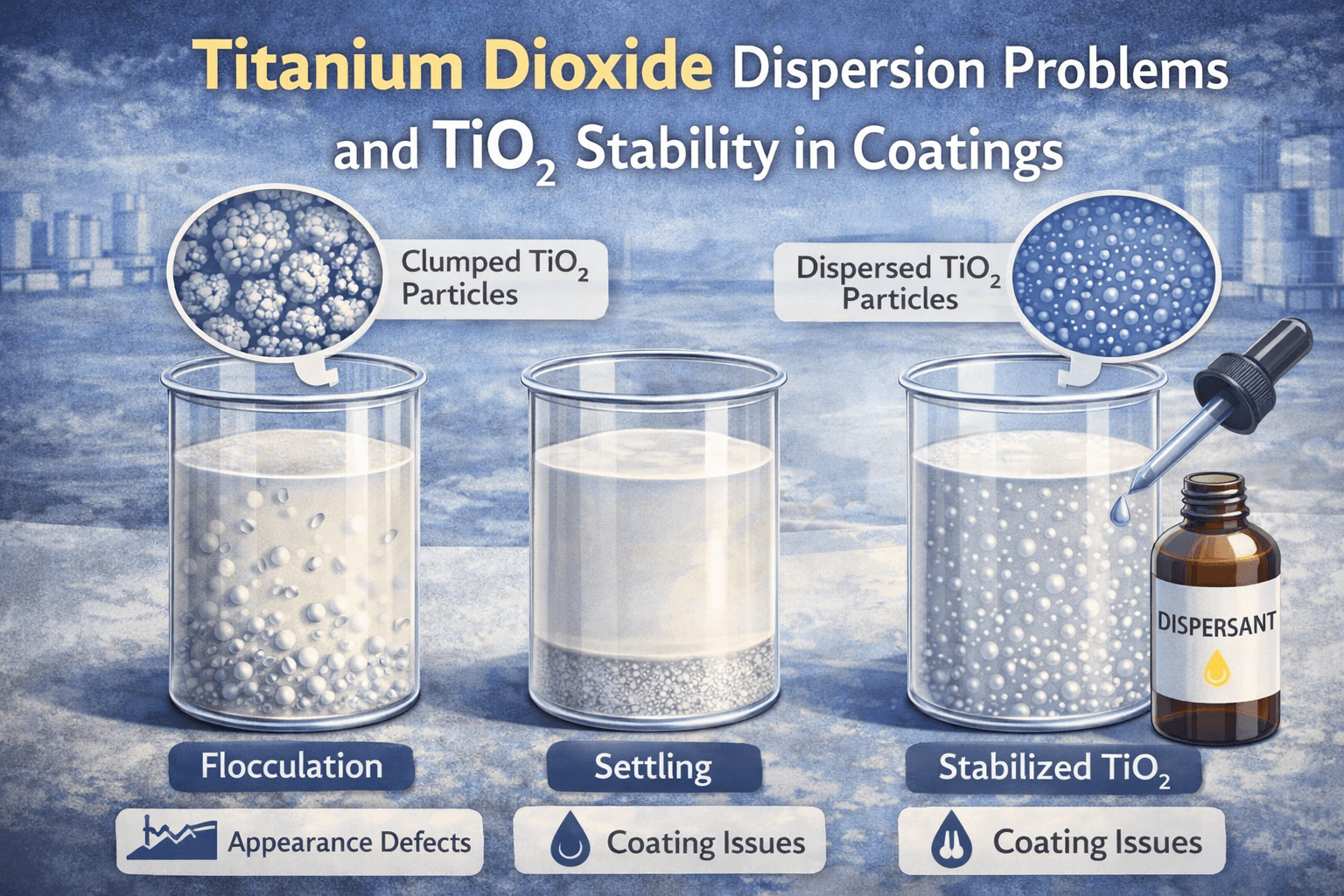
Titanium Dioxide Dispersion Problems in Coatings and How to Improve TiO2 Stability
Titanium dioxide plays a critical role in coating opacity, whiteness, and consistency. But when TiO2 is not dispersed and stabilized properly, formulators can face viscosity rise, poor hiding, settling, and unstable coating performance. This guide explains the common problems and how to improve TiO2 stability in practical coating systems.
What this blog covers
Common TiO2 dispersion problems, key root causes, and practical ways to improve coating stability and consistency.
Who it is for
R&D teams, formulators, plant chemists, and buyers working with titanium dioxide-rich coating systems.
Main focus
TiO2 dispersion, settling, viscosity control, hiding efficiency, and additive-based stabilization.
Core outcome
Better process control, improved pigment stability, and more reliable coating performance over time.
Why titanium dioxide dispersion matters so much in coatings
Titanium dioxide is one of the most important pigments used in coatings because it contributes significantly to opacity, whiteness, brightness, and visual consistency. In many formulations, TiO2 is central to achieving the expected hiding power and final appearance. However, simply adding titanium dioxide into a system does not guarantee good performance.
If TiO2 is not dispersed properly, the formulation may suffer from poor particle distribution, viscosity instability, incomplete pigment utilization, reduced opacity consistency, and storage problems. Even when the coating looks acceptable initially, poor stabilization may create issues later during storage, transport, or application.
Common titanium dioxide dispersion problems in coatings
TiO2-related problems often appear gradually, but they usually begin at the dispersion stage. Below are some of the most common issues formulators face in titanium dioxide-based coating systems.
High or unstable viscosity
When titanium dioxide is not dispersed or stabilized properly, the millbase or finished coating may become difficult to process and inconsistent over time.
Poor hiding consistency
Improper TiO2 distribution can reduce the efficiency of pigment utilization and create variation in opacity or film appearance.
Settling and hard sediment
Dense pigment systems may settle during storage if the stabilization package is not strong enough.
Batch inconsistency
Weak dispersion control can lead to differences in viscosity, whiteness, gloss, or appearance from one batch to another.
Other symptoms formulators may notice
- Viscosity drift after a few days or weeks
- Poor grind efficiency
- Lower-than-expected coating uniformity
- Storage instability in filled systems
- Difficult redispersion after settling
What causes TiO2 dispersion and stability issues?
Titanium dioxide is widely used, but stable dispersion still depends on multiple formulation and process factors. Problems usually come from a combination of pigment behavior, additive selection, formulation balance, and process conditions rather than one single reason.
Incomplete wetting of pigment surface
If the wetting stage is weak, the liquid phase does not spread properly across the TiO2 surface. This can reduce dispersion efficiency and create instability later.
Insufficient dispersing additive selection
A dispersing additive that is too weak, poorly matched to the system, or dosed incorrectly may fail to maintain proper separation and stabilization of titanium dioxide particles.
High pigment or filler loading
When the system is pushed to higher solids or contains a dense inorganic package, the stabilization demand increases significantly.
Binder and system incompatibility
Even a technically strong additive may underperform if it is not compatible with the resin, medium, or broader formulation chemistry.
Inadequate process conditions
Grinding method, shear level, addition sequence, and process discipline can all affect the final quality of TiO2 dispersion.
Why TiO2 stability is critical beyond the initial grind
Many coating systems appear acceptable immediately after manufacturing, but stability problems often emerge later. That is why formulators should not judge titanium dioxide performance only from fresh batch appearance.
Good TiO2 stability helps maintain:
- uniform viscosity over time
- consistent opacity and whiteness
- better storage resistance
- lower settling tendency
- better batch-to-batch reliability
- more predictable application performance
How to improve titanium dioxide dispersion in coatings
Improving TiO2 dispersion is not about a single “fix.” It usually requires better control across wetting, grinding, stabilization, and overall formulation compatibility.
What to look for in an additive for TiO2-based systems
Titanium dioxide-rich systems need more than simple short-term wetting support. The right additive should help create a formulation that is stable, processable, and reliable from production through final application.
Key selection priorities
- good wetting of inorganic pigment surfaces
- stable dispersion under plant conditions
- viscosity control during processing and storage
- compatibility with the chosen binder system
- reduced settling and better redispersibility
- consistent final appearance and opacity performance
| Problem Seen in TiO2 System | Possible Reason | What to Review |
|---|---|---|
| Viscosity rises after storage | Weak stabilization or incompatibility | Additive selection, dosage, binder fit |
| Poor opacity consistency | Incomplete dispersion or uneven distribution | Wetting quality, grinding, additive efficiency |
| Settling or hard sediment | Dense inorganic package not sufficiently stabilized | Dispersant strength, rheology balance, filler interaction |
| Batch-to-batch variation | Uncontrolled process or unstable formulation window | Process discipline, addition sequence, system robustness |
TiO2 stability becomes more challenging in filled coating systems
Titanium dioxide is often not used alone. In many practical formulations, it is combined with extenders, fillers, and other inorganic components. This can increase the complexity of stabilization and make additive selection more important.
In such systems, formulators need to consider:
- interaction between TiO2 and filler surfaces
- overall pigment volume concentration
- density-driven settling risk
- rheology support for storage stability
- combined effect of additive package across all solids
How to evaluate TiO2 stability more practically
A strong titanium dioxide formulation should be checked across more than one parameter. The best evaluation combines fresh process behavior with aged storage observations.
Useful checkpoints for formulators
- millbase viscosity after dispersion
- finished viscosity after let-down
- viscosity trend after storage
- settling and redispersibility
- appearance consistency
- application and film uniformity
How Raj Speciality Additives supports TiO2-based coating systems
At Raj Speciality Additives, we understand that titanium dioxide performance depends on much more than simply choosing a pigment grade. The right additive strategy can improve wetting, support dispersion, reduce instability, and help maintain consistency in practical industrial coating systems.
Explore our related coating additive solutions:
Final thoughts
Titanium dioxide is essential for many coating systems, but its full value can only be realized when dispersion and stability are controlled properly. Problems such as viscosity drift, settling, poor opacity consistency, and unstable performance are often not pigment issues alone. They are usually the result of incomplete wetting, weak stabilization, or poor formulation balance.
A more structured approach to TiO2 additive selection and stability testing can help coating manufacturers improve consistency, reduce processing issues, and get better performance from the full coating system.
Need better TiO2 stability in your coating system?
Connect with Raj Speciality Additives to discuss titanium dioxide dispersion, settling control, and the right wetting and dispersing strategy for your formulation.
Frequently Asked Questions
Titanium dioxide is widely used because it contributes strongly to opacity, whiteness, brightness, and visual consistency in many coating systems.
Poor TiO2 dispersion can lead to viscosity instability, poor hiding consistency, settling, difficult processing, and storage-related performance issues.
Yes. The right wetting and dispersing additive can help improve pigment wetting, stabilize TiO2 distribution, reduce settling tendency, and support better coating consistency.
Settling may occur because titanium dioxide is part of a dense inorganic package and the stabilization or rheology balance is not strong enough to maintain storage stability.
No. A formulation should also be checked after storage to evaluate viscosity drift, settling, redispersibility, and overall long-term stability.
This blog should mainly support Wetting & Dispersing Agents, Dispersing Additives, Hyperdispersant Additives, Rheology Additives, and the Coating Additives Manufacturer page.
References & Citations
The technical points in this article are supported by formulation literature and industry references related to titanium dioxide performance, pigment dispersion, dispersant selection, viscosity reduction, and stability in coating systems.
Ti-Pure™ — Titanium Dioxide Solutions for Paints & Coatings
Explains why titanium dioxide is the most important white pigment in coatings and how it contributes to whiteness, brightness, opacity, gloss retention, and durability.
View Source
Evonik — Technical Background: Wetting and Dispersing Additives
Covers the role of wetting and dispersing additives in lowering viscosity, improving gloss, reducing flocculation, and stabilizing pigment-containing coating systems, including titanium dioxide.
View Source
TEGO® Dispers 625 — Technical Data Sheet
Highlights strong viscosity reduction and long-term stabilization in titanium dioxide and filler-containing mill bases, supporting the formulation importance of proper dispersant choice.
View Source
Lubrizol Solsperse™ 53095 — Product Data Sheet
Describes a polymeric dispersant designed to improve pigment dispersion and titanium dioxide stability, supporting the link between dispersant chemistry and TiO2 stability.
View Source
Lubrizol — Dispersants Technology and Benefits
Explains how dispersants reduce inter-particle attraction, improve dispersion efficiency, and contribute to viscosity control and stability in highly pigmented systems.
View Source
Ti-Pure™ R-900 — Titanium Dioxide for Coatings
Product-level technical reference showing titanium dioxide use in architectural paints, primers, and appliance coatings, useful as application context for TiO2-based coating systems.
View Source