
RSA • Wetting and Dispersing Agents • Industrial & Global Coating Additives
Wetting and Dispersing Agent for Coatings – Dispersion Control for Stable Paint & Coating Formulations
Wetting and dispersing agents play a critical role in paint and coating formulations by ensuring that pigments and fillers are properly wetted, uniformly distributed, and stabilized within the liquid medium. Poor wetting or dispersion can lead to defects such as flocculation, flooding and floating, color inconsistency, viscosity drift, and reduced coating performance.
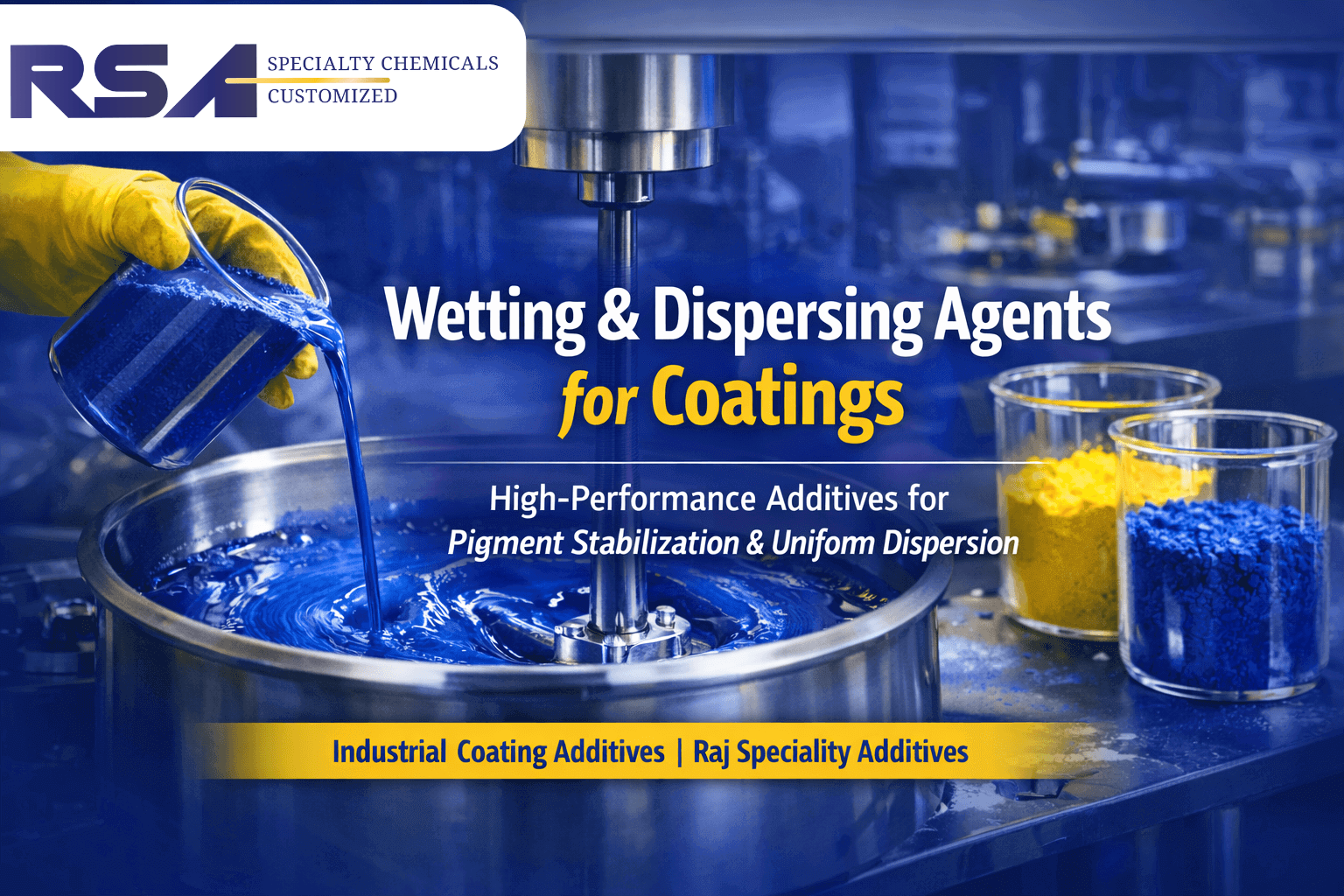
RSA develops wetting and dispersing agents for coatings used in solvent-based and industrial coating systems, as well as water-based coatings, with a focus on formulation compatibility, dispersion stability, and repeatable performance. RSA supplies globally including Saudi Arabia, UAE, South Africa, Vietnam, and India.
Why Wetting and Dispersion Are Critical in Coatings
In coating formulations, pigments and fillers must be fully wetted by the binder system and then uniformly dispersed to achieve desired color strength, opacity, gloss, and stability. Inadequate wetting results in incomplete pigment surface coverage, while poor dispersion leads to pigment agglomeration and flocculation.
These issues can negatively impact not only appearance but also rheology, application behavior, and long-term storage stability. In industrial and solvent-based coatings, stable dispersion is especially important where performance consistency and process efficiency are critical.
Difference Between Wetting Agents and Dispersing Agents
Wetting agents reduce interfacial tension between solid pigment surfaces and the liquid phase, allowing the liquid to penetrate pigment agglomerates more easily. Dispersing agents, on the other hand, stabilize the separated pigment particles by preventing re-agglomeration through electrostatic and/or steric mechanisms.
In practice, many modern additives combine both wetting and dispersing functions to support efficient dispersion and long-term stability.
Mechanisms of Dispersion Stabilization
Dispersion stabilization is generally achieved through two primary mechanisms:
- Electrostatic stabilization – achieved by generating repulsive electrical charges between pigment particles
- Steric stabilization – achieved by polymer chains adsorbed on pigment surfaces that create a physical barrier
The choice of mechanism depends on pigment type, binder chemistry, and coating system. Hyperdispersants are typically designed to provide strong steric stabilization for demanding formulations.
Illustration 1: Pigment Wetting
Pigment agglomerate → wetting agent reduces surface tension → liquid penetrates the agglomerate more effectively.
Illustration 2: Dispersion Stability
Dispersing additive adsorbs on pigment particles and helps prevent flocculation during storage and application.
Illustration 3: Steric vs Electrostatic
One system stabilizes by repulsive charges, the other by a physical barrier around the pigment surface.
Role of Wetting and Dispersing Agents in Solvent-Based Systems
In solvent-based coatings, wetting and dispersing agents are selected to ensure rapid pigment wetting and stable dispersion under high shear conditions. Compatibility with solvent polarity and resin systems is critical to avoid flocculation or viscosity instability.
Since RSA primarily focuses on solvent-based and industrial coatings, this is a key application area where wetting and dispersing agents support process stability, color development, and long-term formulation consistency.
Role of Wetting and Dispersing Agents in Water-Based Coatings
Water-based coatings often contain high levels of surfactants and polar components, which influence wetting behavior and dispersion stability. Effective wetting and dispersing agents for waterborne systems must balance pigment wet-out, foam generation, and compatibility with binders.
Improper selection may lead to excessive foam, reduced gloss, or poor storage stability.
Pigment and Filler Considerations
Different pigments and fillers present unique dispersion challenges depending on their surface chemistry, particle size, and structure.
- Organic pigments – often require strong dispersing power to prevent flocculation and maintain color strength.
- Inorganic pigments – may require efficient wetting to achieve uniform dispersion and optimal opacity.
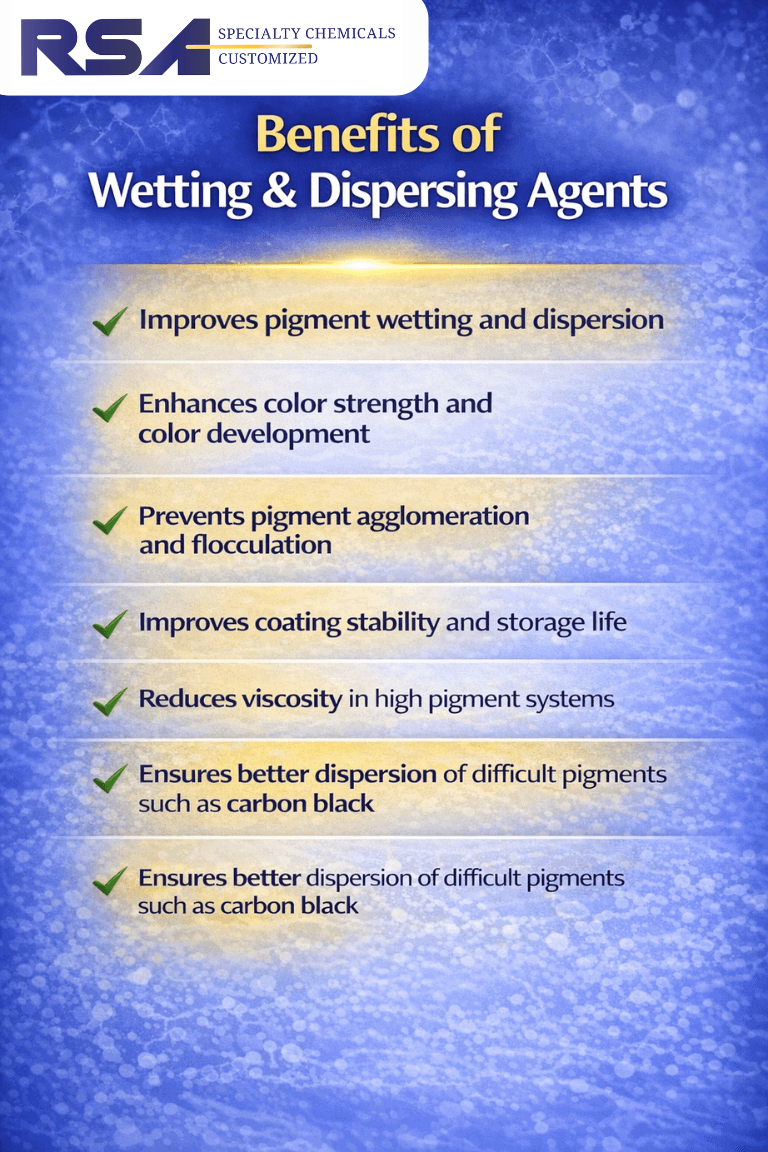
- Carbon black – requires high-efficiency dispersing agents due to its extremely fine particle size and high surface area, which makes it prone to agglomeration.
- Effect pigments – sensitive to shear and orientation during dispersion.
Proper selection of wetting and dispersing agents must consider pigment surface chemistry, particle size distribution, and milling conditions to achieve stable dispersion.
Common Dispersion-Related Defects in Coatings
- Flocculation and settling
- Flooding and floating
- Loss of color strength
- Viscosity increase or drift
- Reduced gloss and surface defects
Proper additive selection helps coating formulators reduce these defects while improving stability and process control.
Interaction With Other Additives
Wetting and dispersing agents interact closely with other additive categories such as antifoams, rheology modifiers, and flow and leveling additives. Balanced formulation design ensures dispersion stability without compromising foam control or surface appearance.
Selecting the Right Wetting and Dispersing Agent
Selection should be guided by:
- Coating system type (solvent-based or water-based)
- Binder and resin chemistry
- Pigment and filler type
- Target dispersion quality and stability
- Processing conditions and shear levels
Laboratory evaluation and formulation trials are recommended to validate performance.
Industries and Applications
Wetting and dispersing agents supplied by RSA are used in:
- Industrial and protective coatings
- Decorative and architectural paints
- Automotive and specialty coatings
- Wood coatings
- Specialty industrial applications
These applications are relevant across global markets including Saudi Arabia, UAE, South Africa, Vietnam, and India.
Frequently Asked Questions
Q: What happens if pigments are not properly dispersed?
A: Poor dispersion can result in flocculation, settling, color inconsistency, and reduced coating performance.
Q: Are wetting agents and dispersing agents the same?
A: No. Wetting agents improve initial wetting, while dispersing agents stabilize pigments after dispersion.
Q: Do wetting and dispersing agents increase foam?
A: Some agents may influence foam behavior, which is why compatibility with antifoams is important.
Q: Can one additive work for all pigments?
A: Additive selection often depends on pigment chemistry, binder system, and final coating requirements.
Q: Do these additives affect long-term storage stability?
A: Properly selected dispersing agents help improve long-term stability and reduce issues such as viscosity drift and settling.
Need support for pigment wetting and dispersion stability?
Connect with RSA for discussions on solvent-based, industrial, or water-based coating formulations and bulk additive supply.