
Common Foam Problems in Industrial Coatings and How Antifoam Additives Help
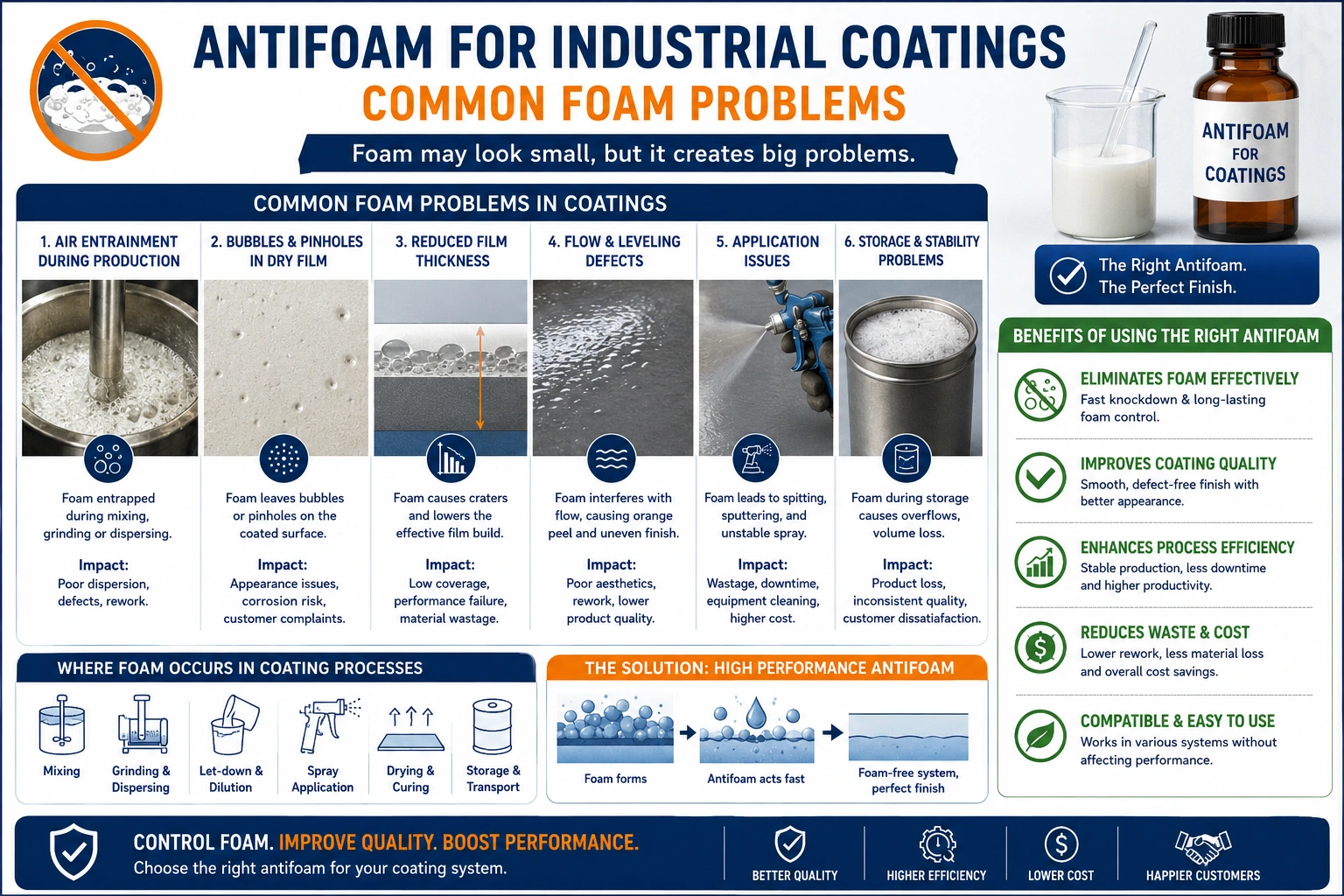
Foam can affect industrial coating production, filling, application, appearance, and final film performance. The right antifoam for industrial coatings helps formulators manage foam at different stages without disturbing coating stability, flow, leveling, or surface finish.
Quick Summary
Foam is one of the most common processing and application problems in industrial coatings. Selecting the right antifoam for industrial coatings helps reduce air entrapment, surface defects, production delays, filling issues, and coating film problems.
Foam starts early
Foam can form during pigment grinding, high-speed mixing, let-down, pumping, filtration, filling, and application.
Defects may appear later
Foam can create pinholes, craters, poor leveling, entrapped air, reduced gloss, and weak film appearance.
Selection matters
The antifoam must be compatible with the coating system, resin chemistry, pigment package, and application method.
Choosing the right antifoam for industrial coatings is important when a formulation faces persistent foam during production, storage, filling, application, or drying. Foam may look like a simple processing issue, but it can affect the final coating film and create quality problems for paint and coating manufacturers.
In coating systems, foam is usually caused by air incorporation and the stabilization of air bubbles by surfactants, wetting agents, dispersants, resins, pigments, fillers, or other surface-active ingredients. This is why foam control should be evaluated as part of the complete formulation, not as a separate last-minute correction.
Why Foam Is a Common Problem in Industrial Coatings
Foam is created when air becomes trapped in the liquid coating system. During mixing, grinding, pumping, and application, air is pulled into the coating. If the bubbles break quickly, foam may not become a serious problem. But if the bubbles are stabilized by formulation ingredients, foam can persist and create defects.
Industrial coatings often contain ingredients that can unintentionally stabilize foam, including:
- Surfactants and wetting agents
- Dispersing additives
- Water-soluble or water-dispersible resins
- High pigment and filler loading
- Rheology modifiers
- Emulsifiers and stabilizers
- High-speed mixing conditions
Because of this, foam control is especially important in water-based coatings, high-build coatings, pigmented systems, industrial primers, protective coatings, and coatings that require smooth surface appearance.
Where Foam Forms During Coating Manufacturing
Foam can form at multiple stages in the coating manufacturing process. The source of foam must be identified before selecting an antifoam for coatings, because foam generated during grinding may need a different approach than foam appearing during application.
| Stage | How Foam Forms | Possible Impact |
|---|---|---|
| Premixing | Air is incorporated while powders, liquids, resins, and additives are blended. | Foam build-up, inaccurate volume reading, slower processing. |
| Pigment grinding | High shear and dispersing additives can stabilize air bubbles. | Entrapped air, poor milling efficiency, inconsistent dispersion. |
| Let-down stage | Foam may increase when resin, water, solvent, or additives are added. | Batch instability, filling difficulty, surface bubbles. |
| Pumping and filtration | Air can enter through turbulence, transfer lines, or pressure changes. | Microfoam, slow filtration, unstable filling. |
| Filling and packaging | Foam rises during can filling or drum filling. | Lower filling speed, inaccurate filling level, overflow risk. |
| Application | Brush, roller, spray, dip, or curtain application can introduce air. | Pinholes, craters, bubbles, poor surface finish. |
Common Foam-Related Defects in Coatings
Foam does not always remain visible as foam. In many cases, it appears as a surface or film defect after the coating is applied and dried. This makes troubleshooting more difficult because the visible defect may be created earlier in the process.
Pinholes
Pinholes can form when small air bubbles rise through the coating film and leave tiny holes after drying or curing. This can affect appearance and may reduce protective performance in some industrial coatings.
Cratering
Craters may occur when there is surface tension imbalance, contamination, or incompatible additives. Incorrect antifoam selection or overdosing can also contribute to craters, so compatibility testing is important.
Microfoam
Microfoam is difficult to detect because it appears as very fine bubbles distributed within the coating. It can affect gloss, clarity, film density, leveling, and application appearance.
Poor leveling and surface appearance
Persistent foam can disturb surface flow and create uneven film appearance. In such cases, formulators may need to evaluate antifoam additives together with flow and leveling additives.
Reduced gloss or haze
Entrapped air, poor bubble release, and additive incompatibility can reduce gloss or create haze in selected systems. This is especially important in high-gloss industrial coatings and decorative finishes.
For related surface defects, read RSA’s blog on what causes orange peel in industrial coatings.
Facing foam, pinholes, craters, or surface defects?
Share your coating system, application process, and foam issue with Raj Speciality Additives. Our team can help you evaluate the right foam control additive direction.
How Antifoam Additives Work in Coating Systems
Antifoam additives work by destabilizing foam bubbles and helping trapped air escape from the coating system. They are usually designed to be partially incompatible with the coating medium so they can move to the air-liquid interface and weaken the bubble wall.
A good antifoam must create the right balance. It should be incompatible enough to break foam, but not so incompatible that it causes defects such as craters, fish eyes, separation, or poor surface appearance.
Antifoam additives may help with:
- Reducing foam during production
- Improving filling speed and batch handling
- Releasing entrapped air during application
- Reducing pinholes and bubble marks
- Improving film appearance where foam is the root cause
- Supporting smoother processing in water-based coatings
Difference Between Preventing Foam and Breaking Foam
Foam control usually involves two related but different functions: preventing foam formation and breaking foam that has already formed. Many users use the words antifoam and defoamer interchangeably, but in practical formulation work, it is useful to understand the distinction.
| Function | Main Role | Where It Helps |
|---|---|---|
| Antifoam action | Helps prevent foam from forming or becoming stable. | Premixing, grinding, let-down, filling, and storage. |
| Defoaming action | Helps break foam that has already formed. | During processing, after mixing, during transfer, or before filling. |
| Air release | Helps entrapped air escape from the liquid film. | High-build coatings, roller application, spray application, and thick films. |
In many coating formulations, one additive may provide more than one foam-control function. The correct choice depends on whether the main problem is surface foam, microfoam, entrapped air, filling foam, application bubbles, or dried film defects.
Choosing Antifoam for Water-Based and Solvent-Based Coatings
Antifoam selection depends on the coating type. Water-based coatings often generate more persistent foam because water-based systems contain surfactants, emulsifiers, wetting agents, and dispersants. Solvent-based coatings may have different foam behavior due to lower surface tension and different resin-solvent interactions.
For water-based coatings
Water-based systems often require antifoams that can control foam without destabilizing the emulsion, reducing gloss, or creating craters. Compatibility and dosage control become very important.
For solvent-based coatings
Solvent-based systems may require antifoams designed for solvent compatibility, fast air release, and surface defect control. The additive must not negatively affect clarity, gloss, leveling, or recoatability.
For high-viscosity coatings
High-viscosity coatings can trap air more easily. In such systems, antifoam and air-release performance should be evaluated under actual mixing and application conditions.
For pigmented coatings
Pigment and filler loading can influence foam stability. The antifoam must be checked with the actual pigment package, dispersing additive, and resin system.
Since foam behavior is connected with dispersion and surface activity, formulators should also evaluate interaction with wetting and dispersing agents for coatings.
How Antifoam Dosage Affects Final Coating Performance
Antifoam dosage is a critical part of formulation development. Too little antifoam may not control foam properly. Too much antifoam can create surface defects, compatibility issues, gloss reduction, separation, or coating instability.
Formulators should avoid assuming that higher dosage will always give better foam control. The better approach is to test a dosage ladder and evaluate foam control together with coating appearance and final film performance.
For more detail on this topic, read RSA’s blog on how antifoam dosage affects coating performance.
How to Test Antifoam Performance in Industrial Coatings
Antifoam performance should be evaluated under practical conditions that reflect actual production and application. A lab test should not only measure how quickly foam collapses, but also whether the coating remains stable and defect-free.
Useful evaluation checks include:
- Foam height during mixing
- Foam collapse time after mixing
- Microfoam observation in the wet film
- Air release in high-viscosity systems
- Application by brush, roller, spray, or actual method
- Pinholes, craters, fish eyes, and surface defects
- Gloss and appearance after drying
- Storage stability and separation tendency
- Compatibility with dispersants, wetting agents, and flow additives
The final selection should be based on overall coating performance, not foam collapse alone.
How RSA Supports Foam Control in Coating Formulations
Raj Speciality Additives supports coating, ink, and paint manufacturers with specialty additives for foam control, dispersion, adhesion, rheology, surface performance, and formulation stability.
As a coating additives manufacturer and paint additives supplier, RSA helps customers evaluate additive selection based on coating type, foam source, resin system, application method, and final performance requirement.
- Antifoam additives
- Foam control additives
- Coatings and inks
- Wetting agents
- Dispersing additives
- Hyperdispersants
- Flow and leveling support
- Industrial coating additives
Need antifoam for industrial coatings?
Connect with Raj Speciality Additives to discuss foam control additives for water-based coatings, solvent-based coatings, industrial paints, inks, and specialty coating systems.
FAQs on Antifoam for Industrial Coatings
What causes foam in industrial coatings?
Foam in industrial coatings is usually caused by air incorporation during mixing, grinding, pumping, filling, or application. Surface-active ingredients such as wetting agents, dispersants, surfactants, resins, and rheology modifiers can stabilize the bubbles.
What is antifoam for industrial coatings?
Antifoam for industrial coatings is a foam control additive used to prevent or reduce foam during coating production, storage, filling, and application. It helps improve processing and reduce foam-related surface defects when selected correctly.
Can antifoam additives cause craters?
Yes, if the antifoam is incompatible or overdosed, it may contribute to craters, fish eyes, poor leveling, haze, or gloss reduction. That is why antifoam selection should include compatibility and surface appearance testing.
Is antifoam required in water-based coatings?
Water-based coatings often require antifoam because surfactants, emulsifiers, wetting agents, and dispersants can stabilize foam. The selected antifoam should control foam without disturbing stability or surface finish.
How do I choose the right antifoam for coatings?
Choose antifoam based on coating type, resin system, water-based or solvent-based chemistry, pigment loading, application method, foam source, required surface finish, and compatibility with the full additive package.
Does RSA supply antifoam for coatings and inks?
Yes. Raj Speciality Additives supports coating, ink, and paint manufacturers with antifoam additives, wetting and dispersing agents, hyperdispersants, adhesion promoters, rheology additives, and other specialty coating additives.
References & Citations
- PCI Magazine – Additives for Coatings and Inks
- SpecialChem – Defoamers and Foam Control in Coatings
- Coatings World – Additives for Coatings
- ASTM D714 – Evaluating Degree of Blistering of Paints
- ISO 4618 – Paints and varnishes: Terms and definitions
These references are included for technical context around coating additives, foam control, surface defects, and paint terminology. Antifoam selection should always be validated based on the actual formulation, production process, application method, and performance requirement.