
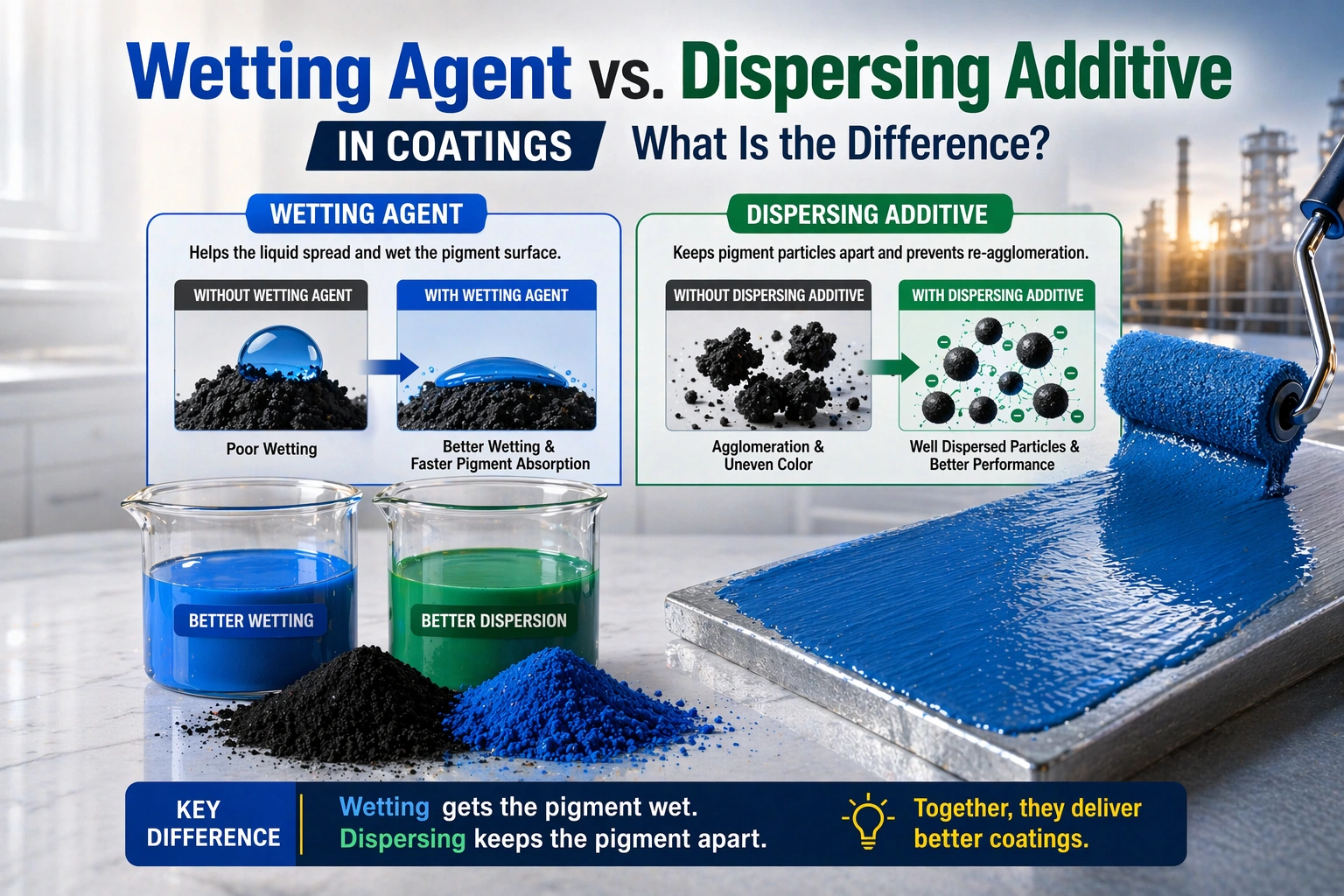
How to Select a Dispersing Additive for Industrial Coating Formulations
Selecting the right dispersing additive for coatings is not only about improving grind efficiency. It is about achieving better pigment stabilization, colour development, gloss, viscosity balance, storage stability, and batch reproducibility. This blog explains the key factors formulators should evaluate when choosing a dispersing additive for industrial coating formulations.
In industrial coatings, dispersion quality strongly influences how the final product looks, behaves, stores, and performs. Pigments and fillers must be properly wetted, efficiently deagglomerated, and then kept stable inside the formulation. This is where the selection of the right dispersing additive for coatings becomes important.
A dispersing additive that performs well in one formulation may not perform the same way in another. Resin chemistry, pigment type, loading level, process conditions, appearance targets, and storage expectations all shape additive performance. That is why selection should be based on formulation fit rather than generic assumptions.
Selection goal
Choose a dispersing additive that supports stable pigment distribution and balanced performance across the full coating system.
Common mistake
Choosing only for initial grind performance without checking long-term stability, gloss, viscosity behaviour, and storage results.
Why does dispersing additive selection matter so much?
A dispersing additive does more than help pigment mix into a batch. It can influence colour strength, gloss, transparency, viscosity, flooding and floating resistance, storage stability, sedimentation behaviour, and overall formulation reproducibility. When the additive is not well matched to the system, even a technically sound coating formulation may show avoidable instability or performance loss.
In industrial coatings, that means additive selection can affect not only lab results but also milling efficiency, process consistency, rejection rate, and customer-perceived quality. This is why choosing the right dispersing additive should be treated as a formulation decision with broad performance implications.
1. Start with the pigment and solid particle type
One of the first selection factors is the type of solid particles in the formulation. Different pigments and fillers behave differently. Inorganic pigments, organic pigments, carbon black, extenders, matting agents, and specialty solids do not all require the same dispersion support.
Some pigments are easier to wet and stabilize, while others, especially carbon black and certain organic pigments, can be much more demanding. High surface area pigments often need stronger stabilization support because the risk of re-agglomeration is higher.
Questions to consider
- Is the system based on inorganic pigments, organic pigments, or both?
- Does it include carbon black or other difficult pigments?
- Are fillers or extenders influencing viscosity and settling behaviour?
- Is the system a pigment concentrate or a ready-to-apply coating?
2. Consider the resin and formulation chemistry
A dispersing additive for coatings must work within the complete resin environment. An additive that gives good results in one resin system may not remain equally compatible or effective in another. Solvent-based and water-based systems, for example, often have different wetting and stabilization requirements.
Resin polarity, solvent balance, solid content, and overall formulation architecture all influence how the additive interacts with the system. Compatibility is therefore not a side issue. It is central to good additive selection.
3. Define the main performance priority clearly
Not every industrial coating formulation has the same performance priority. Some systems need maximum colour strength. Others need gloss, viscosity stability, low flooding tendency, or long storage life. The additive should be selected according to what matters most in that formulation.
| Formulation Priority | Why It Matters | What to Check in Additive Evaluation |
|---|---|---|
| Colour strength | Important in pigmented systems and tinting precision | Shade development, tint strength, pigment efficiency |
| Gloss and appearance | Critical in high-finish coatings | Gloss retention, haze control, uniform film appearance |
| Viscosity control | Important for process handling and consistency | Initial viscosity and viscosity drift over time |
| Storage stability | Required for shelf life and customer use | Settling tendency, hard sedimentation, redispersibility |
| Defect control | Needed in sensitive coating systems | Flooding, floating, rub-out difference, flocculation signs |
| Process efficiency | Important for milling and production economics | Grind speed, fineness development, throughput support |
4. Evaluate performance during and after grinding
A common selection mistake is to focus only on initial grind efficiency. While this is important, it is not enough. A dispersing additive may appear effective during the milling stage and still fail later if the particles are not stabilized properly.
Evaluation should therefore cover both the dispersion stage and the post-dispersion stage. The question is not only whether the additive helps break down agglomerates, but also whether it keeps the particles from coming back together over time.
Look at both stages
- Ease of pigment incorporation
- Grinding efficiency and fineness development
- Colour strength after let-down
- Gloss and film appearance
- Stability after storage
- Rub-out difference and flocculation tendency
5. Pay special attention to difficult pigments
If the formulation includes carbon black, high surface area pigments, certain organic pigments, or complex colour blends, additive selection becomes even more important. These systems may require stronger stabilization performance and more careful matching to the pigment surface.
Difficult pigments can challenge wetting, raise viscosity, reduce colour development, and increase the risk of flocculation or settling. The additive should therefore be tested under realistic conditions using the actual pigment package whenever possible.
6. Watch viscosity behaviour and stability closely
Viscosity is often one of the clearest signs of whether a dispersing additive is working well in the system. Poorly stabilized pigment particles may interact more strongly, causing higher viscosity, drift over time, or unstable processing behaviour.
Stability should also be assessed through storage observation. Settling, hard sedimentation, or poor redispersion are signs that the additive may not be providing enough long-term stabilization.
Useful checks
- Initial viscosity after manufacture
- Viscosity after storage
- Settling tendency
- Ease of redispersion
- Visual signs of flocculation or separation
7. Evaluate defect-related behaviour
Dispersion-related issues often appear as application or appearance defects. Flooding, floating, rub-out differences, and gloss loss may all indicate that pigment stabilization is not strong enough. These results should be included in additive selection, not treated as separate downstream issues.
For appearance-sensitive industrial coatings, a dispersing additive should be judged partly by how well it helps control these practical risks.
8. Test under realistic formulation and process conditions
Additive selection is only reliable when testing reflects actual use conditions. Lab screening is useful, but the closer the evaluation gets to the real formulation, real pigment loading, real process energy, and real storage environment, the more meaningful the conclusion becomes.
Process parameters such as shear level, milling energy, order of addition, dosage, and let-down sequence can all influence final performance. This means additive selection should never be separated from process context.
A practical selection framework for formulators
When choosing a dispersing additive for industrial coating formulations, a practical framework can help reduce guesswork and improve decision quality.
- Identify the pigment and filler system clearly
- Review resin compatibility and system polarity
- Define the main performance priority
- Screen additives under real formulation conditions
- Compare grind efficiency and colour development
- Check gloss, viscosity, and storage stability
- Evaluate defect-related behaviour such as flooding or rub-out difference
- Confirm reproducibility across repeat batches
Conclusion
Selecting the right dispersing additive for coatings requires more than choosing a product that helps pigments grind faster. The additive should be matched to the pigment type, resin system, formulation objective, and real process conditions. It should also be evaluated not only for initial dispersion, but for long-term stability, gloss, viscosity balance, and final coating consistency.
For industrial coating formulators, the best selection approach is a practical and system-based one. When the additive is well matched to the formulation, it can support better pigment stabilization, more reliable processing, and stronger overall coating performance.
Frequently Asked Questions
Start with the pigment type and the overall formulation system. Pigment surface properties, resin chemistry, and performance priorities all influence which dispersing additive may work best.
No. Grind efficiency is important, but selection should also include colour strength, gloss, viscosity behaviour, storage stability, settling tendency, and defect-related performance.
Difficult pigments such as carbon black and some organic pigments are harder to wet and stabilize. They may require stronger or more specifically matched dispersing additives to achieve reliable results.
Not necessarily. Additive performance depends on pigment type, resin system, formulation structure, process conditions, and the required end-use properties of the coating.
A dispersing additive may look effective immediately after manufacture but still allow flocculation, settling, or viscosity drift later. Storage stability testing helps confirm whether the pigment system remains stable over time.
Need better additive selection support for industrial coatings?
Explore RSA’s coating additive solutions for pigment wetting, dispersion stability, process consistency, and formulation performance across industrial coating systems.
- European Coatings. Industry resources on pigment dispersion, additive selection, and coatings formulation. https://www.european-coatings.com/
- PCI Magazine. Technical articles covering dispersing additives, pigment stabilization, coating defects, and formulation testing. https://www.pcimag.com/
- UL Prospector. Coatings formulation guidance on dispersants, pigments, additive compatibility, and performance screening. https://www.ulprospector.com/
- SpecialChem Coatings. Technical guidance on wetting and dispersing agents, pigment behaviour, and formulation troubleshooting. https://www.specialchem.com/coatings
- General coatings formulation literature and technical guidance related to pigment wetting, particle stabilization, dispersion evaluation, storage stability, and industrial coating process performance.