
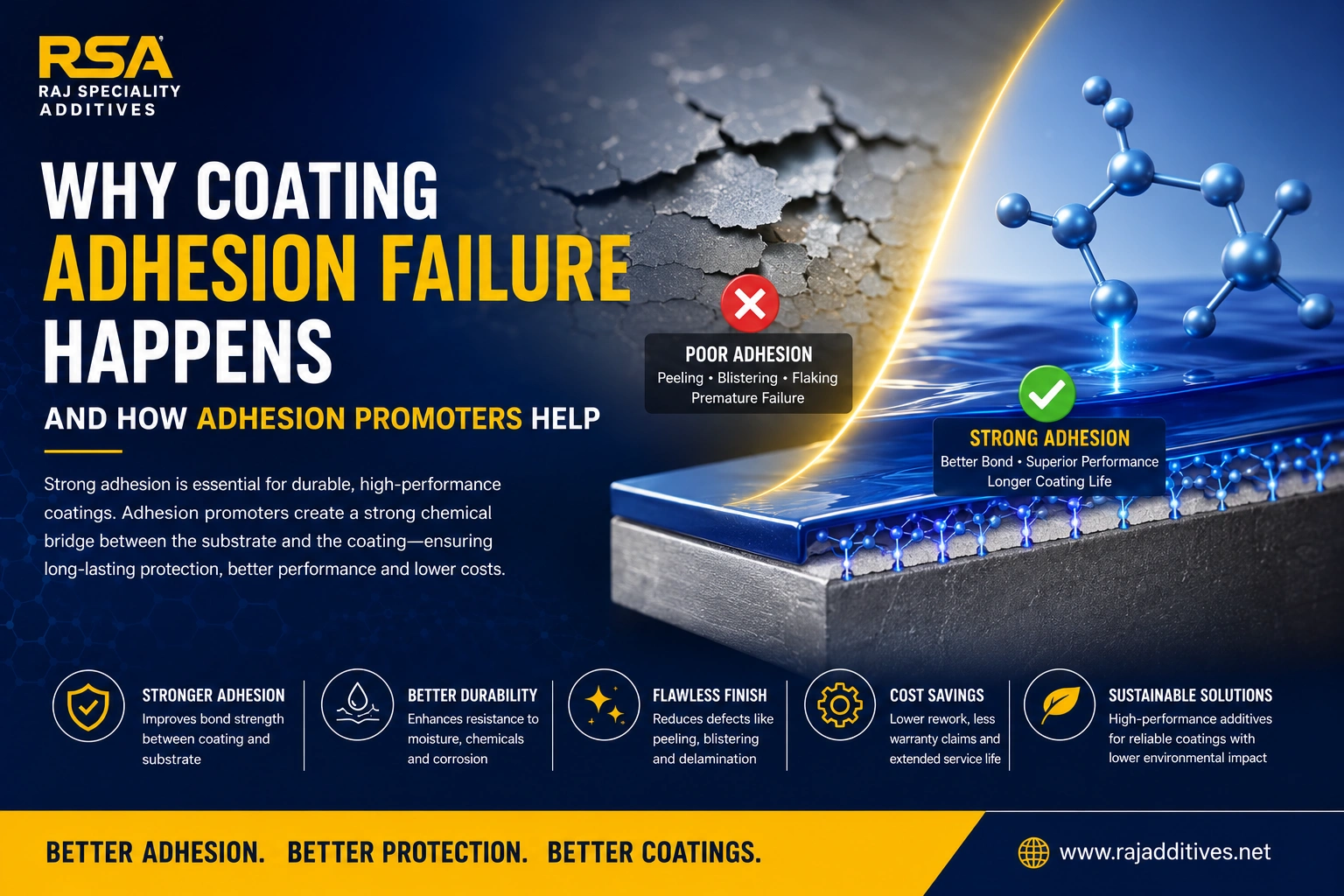
Why Coating Adhesion Failure Happens and How Adhesion Promoters Help
Coating adhesion failure can lead to peeling, flaking, delamination, poor durability, and costly rework in industrial applications. This blog explains why adhesion problems happen, which factors influence coating-substrate bonding, and how an adhesion promoter for coatings helps improve adhesion performance in demanding systems.
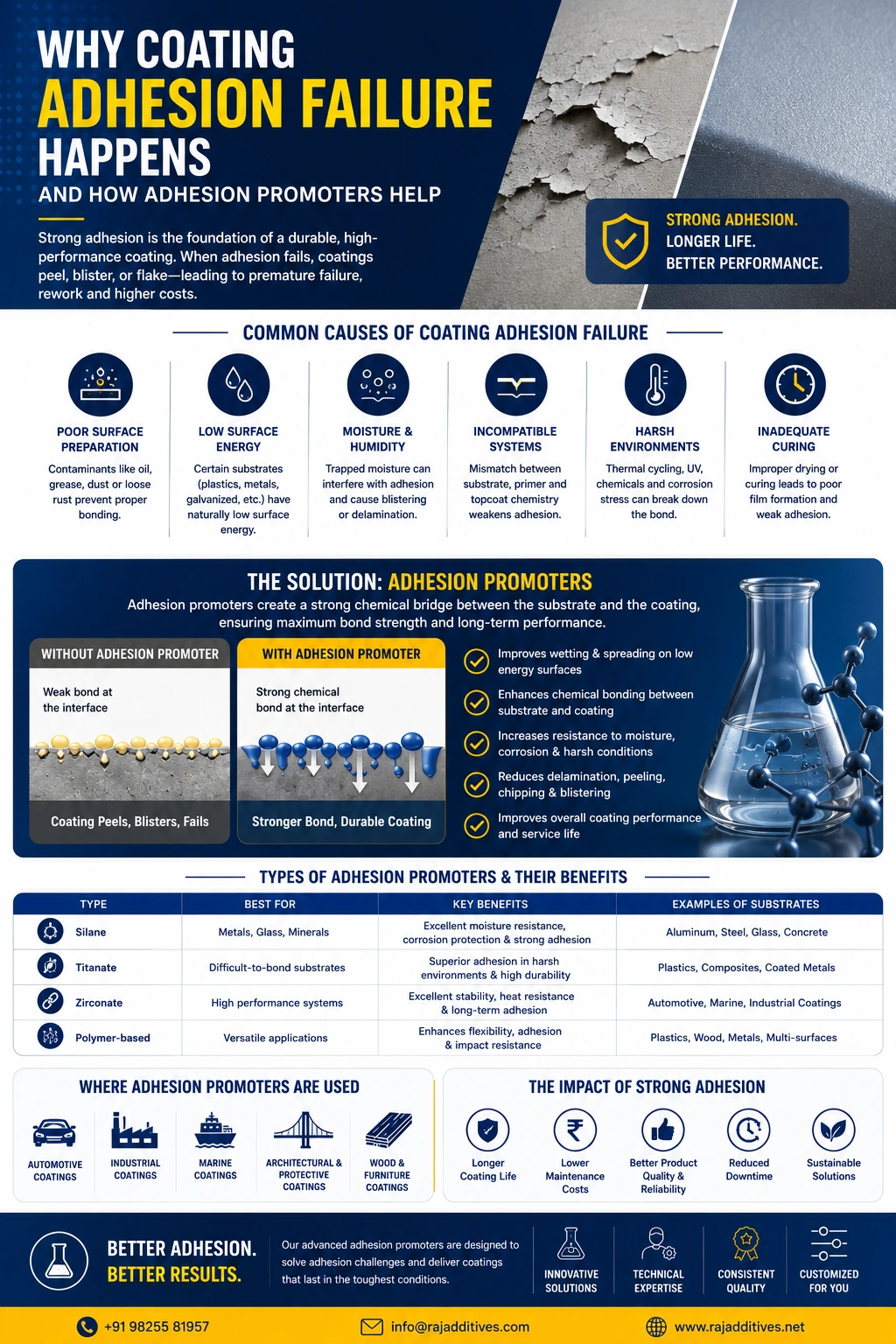 In industrial coatings, appearance alone is never enough. A coating may look smooth and uniform immediately after application, but if it does not bond properly to the substrate, failure can happen later during handling, service exposure, temperature changes, moisture contact, or mechanical stress. This is why adhesion is one of the most important performance requirements in modern coating systems.
When adhesion is poor, the coating may peel, chip, crack, lift at the edges, or delaminate between layers. These issues reduce product reliability and can affect both manufacturing quality and end-use durability. In many cases, an adhesion promoter for coatings is used to improve the bond between the coating and the substrate or between coating layers.
Common failure result
Poor adhesion can cause peeling, flaking, delamination, reduced durability, and inconsistent long-term coating performance.
Role of adhesion promoter
An adhesion promoter helps improve bonding at the interface, supporting better attachment to difficult or demanding surfaces.
What is coating adhesion failure?
Coating adhesion failure happens when the applied coating does not remain properly attached to the substrate or to an underlying coating layer. This failure can happen immediately after drying or curing, or it may appear later during use. The problem may affect the full coating film or specific local areas depending on the cause.
In practical terms, adhesion failure means the bond at the interface is weaker than required for the application. Once that bond is compromised, the coating can separate under stress, moisture, temperature variation, abrasion, or chemical exposure.
Common signs of adhesion failure in coatings
Adhesion problems can appear in several visible or performance-related ways. Some are obvious during testing, while others only become clear after the coated article enters service.
- Peeling or flaking of the coating film
- Delamination between coating layers
- Edge lifting
- Blistering followed by coating separation
- Chipping under mechanical stress
- Cross-hatch failure or poor tape test results
- Reduced durability after moisture, heat, or chemical exposure
Why does coating adhesion failure happen?
Adhesion failure is rarely caused by one factor alone. In many industrial systems, it results from a combination of substrate characteristics, surface contamination, low surface energy, poor wetting, formulation limitations, or insufficient chemical interaction at the interface.
1. Surface contamination
Oil, grease, dust, release agents, moisture, or processing residues can interfere with coating-substrate contact. Even a well-formulated coating may fail if the surface is not properly prepared.
2. Low surface energy substrates
Certain plastics and difficult substrates are naturally hard to coat because the coating does not wet and anchor well to the surface. These surfaces often need additional adhesion support.
3. Incompatible coating-substrate interaction
Good adhesion depends on compatibility between the coating chemistry and the surface being coated. If the interface does not allow sufficient interaction, the bond may remain weak.
4. Poor intercoat adhesion
In multilayer systems, one coating layer may not bond properly to the layer beneath it. This can happen because of curing imbalance, contamination, or insufficient interfacial interaction.
5. Process and curing issues
Application thickness, drying conditions, cure profile, and processing sequence can all affect final adhesion. Even a suitable formulation may underperform if the process does not support proper film formation and bonding.
6. Service exposure stress
Heat, humidity, chemicals, mechanical stress, and weathering can reveal weak adhesion that was not immediately visible during initial inspection.
Which substrates are most prone to adhesion problems?
Adhesion problems can happen on many surfaces, but some substrates are more demanding than others because of their surface properties, contamination risk, or processing conditions.
- Metal surfaces with oils or pretreatment variability
- Plastic substrates with low surface energy
- Powder-coated or pre-coated surfaces needing intercoat adhesion
- Composite materials
- Difficult industrial substrates with smooth, non-porous surfaces
How do adhesion promoters help in coatings?
An adhesion promoter for coatings is used to improve bonding at the interface between the coating and the substrate, or between coating layers in multi-coat systems. Its role is to strengthen interfacial interaction so the coating attaches more effectively and resists separation under stress.
Depending on the chemistry and application, adhesion promoters may improve wetting, support chemical interaction, enhance anchoring, or help bridge compatibility gaps between the coating and the substrate.
| Adhesion Challenge | How Adhesion Promoters Help | Potential Benefit |
|---|---|---|
| Low surface interaction | Improves interfacial bonding support | Better coating attachment |
| Difficult plastic surfaces | Helps the coating interact more effectively with low-energy substrates | Improved adhesion on demanding plastics |
| Metal coating adhesion variability | Supports more consistent bond development | Better reliability in metal coating systems |
| Intercoat delamination | Improves layer-to-layer bonding support | Stronger intercoat adhesion |
| Durability under service stress | Helps maintain bond integrity under demanding conditions | Reduced risk of peeling or flaking |
Where are adhesion promoters commonly used?
Adhesion promoters are used in industrial coatings where the substrate is difficult, the performance requirements are high, or long-term durability is critical. They are especially useful where standard resin-substrate interaction may not be enough on its own.
- Industrial metal coatings
- Plastic coatings
- Multi-layer coating systems
- Protective coatings
- Coatings applied to difficult or low-energy substrates
- Systems needing stronger intercoat adhesion
What should formulators evaluate when selecting an adhesion promoter?
Choosing the right adhesion promoter for coatings depends on the substrate, the resin system, the curing conditions, and the final performance requirements. Selection should be practical and system-specific rather than based only on general additive description.
Useful evaluation points
- Target substrate type
- Compatibility with the coating resin system
- Impact on application and film appearance
- Intercoat adhesion requirements
- Performance after cure and after service exposure
- Durability under humidity, temperature, or chemical stress
Why adhesion failure matters commercially
Adhesion failure does not only affect coating performance. It can increase rejection rate, rework, warranty risk, and customer dissatisfaction. In industrial applications, even small adhesion issues can lead to quality concerns, reduced asset life, and higher total coating cost.
This is why the use of an effective adhesion promoter for coatings is often part of a broader strategy to improve formulation reliability and service durability.
Conclusion
Coating adhesion failure happens when the bond between the coating and the substrate, or between coating layers, is not strong enough for the application conditions. It may be caused by contamination, low surface energy, poor compatibility, curing issues, or weak interfacial interaction.
An adhesion promoter for coatings helps reduce these risks by improving bonding support at the interface. For industrial coating formulators, adhesion promoters are an important tool for building more reliable coating systems on metal, plastic, and other demanding substrates.
Frequently Asked Questions
Coating adhesion failure can be caused by contamination, low surface energy substrates, poor coating-substrate compatibility, weak intercoat bonding, curing issues, or service stresses such as moisture and heat.
An adhesion promoter helps improve the bond between the coating and the substrate, or between coating layers, so the coating is less likely to peel, flake, or delaminate.
Adhesion promoters are often helpful on difficult plastics, metal surfaces with variable conditions, multi-coat systems, composites, and other challenging industrial substrates.
Yes. In many coating systems, adhesion promoters can help improve layer-to-layer bonding and reduce the risk of intercoat delamination.
Adhesion is essential because a coating must stay bonded during handling, service exposure, and long-term use. Poor adhesion reduces durability and can lead to failure of the protective or decorative coating system.
Need stronger coating adhesion on difficult substrates?
Explore RSA’s coating additive solutions for adhesion improvement, intercoat performance, and formulation reliability across industrial coating systems.
- European Coatings. Industry resources on coating adhesion, substrate interaction, and additive selection. https://www.european-coatings.com/
- PCI Magazine. Technical articles on adhesion performance, coating failure analysis, and formulation troubleshooting. https://www.pcimag.com/
- UL Prospector. Coatings formulation resources covering adhesion, substrate compatibility, and additive performance. https://www.ulprospector.com/
- SpecialChem Coatings. Technical guidance on adhesion promotion, difficult substrates, and coating formulation support. https://www.specialchem.com/coatings
- General coatings formulation literature and technical guidance related to substrate bonding, intercoat adhesion, surface preparation, and industrial coating durability.