
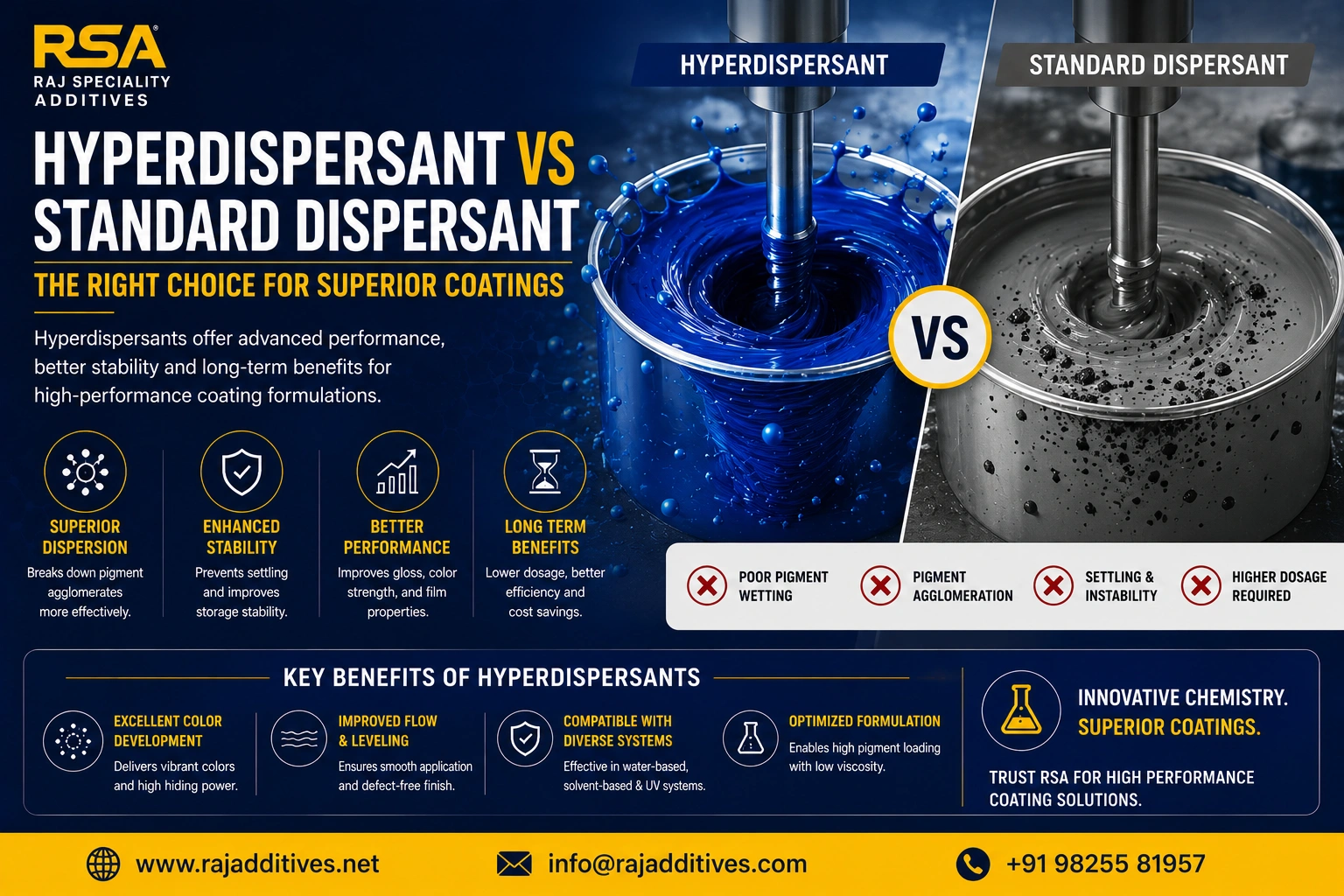
Hyperdispersant vs Standard Dispersant: Which One Should You Use?
Hyperdispersants and standard dispersing additives both support pigment dispersion, but they are not always used for the same formulation challenges. Choosing the right one depends on pigment difficulty, pigment loading, resin system, coating medium, grinding process and final stability requirement.
Why the right dispersion chemistry matters
Pigment dispersion is not only about reducing particle size. A coating, paint, ink or pigment concentrate also needs stable pigment separation, controlled viscosity, good color strength, gloss, hiding and long-term storage stability. This is where dispersing additives and hyperdispersants play an important role.
The wrong selection can cause viscosity rise, flocculation, low color strength, poor gloss, floating, flooding, settling or poor let-down stability. The correct choice should be based on the pigment surface, resin compatibility, water or solvent phase, processing condition and final coating requirement.
Hyperdispersants are often considered when:
- Standard dispersants are not giving stable pigment dispersion
- Carbon black or difficult organic pigments are used
- High pigment loading causes viscosity or stability issues
- Pigment concentrates need let-down compatibility
- Better color strength, gloss or transparency is required
- Long-term anti-flocculation performance is important
Hyperdispersant vs standard dispersant in coatings
Both additive types help pigment dispersion, but their best-fit applications and performance expectations can be different.
| Point of Difference | Standard Dispersant | Hyperdispersant |
|---|---|---|
| Main role | Supports general pigment wetting, separation and stabilization. | Provides stronger stabilization support for demanding pigment systems. |
| Best-fit pigments | General inorganic pigments, fillers and standard pigment systems. | Carbon black, organic pigments, high-performance pigments and difficult pigments. |
| Pigment loading | Suitable for moderate pigment loading depending on formulation. | Often preferred for high pigment loading and pigment concentrates. |
| Stability need | Useful for standard dispersion stability requirements. | Useful where stronger anti-flocculation, let-down and storage stability are needed. |
| Common formulation goal | Improve wetting, grind efficiency and basic stability. | Improve color strength, gloss, viscosity control, stability and pigment performance. |
| Typical use case | Decorative paints, general coatings and standard dispersion systems. | Pigment concentrates, printing inks, carbon black systems and advanced coatings. |
When a standard dispersant may be enough
A standard dispersing additive may be suitable when the pigment system is not highly demanding and the formulation needs general wetting and stabilization support.
- Moderate pigment loading
- General inorganic pigments or fillers
- Standard decorative or industrial coatings
- Basic grinding and dispersion stability needs
When a hyperdispersant may be better
A hyperdispersant may be better when the formulation contains difficult pigments or needs higher dispersion stability and stronger pigment performance.
- Carbon black or difficult organic pigments
- High pigment loading or pigment concentrates
- Viscosity rise during grinding
- Low color strength, gloss or stability issues
Where hyperdispersants are commonly evaluated
Hyperdispersants are useful where pigment systems are difficult, concentrated or performance-sensitive.
Carbon Black Systems
Carbon black has high surface area and difficult wetting behaviour, so stronger stabilization support may be required.
Organic Pigments
Organic pigments can show flocculation, poor color strength and viscosity challenges if not stabilized correctly.
High Pigment Loading
High pigment loading can cause viscosity rise, poor flow and instability without suitable dispersing support.
Pigment Concentrates
Pigment concentrates need strong dispersion stability and let-down compatibility with final paint, ink or coating systems.
Printing Inks
Ink systems often require strong color strength, gloss, flow and stable pigment dispersion.
High-Performance Coatings
Advanced coatings may need improved gloss, color strength, transparency, hiding and long-term stability.
When to move from a standard dispersant to a hyperdispersant
If a standard dispersant is not solving the problem, a hyperdispersant may be worth evaluating.
| Formulation Problem | Possible Reason | Why Hyperdispersant May Help |
|---|---|---|
| High mill base viscosity | Pigments are not properly separated or stabilized. | Can improve pigment stabilization and reduce viscosity issues in suitable systems. |
| Low color strength | Pigment particles are not fully dispersed or are re-agglomerating. | Can help improve pigment utilization and color development. |
| Poor gloss or transparency | Weak dispersion creates poor film clarity and surface appearance. | Can improve dispersion quality and final visual performance. |
| Flocculation during storage | Pigment stabilization is not strong enough over time. | Can support long-term anti-flocculation performance. |
| Let-down shock | Concentrate is not compatible with final paint or coating system. | Can improve let-down stability when selected correctly. |
| Carbon black dispersion issues | Carbon black has high surface area and difficult wetting behaviour. | Can provide stronger support for difficult pigment surfaces. |
How to choose between hyperdispersant and standard dispersant
Selection should be based on pigment difficulty, loading level, coating medium, resin compatibility and final stability requirement.
- Use standard dispersants for general pigment dispersion and moderate stability needs.
- Evaluate hyperdispersants for carbon black, organic pigments and difficult pigments.
- For pigment concentrates, test let-down stability in the final coating or ink system.
- Check compatibility with water-based or solvent-based formulation chemistry.
- Compare color strength, gloss, viscosity, particle size and storage stability.
- Optimize dosage carefully because overdosing can affect viscosity, stability or film properties.
Practical formulation note
Do not choose a hyperdispersant only because it sounds stronger. Use it where the pigment system actually needs advanced stabilization. For simple pigment systems, a standard dispersant may be sufficient and easier to optimize.
FAQs on hyperdispersant vs standard dispersant
Common questions from coating, paint, ink and pigment concentrate manufacturers.
What is the difference between hyperdispersant and standard dispersant?
A standard dispersant supports general pigment wetting and stabilization, while a hyperdispersant is usually evaluated for more demanding pigment systems such as carbon black, organic pigments, high pigment loading and pigment concentrates.
When should I use a hyperdispersant?
A hyperdispersant may be useful when standard dispersants do not provide enough stability, color strength, viscosity control or anti-flocculation performance for difficult pigments or high pigment loading.
Is hyperdispersant always better than standard dispersant?
No. Hyperdispersants are useful for demanding systems, but a standard dispersant may be enough for simpler pigment systems. Selection should be based on formulation trials and performance needs.
Are hyperdispersants useful for carbon black?
Yes. Carbon black is often difficult to wet and stabilize because of high surface area. Hyperdispersants or high-performance dispersing additives are commonly evaluated for carbon black systems.
Can hyperdispersants improve color strength?
In suitable pigment systems, hyperdispersants can help improve pigment separation and stability, which may improve color strength, gloss, transparency and shade consistency.
Can hyperdispersants be used in pigment concentrates?
Yes. Hyperdispersants are often considered for pigment concentrates because these systems usually have high pigment loading and need strong stability and let-down compatibility.
Can RSA help select hyperdispersants?
Yes. Raj Speciality Additives can help coating, paint, ink and pigment concentrate manufacturers evaluate suitable hyperdispersant or dispersing additive categories based on pigment type, system chemistry and performance challenge.
Need help choosing a hyperdispersant or dispersant?
Share your pigment type, coating system, pigment loading, grinding issue or stability challenge with Raj Speciality Additives. Our team can help identify suitable dispersing additive options.
Send Your Enquiry
Please fill out the form and our team will get back to you.