
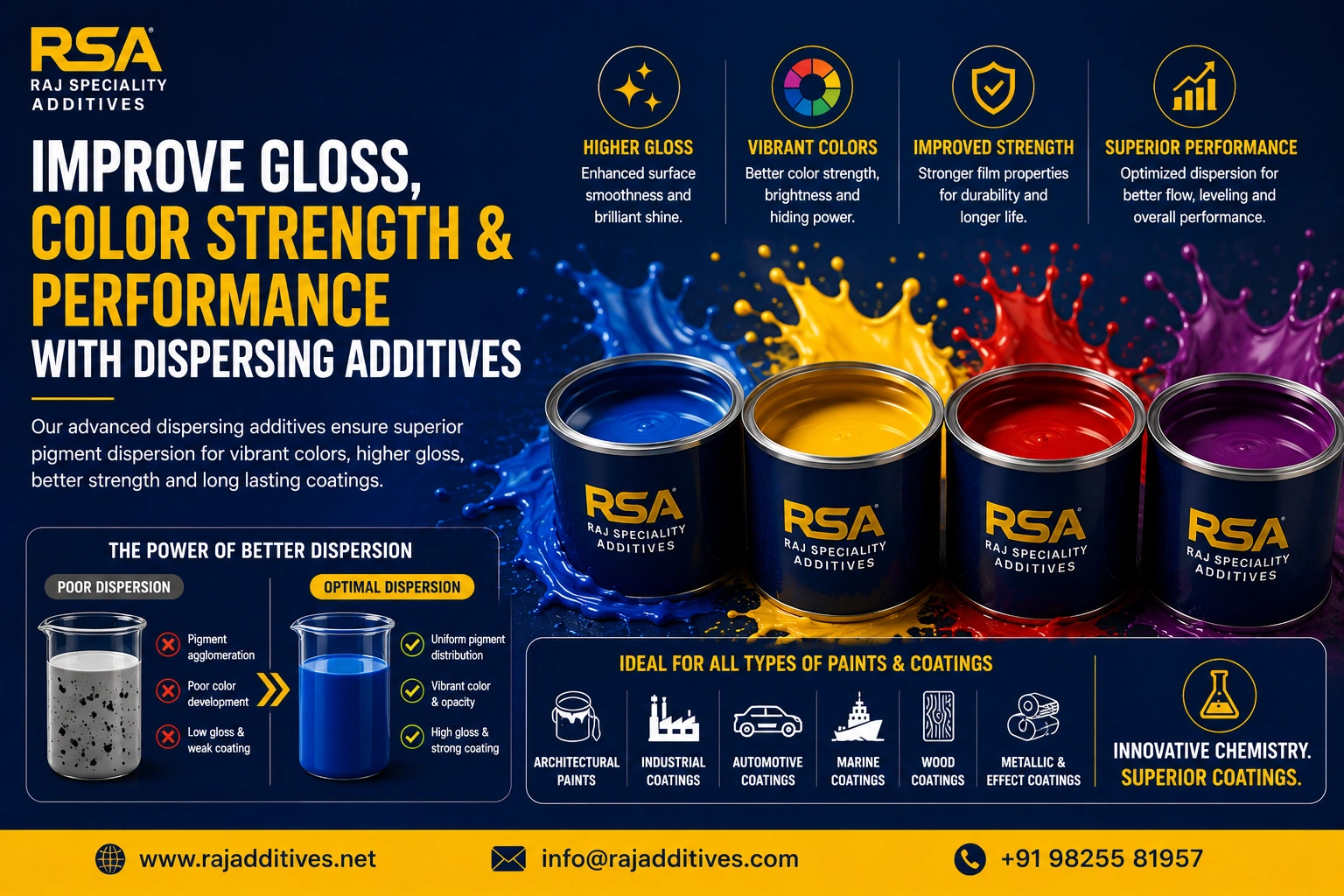
How to Improve Gloss and Color Strength in Paints Using Dispersing Additives
Gloss and color strength in paints are strongly influenced by pigment wetting, particle separation, dispersion stability and formulation compatibility. The right dispersing additive helps pigments perform better and improves final paint appearance.
Why gloss and color strength depend on pigment dispersion
Paint color is not determined only by pigment quality. Even a good pigment can show poor color strength, low gloss, poor hiding or shade variation if it is not properly wetted, dispersed and stabilized inside the coating system.
In decorative paints, industrial paints, pigment concentrates and printing inks, poor dispersion can lead to dull appearance, weak shade, low hiding, high viscosity, pigment settling, floating, flooding and inconsistent batch quality.
Good pigment dispersion helps improve:
- Color strength and shade consistency
- Gloss, clarity and surface appearance
- Hiding power and pigment efficiency
- Viscosity control and application feel
- Storage stability and anti-settling support
- Resistance to flocculation, floating and flooding
Why paints lose gloss and color strength
Low gloss and weak color strength usually indicate that pigments are not fully performing inside the formulation.
Poor Pigment Wetting
Incomplete wetting prevents pigments from dispersing properly, reducing color development and coating appearance.
Pigment Flocculation
Re-agglomeration of pigment particles reduces gloss, color strength, hiding and shade stability.
High Mill Base Viscosity
High viscosity can reduce grinding efficiency and prevent proper particle separation.
Floating & Flooding
Unstable pigment distribution can create uneven color, shade separation and poor final appearance.
Pigment Settling
Poor stabilization can cause pigments or fillers to settle during storage, affecting consistency and performance.
Poor Compatibility
The dispersing additive must match the pigment, resin, solvent or water phase and complete additive package.
How dispersing additives improve gloss and color strength
Dispersing additives improve pigment performance by supporting wetting, separation and stabilization.
| Function | How It Helps | Impact on Paint Performance |
|---|---|---|
| Pigment Wetting | Helps replace air and moisture around pigment particles with the liquid medium. | Improves grinding efficiency, color development and pigment utilization. |
| Particle Separation | Helps break pigment agglomerates into smaller, better-distributed particles. | Improves color strength, gloss, hiding and transparency control. |
| Stabilization | Helps prevent pigment particles from coming back together after dispersion. | Reduces flocculation, settling, floating and flooding. |
| Viscosity Control | Helps reduce unwanted viscosity rise in pigment-rich systems. | Improves processability, flow, let-down and application consistency. |
| Let-Down Compatibility | Supports stable transfer of mill base or pigment concentrate into the final paint system. | Reduces shade shift, instability and batch inconsistency. |
Decorative Paints
Decorative paints need strong color development, smooth application, good hiding and stable shade. Dispersing additives help improve pigment efficiency and visual consistency.
- Improved tint strength
- Better hiding and shade stability
- Reduced flocculation and settling
- Smoother finish in wall paints
Industrial Paints
Industrial paints need consistent dispersion, controlled viscosity and stable color performance across production and application conditions.
- Improved gloss and finish
- Better pigment stability
- Reduced floating and flooding
- Better batch-to-batch consistency
Pigment types that affect gloss and color strength
Different pigments need different dispersing additive support depending on surface area, polarity, particle structure and performance requirement.
| Pigment Type | Common Issue | Recommended Focus |
|---|---|---|
| Organic Pigments | Flocculation, low color strength, poor transparency and shade instability. | Strong stabilization and compatibility with the resin system. |
| Inorganic Pigments | Poor wetting, settling, low gloss or incomplete dispersion. | Efficient wetting, grinding support and storage stability. |
| Carbon Black | Difficult wetting, high viscosity, poor jetness and low color intensity. | Hyperdispersant or strong dispersing additive support. |
| Titanium Dioxide / TiO₂ | Poor hiding, gloss reduction, viscosity instability and crowding. | Efficient TiO₂ dispersion and stabilization. |
| Pigment Concentrates | High pigment loading, let-down shock, shade shift and viscosity issues. | High-performance dispersing or hyperdispersant support. |
How to select dispersing additives for better gloss and color
The right dispersing additive should improve pigment performance without creating side effects such as foam, instability, viscosity imbalance or poor film properties.
- Start with pigment type: organic, inorganic, carbon black, TiO₂ or filler.
- Check if the system is water-based, solvent-based, ink or pigment concentrate.
- Evaluate color strength, gloss, hiding, transparency and shade consistency.
- Check mill base viscosity and grinding efficiency during processing.
- Test storage stability, flocculation resistance and let-down compatibility.
- Review interaction with antifoams, rheology additives and flow additives.
Practical formulation note
Low gloss and weak color strength are not always solved by adding more pigment. In many cases, improving pigment dispersion helps existing pigments perform better and can improve formulation efficiency.
Mistakes that reduce gloss and color strength
These formulation mistakes can reduce pigment performance even when high-quality pigments are used.
Using the Wrong Dispersant
A dispersant that does not match the pigment or resin system may cause flocculation, viscosity rise or weak shade.
Ignoring Dosage Optimization
Too little additive may not stabilize pigments; too much may affect viscosity, foam, film performance or cost.
Skipping Let-Down Testing
A pigment dispersion may look stable in the mill base but fail when added into the final paint system.
FAQs on improving gloss and color strength in paints
Common questions from paint, coating, ink and pigment concentrate manufacturers.
How do dispersing additives improve color strength in paints?
Dispersing additives improve color strength by helping pigments wet, separate and stay stable in the paint system. Better dispersion allows pigments to develop stronger and more consistent color.
How do dispersing additives improve gloss?
Better pigment dispersion helps create a smoother and more uniform coating film. This can improve gloss, clarity and final surface appearance depending on the paint system.
Can poor dispersion reduce hiding power?
Yes. Poor pigment dispersion can reduce pigment efficiency and hiding power, especially when pigments are flocculated or not evenly distributed in the coating film.
Which additive is useful for improving pigment dispersion?
Wetting and dispersing additives, dispersing additives and hyperdispersants can help improve pigment wetting, grinding efficiency, color strength, gloss and dispersion stability.
Can hyperdispersants improve gloss and color strength?
In demanding pigment systems such as carbon black, organic pigments or pigment concentrates, hyperdispersants may help improve pigment stabilization, color strength, gloss and viscosity control.
Why does paint color change during storage?
Paint color may change during storage due to pigment flocculation, settling, floating, flooding, poor dispersion stability or incompatibility between the pigment dispersion and final paint system.
Can RSA help improve gloss and color strength in paints?
Yes. Raj Speciality Additives can help paint and coating manufacturers evaluate suitable wetting, dispersing and hyperdispersant additive categories based on pigment type, formulation system and performance challenge.
Need help improving gloss and color strength?
Share your pigment type, paint system, color strength issue, gloss problem or dispersion challenge with Raj Speciality Additives. Our team can help identify suitable dispersing additive options.
Send Your Enquiry
Please fill out the form and our team will get back to you.