
How to Prevent Floating and Flooding in Paints
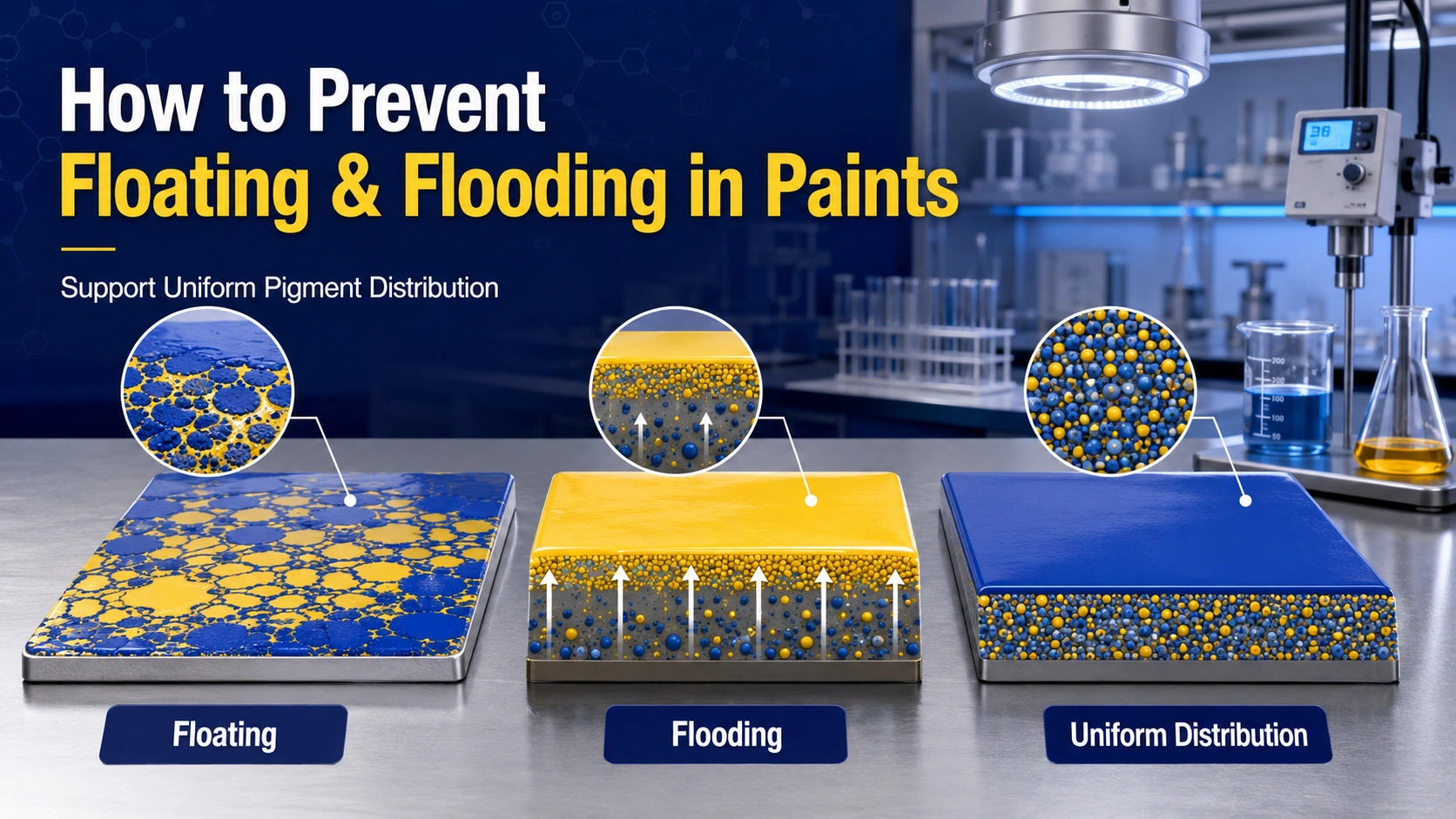
Floating and flooding are paint defects where pigments separate, migrate or appear unevenly distributed in the coating film. These issues can cause shade variation, patchy color, poor appearance and inconsistent batch performance. Suitable wetting, dispersing and pigment stabilization additives help reduce these problems.
Why floating and flooding happen in paints
Floating and flooding happen when pigments are not uniformly dispersed or remain unstable in the paint system. Differences in pigment particle size, density, surface chemistry, wetting behaviour and compatibility can cause one pigment to separate or concentrate differently during application and drying.
These defects are especially important in colored paints, tinting systems, pigment concentrates, industrial coatings and decorative paints where shade uniformity and color consistency are critical.
Floating and flooding may indicate:
- Poor pigment wetting or dispersion
- Pigment flocculation or re-agglomeration
- Different pigment mobility during drying
- Incorrect dispersing additive selection
- Rheology or viscosity imbalance
- Poor let-down or tinting compatibility
Floating vs flooding: what is the difference?
Both are pigment distribution defects, but they appear differently and may need different formulation checks.
| Defect | What It Looks Like | Common Cause | Additive Focus |
|---|---|---|---|
| Floating | Uneven pigment separation on the surface, often appearing as streaks, mottling or color separation. | Different pigment movement, poor stabilization, surface tension differences or flow imbalance. | Wetting and dispersing additives, flow control, rheology balance. |
| Flooding | Overall shade change where one pigment dominates or migrates more uniformly across the surface. | Pigment separation during drying, poor compatibility or unstable pigment dispersion. | Dispersing additives, pigment stabilization, let-down compatibility testing. |
Common causes of floating and flooding in paints
Before changing pigments or increasing dosage, identify whether the issue is wetting, dispersion, stability, rheology or compatibility.
Poor Pigment Dispersion
Incomplete dispersion can allow pigment particles to separate or behave differently during drying.
Pigment Flocculation
Flocculated pigments can move unevenly in the coating film and cause shade variation.
Particle Size & Density Difference
Different pigments can move or settle differently due to particle size, density and surface chemistry.
Rheology Imbalance
Poor viscosity and flow balance can allow pigment movement before the coating sets.
Let-Down Shock
Pigment concentrates may become unstable when added into the final paint system.
Poor Flow Control
Surface flow differences can increase pigment separation, especially in multi-pigment systems.
How additives help prevent floating and flooding
The correct additive approach depends on the pigment system and root cause of shade instability.
| Problem Area | Recommended Additive Focus | How It Helps |
|---|---|---|
| Poor pigment wetting | Wetting & Dispersing Additives | Improves pigment wetting, dispersion quality and uniform color development. |
| Flocculation | Dispersing Additives | Helps stabilize pigment particles and reduce re-agglomeration. |
| Difficult pigments | Hyperdispersant Additives | Supports carbon black, organic pigments, high pigment loading and difficult pigment systems. |
| Let-down shock | Pigment Concentrate Additives | Improves compatibility when pigment concentrates are added to final paint systems. |
| Viscosity imbalance | Rheology Additives | Supports pigment suspension, application feel and controlled flow during drying. |
| Surface flow differences | Flow & Leveling Additives | Improves film uniformity and reduces visible pigment movement on the surface. |
Step-by-step approach to prevent floating and flooding
Use a structured formulation check before changing pigments or increasing additive dosage.
Check Pigment Compatibility
Review pigment type, surface treatment, particle size, density and compatibility with the resin system.
Improve Pigment Wetting
Use suitable wetting and dispersing additives to improve initial pigment incorporation.
Optimize Dispersion Stability
Select dispersing additives or hyperdispersants to reduce flocculation and re-agglomeration.
Control Rheology
Balance viscosity, flow and suspension to reduce pigment movement during application and drying.
Test Let-Down Stability
Check if pigment concentrates remain stable after addition into the final paint system.
Check Application Conditions
Evaluate shade consistency during brush, roller, spray or production application conditions.
Where floating and flooding problems are commonly seen
Pigment separation can occur in different paint and coating systems, especially when multiple pigments or pigment concentrates are used.
- Decorative paints need shade consistency, smooth appearance and stable tinting performance.
- Industrial paints need reliable color and batch-to-batch stability.
- Water-based coatings need careful balance of wetting, dispersing, rheology and foam control.
- Solvent-based coatings need compatibility between pigment, resin and additive chemistry.
- Pigment concentrates need strong stabilization and let-down compatibility.
Practical formulation note
If shade changes after storage or application, the issue may not be pigment quality alone. Check dispersion stability, rheology balance and let-down compatibility before changing pigment suppliers.
Mistakes that increase floating and flooding
Pigment stability problems can worsen if the formulation is adjusted without understanding the root cause.
Using One Dispersant for All Pigments
Different pigments may need different dispersing chemistry depending on surface and system compatibility.
Skipping Let-Down Testing
A pigment concentrate may look stable alone but fail after being added into the final paint.
Ignoring Rheology Balance
If viscosity and flow are not balanced, pigments can move unevenly during drying and cause shade defects.
FAQs on floating and flooding in paints
Common questions from paint, coating and pigment concentrate manufacturers.
What causes floating and flooding in paints?
Floating and flooding are commonly caused by poor pigment dispersion, pigment flocculation, differences in pigment particle size or density, poor wetting, rheology imbalance and let-down incompatibility.
How can floating and flooding be prevented?
Floating and flooding can be prevented by improving pigment wetting, using suitable dispersing additives, stabilizing pigment particles, controlling rheology and testing let-down stability in the final paint system.
Which additive helps reduce floating and flooding?
Wetting and dispersing additives, dispersing additives and hyperdispersants can help reduce pigment instability that leads to floating and flooding.
Can poor rheology cause floating and flooding?
Yes. Poor viscosity and flow balance can allow pigments to move unevenly during application and drying, increasing the risk of floating and flooding.
Can pigment concentrates cause floating or flooding?
Yes. Pigment concentrates can cause floating or flooding if they are not compatible with the final paint system or if the dispersion is not stable after let-down.
Is floating and flooding only a pigment problem?
No. Pigment quality matters, but floating and flooding can also be caused by dispersing additive selection, resin compatibility, rheology, let-down process and application conditions.
Can RSA help solve floating and flooding issues?
Yes. Raj Speciality Additives can help coating and paint manufacturers evaluate suitable wetting, dispersing, hyperdispersant, rheology and flow additive categories based on pigment system and defect type.
Need help preventing floating or flooding in paints?
Share your pigment system, paint type, shade issue, let-down problem or formulation challenge with Raj Speciality Additives. Our team can help identify suitable additive directions.
Send Your Enquiry
Please fill out the form and our team will get back to you.