
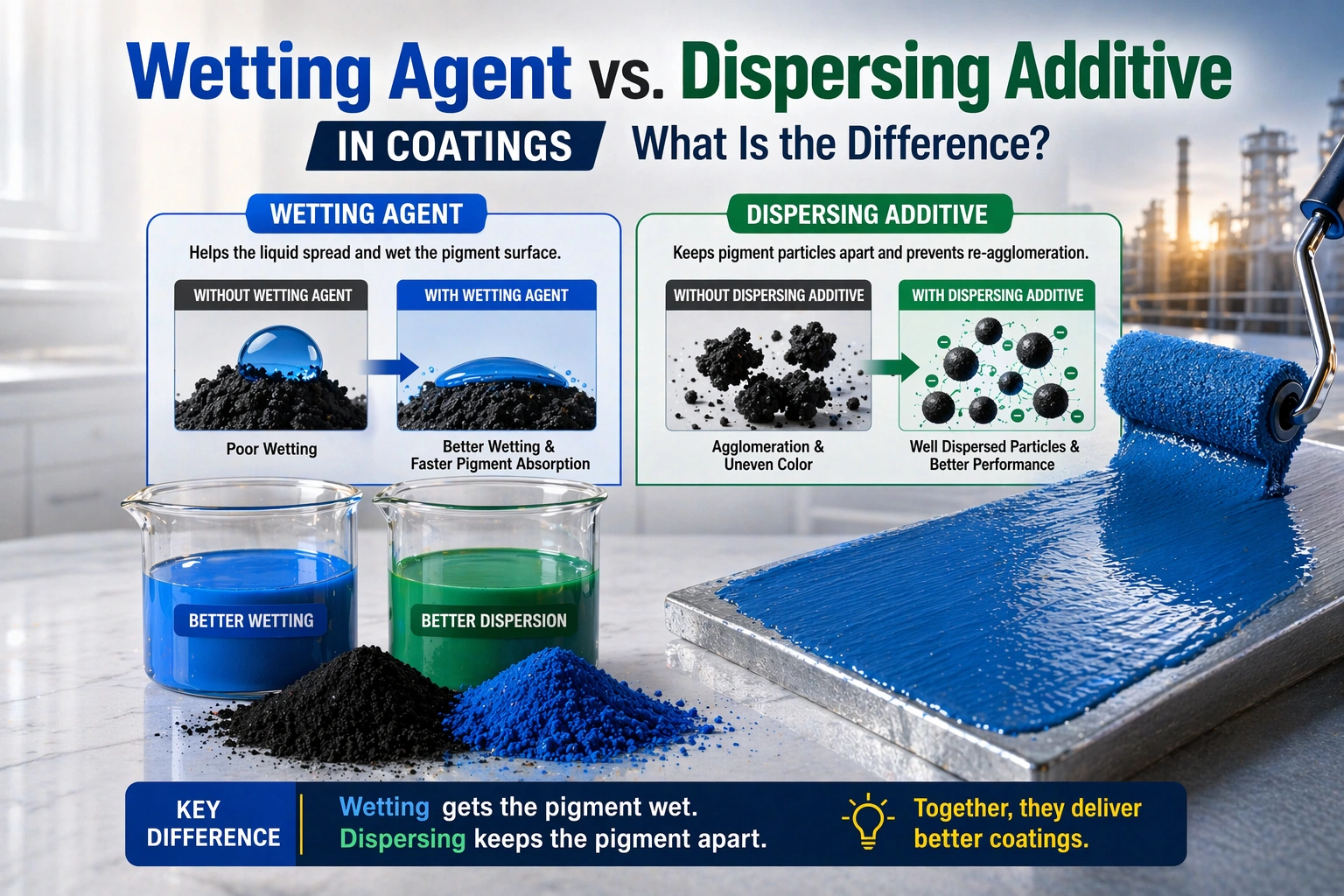
Wetting Agent vs Dispersing Additive in Coatings: What Is the Difference?
In coating formulation, the terms wetting agent and dispersing additive are often used together, and sometimes interchangeably. But they do not always mean the same thing. This blog explains the difference between a wetting agent and a dispersing additive for coatings, why both functions matter, and how formulators should think about them in practical terms.
In industrial coatings, pigment and filler particles must be properly incorporated into the liquid system to achieve the desired appearance, stability, and performance. Two terms often appear in this context: wetting agent and dispersing additive for coatings. While they are closely related, they describe different functions within the formulation process.
Understanding the difference matters because good dispersion is not achieved by one step alone. The system first needs proper wetting of the solid surface, and then it needs enough stabilization to keep the particles separated after deagglomeration. A formulation that gets one part right but not the other may still show colour weakness, viscosity issues, gloss loss, flocculation, or storage instability.
Wetting agent
Mainly helps the liquid phase spread across the surface of pigments or fillers so the system can contact the particles effectively.
Dispersing additive
Usually helps not only wet the particles, but also stabilize them after deagglomeration so they remain uniformly distributed.
What is a wetting agent in coatings?
A wetting agent in coatings is an additive used to help the liquid medium spread more effectively over a solid surface. In pigment dispersion, this means helping the resin or solvent system make better contact with the surface of pigments, fillers, or other solid particles.
Pigment surfaces can resist wetting because of their surface energy characteristics. If the coating medium cannot reach and cover those surfaces properly, the grinding process becomes less efficient and dispersion quality may suffer. A wetting agent helps overcome this first barrier by improving liquid-to-solid contact.
What is a dispersing additive for coatings?
A dispersing additive for coatings usually goes beyond wetting alone. It helps the system first wet the pigment surface and then stabilize the pigment particles after they have been separated during mechanical dispersion. This stabilization is important because particles naturally tend to come back together if the system does not keep them apart.
In many practical coating systems, the value of a dispersing additive comes from this second function. A formulation may initially look well dispersed after milling, but if the particles are not stabilized properly, they may re-agglomerate during storage, application, or drying. That leads to performance problems later.
What is the main difference between the two?
The simplest difference is this:
- Wetting agent: helps the liquid phase spread across the pigment or filler surface
- Dispersing additive: helps wet the particle and then stabilize it after it has been dispersed
Wetting is mainly about surface contact. Dispersion stability is mainly about keeping particles separated after they have been broken down. Both functions are important, but they do not describe the same stage of formulation behaviour.
| Aspect | Wetting Agent | Dispersing Additive |
|---|---|---|
| Main role | Improves liquid-to-solid contact | Improves wetting and particle stabilization |
| Stage of action | Early stage of dispersion | During and after dispersion |
| Primary benefit | Helps the medium reach the particle surface | Helps keep dispersed particles separated |
| Risk if missing | Poor initial incorporation of solids | Re-agglomeration, flocculation, instability |
| Impact on storage stability | Usually limited on its own | Often important for long-term stability |
| Effect on colour/gloss | Indirect support | Directly influences colour strength, gloss, and consistency |
Why do both functions matter in coatings?
A pigment-loaded coating has to move through several stages successfully. First, the coating medium must contact the solid particles. Then mechanical energy must help break down agglomerates. After that, the system must prevent those particles from coming back together.
If wetting is poor, dispersion becomes inefficient from the start. If stabilization is poor, the system may look acceptable for a short time but later show flocculation, settling, viscosity drift, gloss loss, or shade inconsistency. This is why formulators do not usually think in isolated terms. They think in terms of total dispersion performance.
Can one additive do both jobs?
Yes, in many cases one additive can provide both wetting and dispersing functions. Modern additive technologies are often designed that way. However, the fact that one product performs both tasks does not mean the functions themselves are identical.
From a formulation standpoint, separating the concepts is still useful. It helps the formulator diagnose problems more accurately. For example, a system may have adequate initial wetting but poor long-term stabilization, or good stability but inefficient initial incorporation of difficult pigments.
What problems appear when the system has wetting but not enough dispersion stability?
This is a common situation in coating formulation. The pigment may seem to enter the system well at first, but the final result can still become unstable because the particles are not being kept apart effectively.
- Flocculation
- Reduced colour strength
- Gloss loss
- Flooding and floating
- Rub-out differences
- Viscosity drift
- Settling or hard sedimentation
- Batch-to-batch inconsistency
These issues highlight why a true dispersing additive for coatings is often more than just a surface wetting aid.
When does this difference matter the most?
The distinction becomes especially important in formulations that involve difficult pigments, high pigment loading, appearance-sensitive systems, or strict storage stability requirements.
- Carbon black-containing coatings
- Organic pigment systems
- High-gloss industrial coatings
- Pigment concentrates
- Multicolour systems prone to flooding and floating
- Coatings that must remain stable during storage and transport
How should formulators evaluate wetting and dispersing performance?
Evaluation should always be based on the complete formulation rather than additive description alone. A product marketed as a wetting and dispersing agent may perform very well in one resin-pigment system and differently in another. Practical testing is therefore essential.
Useful evaluation points
- Ease of pigment incorporation
- Grinding efficiency and fineness development
- Colour strength and shade development
- Gloss and haze behaviour
- Rub-out performance
- Viscosity stability over time
- Settling tendency and redispersibility
- Storage stability under real conditions
Which is more important: wetting or dispersion stability?
In practice, both are important because they support different parts of the same process. Wetting is essential at the beginning. Stabilization becomes critical for maintaining performance after the particles have been dispersed. Without wetting, the system struggles to start dispersion effectively. Without stabilization, the system may lose quality later.
For many industrial coatings, the more decisive long-term difference often comes from stabilization quality, because that is what helps protect colour development, gloss, viscosity behaviour, and storage consistency over time.
Conclusion
A wetting agent and a dispersing additive for coatings are closely related, but they are not exactly the same. A wetting agent mainly helps the liquid phase contact the particle surface, while a dispersing additive usually helps both with wetting and with stabilizing the particles after they have been separated.
For formulators, understanding this difference helps diagnose coating problems more accurately and supports better additive selection. In modern industrial coatings, achieving strong dispersion performance usually means paying attention to both functions, not just one.
Frequently Asked Questions
Not exactly. A wetting agent mainly helps the liquid phase spread across the particle surface, while a dispersing additive usually also helps stabilize the particles after they have been dispersed.
Wetting is important because the coating medium must properly contact the pigment surface before the particles can be dispersed efficiently. Poor wetting can reduce grind efficiency and overall dispersion quality.
A dispersing additive helps keep the dispersed particles separated after deagglomeration. This reduces the risk of flocculation, settling, gloss loss, colour weakness, and instability during storage.
Yes. Many modern additives are designed to provide both functions in one product, but the two roles are still conceptually different and useful to evaluate separately during formulation work.
It matters because coating systems can fail in different ways. Some problems come from poor initial wetting, while others come from weak long-term stabilization. Understanding the difference helps formulators choose and test additives more effectively.
Need better wetting and dispersion control in coatings?
Explore RSA’s coating additive solutions for wetting, dispersion stability, pigment performance, and formulation consistency in industrial coating systems.
- European Coatings. Industry resources on wetting, dispersing additives, pigment incorporation, and coating formulation. https://www.european-coatings.com/
- PCI Magazine. Technical articles on dispersion behaviour, pigment stabilization, coating defects, and formulation performance. https://www.pcimag.com/
- UL Prospector. Coatings formulation information covering wetting agents, dispersants, pigments, and additive selection. https://www.ulprospector.com/
- SpecialChem Coatings. Technical guidance on wetting, dispersing agents, pigment stabilization, and formulation troubleshooting. https://www.specialchem.com/coatings
- General coatings formulation literature and technical guidance related to pigment wetting, particle stabilization, flocculation control, and storage behaviour in industrial coatings.