
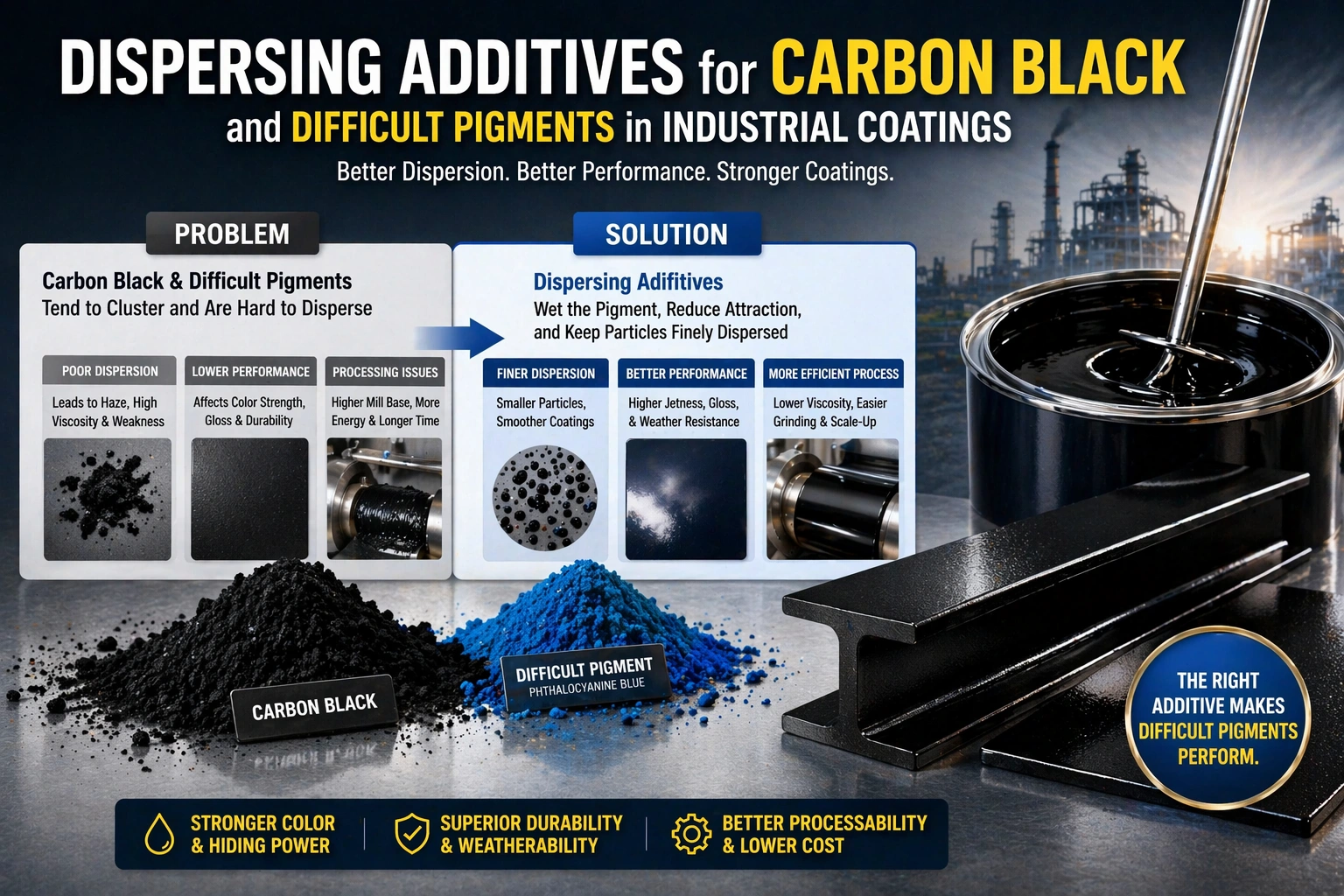
Dispersing Additives for Carbon Black and Difficult Pigments in Industrial Coatings
Carbon black and other difficult pigments are among the most challenging materials to stabilize in industrial coatings. This blog explains why these pigments are harder to disperse, what problems they create in formulations, and how the right dispersing additive for coatings helps improve stability, colour development, gloss, and process consistency.
In many industrial coating formulations, pigment dispersion is already a critical step. That challenge becomes even more important when the formulation includes carbon black or other difficult pigments. These pigments can be harder to wet, harder to deagglomerate, and harder to stabilize over time, making them more demanding from both a process and performance perspective.
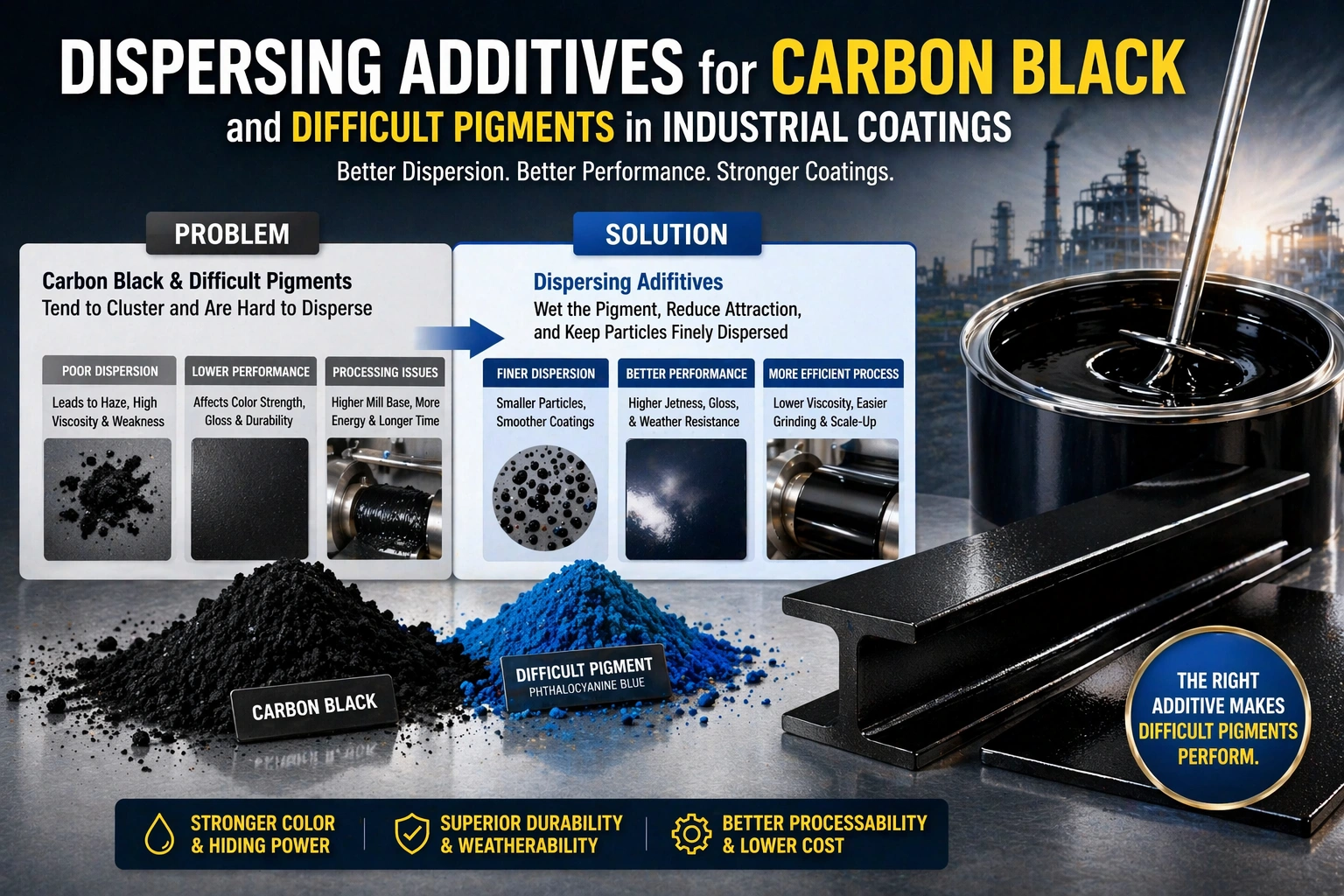
A properly selected dispersing additive for coatings can make a significant difference in these systems. It helps the pigment distribute more effectively, reduces the risk of re-agglomeration, and supports better performance across manufacturing, storage, and final coating appearance.
Why carbon black is difficult
Carbon black has high surface area and strong particle attraction, which makes wetting and stabilization more challenging.
Why the additive matters
The right dispersing additive helps improve grind efficiency, colour strength, gloss, stability, and reproducibility.
Why is carbon black difficult to disperse in coatings?
Carbon black is widely used in industrial coatings because of its colour strength, opacity control, conductivity-related uses in some systems, and ability to create deep black shades. However, from a formulation standpoint, it is known to be one of the most difficult pigments to handle well.
One major reason is its very high surface area. This increases the amount of resin or additive interaction needed to properly wet and stabilize the pigment particles. Carbon black particles also tend to form aggregates and agglomerates, making them harder to break down and distribute evenly in the coating medium.
What other pigments can be difficult to disperse?
Carbon black is the most commonly discussed example, but it is not the only difficult pigment in coatings. Several pigment types can challenge dispersion quality depending on formulation design, resin compatibility, and required film appearance.
- High surface area carbon black grades
- Certain organic pigments
- Transparent iron oxides
- Complex multicolour pigment blends
- Fine particle specialty pigments
- Pigments used in high-gloss or appearance-sensitive systems
These materials may require more careful wetting, stronger stabilization, and more selective additive choice to avoid defects or inconsistent performance.
Common coating problems caused by poor dispersion of carbon black and difficult pigments
When difficult pigments are not dispersed properly, the impact can be seen across the full formulation and finished coating. The issues are not limited to the grind stage. They can affect storage stability, application, and final appearance as well.
1. Weak colour strength
Poor dispersion can prevent the formulation from achieving full pigment efficiency. In carbon black systems, this may mean the expected depth of black, undertone control, or tint strength is not fully developed.
2. Higher viscosity or unstable rheology
Difficult pigments can create strong particle-particle interactions when they are not stabilized properly. This may raise viscosity, make process control harder, and lead to viscosity drift over time.
3. Gloss reduction
In coatings where appearance matters, unstable dispersion may reduce gloss or create haze. Micro-flocculation and non-uniform particle distribution can interfere with smooth film formation.
4. Flocculation and re-agglomeration
Even if the pigment seems well dispersed immediately after grinding, poor stabilization can allow particles to come together again. This reduces coating consistency and can trigger multiple appearance defects.
5. Flooding, floating, and shade inconsistency
In multicolour systems or blended pigment systems, poor stabilization may result in pigment separation during drying. This can appear as tone variation, uneven colour, or visible patterning.
6. Settling and hard sedimentation
Difficult pigments that are not properly stabilized may settle during storage. In severe cases, the sediment may be difficult to redisperse, affecting product usability and shelf stability.
How do dispersing additives help in these systems?
A dispersing additive for coatings supports difficult pigment systems in two important ways. First, it helps the coating medium wet the pigment surface more effectively. Second, it helps stabilize the particles after mechanical dispersion has broken down agglomerates.
This reduces the likelihood of pigment particles coming back together and helps maintain a more stable dispersion across storage and application stages.
| Challenge | Role of the Dispersing Additive | Potential Benefit |
|---|---|---|
| Hard-to-wet pigment surfaces | Improves wetting of carbon black and difficult pigments | Faster and more effective initial dispersion |
| Agglomeration | Supports deagglomeration during grinding | Better particle distribution and colour development |
| Re-agglomeration | Stabilizes particles after dispersion | Improved long-term stability and reduced flocculation |
| Viscosity rise | Helps reduce uncontrolled particle interaction | More manageable and stable viscosity profile |
| Gloss loss | Promotes more uniform pigment distribution | Improved film appearance and surface quality |
| Settling | Supports storage stability of pigment systems | Lower risk of hard sedimentation |
Why additive selection matters even more for carbon black
Carbon black often responds very differently depending on its grade, structure, and surface characteristics. This means a dispersing additive that works well for one pigment type or coating chemistry may not automatically perform well in another.
In industrial coatings, additive selection should therefore be based on the complete formulation context, including the resin system, pigment loading, process conditions, appearance targets, and storage requirements.
Where does this matter most in industrial coatings?
Effective dispersion of carbon black and difficult pigments becomes especially important in applications where appearance, consistency, and formulation stability are critical.
- Industrial coatings with deep black or strong shade requirements
- Protective coatings using complex pigment systems
- Metal coatings where appearance consistency matters
- Wood coatings requiring stable colour development
- Pigment concentrates used for later let-down
- High-gloss coating formulations
- Formulations sensitive to viscosity drift or storage instability
What should formulators evaluate during selection?
When choosing a dispersing additive for coatings involving carbon black or difficult pigments, formulators should look beyond initial grind performance. The real value comes from total system stability and final coating behaviour.
Key evaluation points
- Compatibility with the resin system
- Wetting efficiency on carbon black and specialty pigments
- Effect on colour strength and undertone development
- Influence on viscosity and flow behaviour
- Resistance to flocculation during storage
- Impact on gloss, haze, and film appearance
- Ease of redispersion after storage
- Batch reproducibility under real process conditions
Why this matters commercially for coating manufacturers
Carbon black and difficult pigment dispersion problems can raise milling time, increase rejection risk, reduce consistency, and create avoidable formulation variability. These effects influence manufacturing efficiency and can directly affect product quality perceived by the customer.
By supporting better pigment stabilization, the right dispersing additive helps coating manufacturers improve process control, reduce instability-related defects, and achieve more reliable performance across batches.
Conclusion
Carbon black and other difficult pigments create real formulation challenges in industrial coatings because they are harder to wet, harder to disperse, and more likely to destabilize if not handled properly. Their behaviour can affect colour strength, gloss, viscosity, storage stability, and overall coating consistency.
A properly chosen dispersing additive for coatings helps address these challenges by improving pigment wetting, supporting deagglomeration, and stabilizing particles after dispersion. For industrial coating formulators, this makes dispersing additives an essential part of building reliable systems for carbon black and other difficult pigment applications.
Frequently Asked Questions
Carbon black is difficult to disperse because of its high surface area and strong particle interaction tendency. These properties make wetting, deagglomeration, and stabilization more demanding than with many standard pigments.
Poor carbon black dispersion can cause weak colour strength, viscosity rise, gloss reduction, flocculation, shade inconsistency, settling, and reduced batch-to-batch reproducibility.
A dispersing additive helps by improving pigment wetting, supporting particle separation during grinding, and stabilizing the dispersed particles afterward so they do not easily re-agglomerate.
No. Performance depends on the carbon black grade, resin system, process conditions, and formulation goals. Selection should always be based on actual application testing.
Systems with deep black shades, high-gloss requirements, pigment concentrates, appearance-sensitive industrial coatings, and formulations prone to viscosity drift or settling benefit strongly from proper dispersion control.
Need better control over difficult pigment dispersion?
Explore RSA’s coating additive solutions for pigment wetting, stabilization, dispersion efficiency, and formulation performance in industrial coatings.
- European Coatings. Industry resources on pigment dispersion, additive selection, and coating formulation. https://www.european-coatings.com/
- PCI Magazine. Technical articles related to carbon black dispersion, pigment stabilization, and coating defect control. https://www.pcimag.com/
- UL Prospector. Coatings formulation resources covering dispersants, wetting agents, pigments, and formulation performance. https://www.ulprospector.com/
- SpecialChem Coatings. Technical guidance on carbon black, pigment wetting, dispersing additives, and formulation stability. https://www.specialchem.com/coatings
- General coatings formulation literature and technical guidance related to difficult pigment stabilization, carbon black handling, flocculation control, and storage stability in industrial coating systems.