
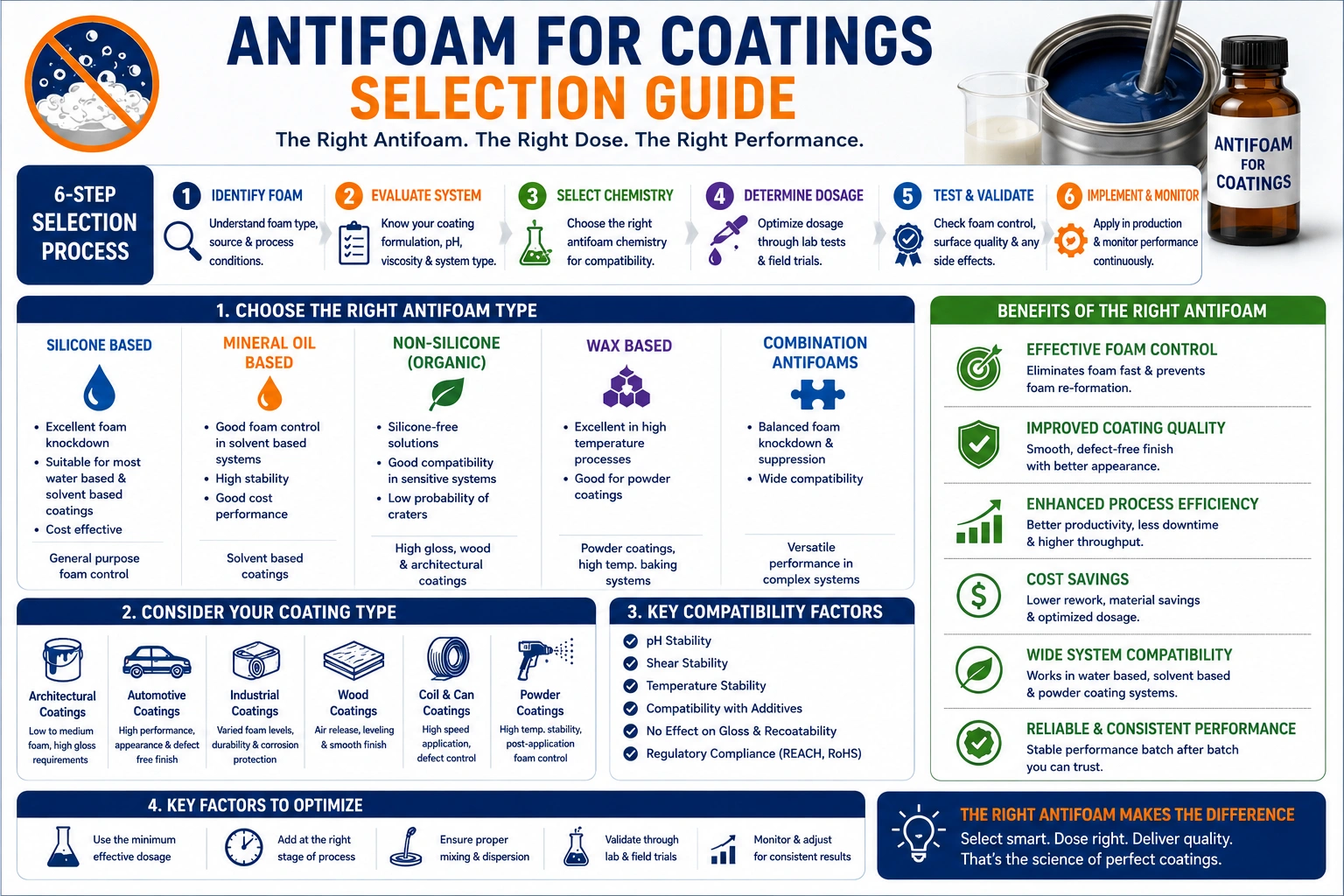
Antifoam for Coatings: How to Choose the Right One for Water-Based and Solvent-Based Systems
Choosing the right antifoam for coatings is important for controlling foam during production, filling, storage, and application while maintaining surface finish, gloss, leveling, film stability, and overall coating performance.
Quick Summary
Selecting an antifoam for coatings depends on the coating type, resin chemistry, water-based or solvent-based system, pigment loading, production process, application method, and expected surface finish.
Know the foam source
Foam may occur during grinding, mixing, let-down, pumping, filling, storage, or application.
Match the system
Water-based and solvent-based coatings usually need different antifoam selection approaches.
Test full performance
Evaluate foam control along with gloss, leveling, craters, storage stability, and compatibility.
The right antifoam for coatings helps formulators control foam without disturbing the final coating film. Foam may appear during high-speed mixing, pigment grinding, let-down, transfer, packaging, or application. If it is not controlled properly, it can lead to pinholes, craters, microfoam, reduced gloss, poor leveling, filling issues, and inconsistent surface appearance.
Antifoam selection becomes more important because coatings are not all the same. A water-based coating may generate persistent foam due to surfactants and dispersants, while a solvent-based coating may need faster air release without affecting gloss or clarity. The best antifoam is the one that controls foam while remaining compatible with the full formulation.
What Is Antifoam for Coatings?
Antifoam for coatings is a specialty additive used to prevent, reduce, or break foam in paint, ink, and coating systems. It helps destabilize air bubbles and allows trapped air to escape from the liquid coating.
In practical formulation work, antifoam additives may support:
- Foam reduction during coating manufacturing
- Improved processing during grinding and mixing
- Better filling and packaging efficiency
- Reduction of entrapped air in the wet film
- Improved surface appearance when foam is the root cause
- Lower risk of pinholes and bubble marks
- More stable application behavior
For a broader explanation of foam issues, read RSA’s related blog on common foam problems in industrial coatings.
Why Antifoam Selection Matters in Coatings
Antifoam selection is a balance between foam control and formulation compatibility. If the additive is too compatible, it may not move efficiently to the air-liquid interface and may not break foam effectively. If it is too incompatible, it may create surface defects such as craters, fish eyes, haze, loss of gloss, or poor leveling.
The selected antifoam must work with:
- Resin or binder chemistry
- Water-based or solvent-based system
- Pigment and filler loading
- Wetting and dispersing additive package
- Rheology modifier system
- Application method
- Final surface finish requirement
- Storage and processing conditions
This is why companies looking for a paint additives supplier or coating additives manufacturer should evaluate antifoam support as part of the total additive package, not as a standalone correction.
Antifoam Requirements in Water-Based Coatings
Water-based coatings are often more foam-sensitive because they contain water-compatible resins, surfactants, wetting agents, dispersants, emulsifiers, and rheology modifiers. These ingredients can stabilize air bubbles and make foam more persistent.
In water-based coatings, the antifoam should be selected to control foam without affecting emulsion stability, pigment dispersion, gloss, leveling, or surface appearance.
Common foam issues in water-based coatings
- Foam during high-speed mixing
- Foam during pigment grinding
- Surface bubbles during roller or brush application
- Microfoam in high-viscosity systems
- Pinholes after drying
- Reduced gloss or hazy appearance
- Foam during can filling or packaging
What to check before selecting water-based coating antifoam
Before selecting a water-based coating antifoam, formulators should check whether the additive remains stable in the system, works across the required pH range, performs during production, and does not create surface defects during application.
| Water-Based Coating Factor | Why It Matters | Evaluation Point |
|---|---|---|
| Surfactant level | Surfactants can stabilize foam and make bubbles harder to break. | Check foam control during mixing and after storage. |
| Dispersant package | Wetting and dispersing agents can influence foam behavior. | Test with the actual pigment grind and let-down system. |
| pH and resin type | Some antifoams may behave differently across pH and resin chemistry. | Evaluate compatibility and stability over time. |
| Application method | Roller, brush, and spray applications create different foam patterns. | Apply by the actual method used by the customer. |
| Surface appearance | Wrong antifoam may cause craters, haze, or poor leveling. | Check dry film surface under proper lighting. |
Need help selecting antifoam for water-based coatings?
Share your coating type, foam source, pigment system, and application method with RSA to evaluate suitable foam control additive options.
Antifoam Requirements in Solvent-Based Coatings
Solvent-based coatings may generate foam differently compared to water-based systems. Because solvents generally reduce surface tension, foam may collapse faster in some cases. However, air entrapment, microfoam, bubbles, and surface defects can still occur, especially in high-build, high-viscosity, heavily pigmented, or fast-drying coatings.
In solvent-based coatings, antifoam selection should focus on air release, compatibility, gloss retention, clarity, surface finish, and film uniformity.
Common foam issues in solvent-based coatings
- Entrapped air in high-viscosity systems
- Bubbles during spray or roller application
- Pinholes caused by trapped air release
- Foam during mixing or pigment dispersion
- Surface disturbances in high-gloss coatings
- Defects due to fast solvent evaporation
What to check before selecting solvent-based coating antifoam
A solvent-based coating antifoam should be evaluated with the actual resin, solvent blend, pigment package, application method, and drying conditions. The additive should not reduce gloss, create haze, or disturb leveling.
| Solvent-Based Coating Factor | Why It Matters | Evaluation Point |
|---|---|---|
| Solvent blend | Solvent polarity and evaporation rate influence air release and compatibility. | Test with the actual production solvent package. |
| Resin chemistry | Alkyd, acrylic, epoxy, polyurethane, and polyester systems can behave differently. | Check compatibility, clarity, gloss, and storage stability. |
| Film thickness | Thicker films can trap air more easily. | Evaluate air release at real film build. |
| Drying speed | Fast drying may trap bubbles before they escape. | Check pinholes, bubbles, and film formation after drying. |
| Surface finish | High-gloss systems are more sensitive to additive incompatibility. | Evaluate gloss, leveling, haze, craters, and surface uniformity. |
Key Factors to Consider Before Selecting an Antifoam
There is no universal antifoam that works perfectly in every coating. Selection should be based on the full system and the exact foam problem.
Important selection factors include:
- Is the formulation water-based or solvent-based?
- Is the foam generated during production, storage, filling, or application?
- Is the problem macrofoam, microfoam, entrapped air, or surface bubbles?
- What is the resin or binder system?
- What pigments, fillers, wetting agents, and dispersants are used?
- What is the viscosity and film thickness?
- What is the final surface finish requirement?
- Is the coating applied by spray, brush, roller, dip, or another method?
- Does the antifoam remain stable during storage?
- Does it affect gloss, leveling, recoatability, or surface defects?
Since foam behavior can be linked with pigment wetting and dispersion, it is also useful to review RSA’s content on wetting and dispersing agent for coatings.
Compatibility with Resin, Pigment, and Additive Package
Antifoam additives interact with the complete formulation. This includes the resin, pigment package, wetting agent, dispersant, rheology additive, flow additive, solvent package, and other surface-active ingredients.
Compatibility should be evaluated through both storage and application testing. A formulation may look stable immediately after mixing but show separation, floating, cratering, or surface defects after storage or application.
Check compatibility with dispersing additives
Dispersing additives can influence foam behavior because they are surface-active. If the dispersant stabilizes foam strongly, the antifoam must be selected carefully to control foam without disturbing pigment dispersion.
Check compatibility with flow and leveling additives
Flow and leveling additives are used to improve surface appearance. If the antifoam is not compatible, it may create craters or leveling issues that reduce the benefit of flow-control additives.
Check compatibility with rheology additives
High-viscosity systems often trap air. Rheology behavior can affect bubble rise and air release, so the antifoam should be tested under actual viscosity and shear conditions.
Common Problems Caused by Wrong Antifoam Selection
Wrong antifoam selection can solve one issue and create another. That is why full-performance testing is needed before final approval.
| Problem | Possible Reason | What to Check |
|---|---|---|
| Craters or fish eyes | Antifoam incompatibility or overdosing. | Reduce dosage, test alternative chemistry, check surface contamination. |
| Loss of gloss | Poor compatibility or air trapped in film. | Check microfoam, application film, and antifoam dispersion. |
| Poor leveling | Surface tension imbalance or additive conflict. | Evaluate antifoam with flow and leveling additive package. |
| Separation during storage | Antifoam instability in the formulation. | Run storage stability and remixing tests. |
| Foam remains after mixing | Antifoam is too compatible or not effective for the foam type. | Check dosage, addition stage, and alternative antifoam type. |
| Pinholes after drying | Entrapped air or foam release during film formation. | Check air release, film thickness, drying speed, and application method. |
For dosage-related guidance, read RSA’s blog on how antifoam dosage affects coating performance.
Practical Testing Before Finalizing an Antifoam
Antifoam testing should simulate real production and application conditions. A simple shake test may give a quick indication, but it is not enough to finalize an industrial coating formulation.
Recommended evaluation checks include:
- Foam height after high-speed mixing
- Foam collapse time
- Microfoam observation in wet film
- Air release in high-viscosity coating
- Application by actual method such as spray, roller, brush, or dip
- Dry film appearance
- Gloss and haze
- Craters, fish eyes, pinholes, and bubbles
- Storage stability
- Compatibility with pigment paste and let-down system
- Performance at different dosage levels
The selected antifoam should be finalized only after checking both wet-stage foam control and final film performance.
RSA’s Approach to Foam Control Additives
Raj Speciality Additives supports paint, coating, and ink manufacturers with foam control additives and specialty additive solutions for formulation performance.
As a coating additives manufacturer and paint additives supplier, RSA helps customers evaluate antifoam selection based on coating type, resin chemistry, water-based or solvent-based system, pigment package, production process, and application needs.
- Antifoam additives
- Foam control additives
- Water-based coatings
- Solvent-based coatings
- Coatings and inks
- Wetting agents
- Dispersing additives
- Industrial coating additives
Looking for the right antifoam for coatings?
Connect with Raj Speciality Additives to discuss antifoam selection for water-based coatings, solvent-based coatings, industrial paints, inks, and specialty coating systems.
FAQs on Antifoam for Coatings
What is antifoam for coatings?
Antifoam for coatings is a foam control additive used to reduce, prevent, or break foam during coating manufacturing, filling, storage, and application. It helps improve processing and surface appearance when selected correctly.
How do I choose the right antifoam for coatings?
Choose antifoam based on whether the system is water-based or solvent-based, the resin chemistry, pigment package, foam source, application method, surface finish requirement, and compatibility with the full formulation.
Is water-based coating antifoam different from solvent-based coating antifoam?
Yes. Water-based coatings often need antifoams that can control surfactant-stabilized foam without affecting emulsion stability. Solvent-based coatings may need additives focused on air release, gloss retention, clarity, and compatibility with the solvent-resin system.
Can antifoam affect gloss and leveling?
Yes. If the antifoam is not compatible or is overdosed, it may affect gloss, leveling, haze, craters, fish eyes, or surface smoothness. Full film testing is important before approval.
When should antifoam be added in coating production?
Antifoam may be added during grinding, let-down, or final adjustment depending on the system and foam source. The best addition stage should be confirmed through lab and production trials.
Does RSA supply antifoam for industrial coatings and inks?
Yes. Raj Speciality Additives supports coating, ink, and paint manufacturers with antifoam additives, wetting and dispersing agents, adhesion promoters, hyperdispersants, rheology additives, and other specialty coating additives.
References & Citations
- SpecialChem – Defoamers and Foam Control in Coatings
- PCI Magazine – Additives for Coatings and Inks
- Coatings World – Additives for Coatings
- ISO 4618 – Paints and varnishes: Terms and definitions
- ASTM D714 – Evaluating Degree of Blistering of Paints
These references are included for technical context around coating additives, foam control, surface defects, and paint terminology. Antifoam selection should always be validated based on the actual formulation, application method, production process, and performance requirement.