
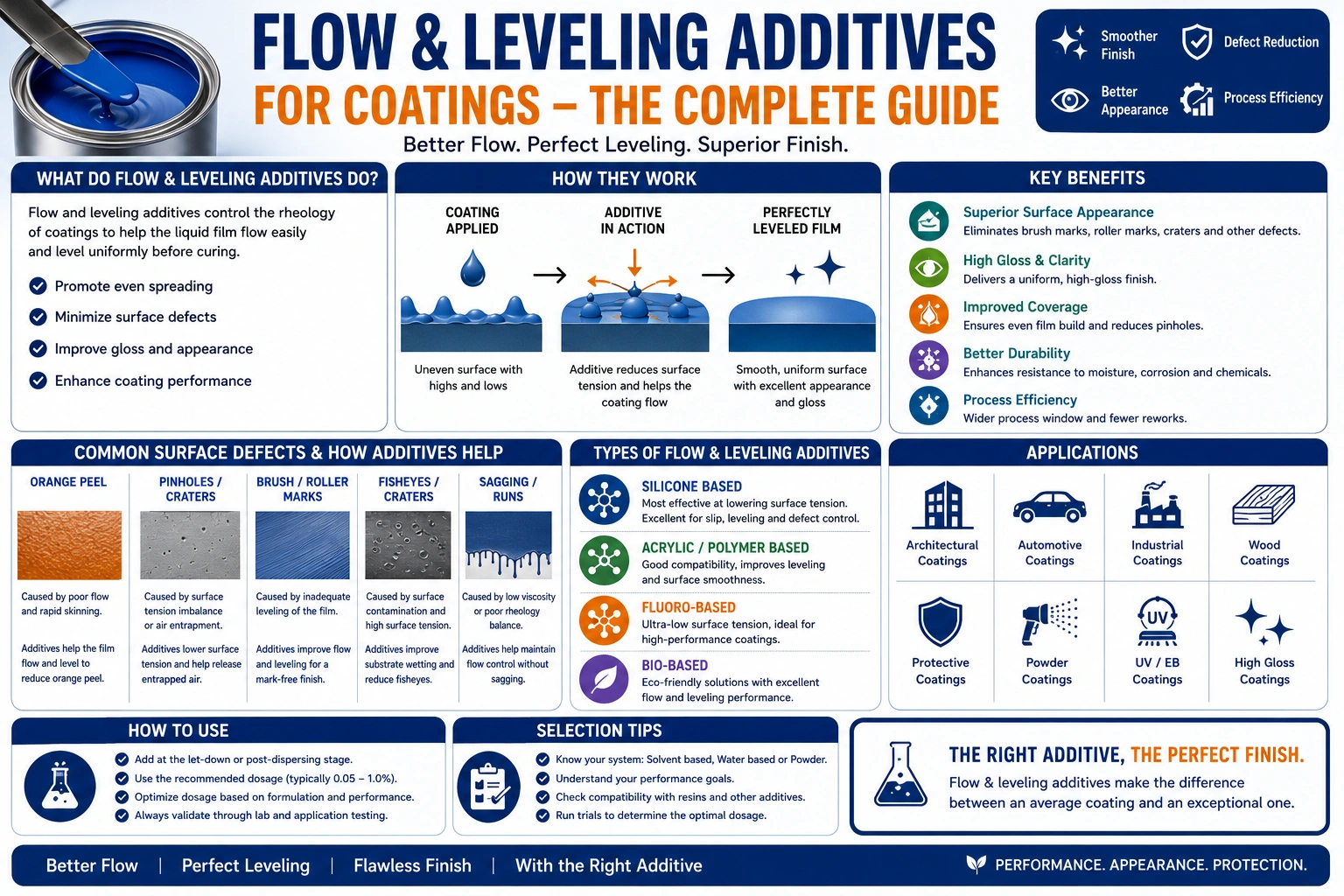
Flow and Leveling Additives for Coatings: What They Are and Why They Matter
Flow and leveling additives for coatings help improve wet film movement, surface smoothness, appearance, gloss, and defect control. They are especially important in industrial coatings, paints, and inks where surface finish and application consistency directly affect product quality.
Quick Summary
Flow and leveling additives for coatings are used to improve how a coating spreads, levels, and forms a smooth film after application. They can help reduce defects such as orange peel, poor leveling, craters, brush marks, roller marks, and uneven surface appearance when selected correctly.
They improve film formation
These additives support better wet film movement and help the coating form a smoother surface.
They reduce defects
They may help manage orange peel, poor leveling, craters, uneven gloss, and application marks.
They need compatibility checks
Wrong selection or overdosing can affect recoatability, adhesion, gloss, or surface appearance.
Choosing the right flow and leveling additives for coatings is important when a formulation needs better surface finish, smoother film formation, improved appearance, and fewer application-related surface defects. In industrial coatings, paints, and inks, surface appearance is not only an aesthetic requirement. It can also influence customer acceptance, application quality, and coating performance perception.
Flow and leveling additives are often used when coatings show problems such as orange peel, poor leveling, brush marks, roller marks, craters, fish eyes, uneven gloss, or poor surface uniformity. However, these additives must be selected carefully because they interact with resin chemistry, pigments, solvents, antifoams, dispersants, and the application process.
What Are Flow and Leveling Additives in Coatings?
Flow and leveling additives are specialty coating additives used to improve how the liquid coating spreads and smooths out after application. They help reduce surface tension differences, support better wet film movement, and allow the coating to form a more uniform surface before drying or curing.
In simple terms, a flow additive helps the coating move and spread, while a leveling additive helps the wet film become more even and smooth before the film sets.
These additives are commonly used in:
- Industrial coatings
- Decorative paints
- Protective coatings
- Wood coatings
- Metal coatings
- Plastic coatings
- Floor coatings
- Automotive and general industrial finishes
- Coatings and inks where surface appearance is important
Why Surface Flow and Leveling Matter in Industrial Coatings
During application, the coating must spread over the substrate and form a continuous film. If the wet film does not flow and level properly, surface defects can appear after drying. These defects may include orange peel, streaks, roller marks, brush marks, poor gloss, surface waviness, or uneven film appearance.
Good flow and leveling can support:
- Smoother coating film appearance
- Better gloss development in suitable systems
- Reduced orange peel tendency
- Improved surface uniformity
- Better application marks reduction
- More consistent wet film behavior
- Improved customer perception of finish quality
For companies working with a coating additives manufacturer or paint additives supplier, flow and leveling additives should be evaluated together with dispersants, antifoams, adhesion promoters, and rheology modifiers to avoid formulation conflicts.
Difference Between Flow and Leveling in Coating Formulations
The terms flow and leveling are often used together, but they are not exactly the same. Understanding the difference helps formulators select the right additive for the actual problem.
| Parameter | Flow | Leveling |
|---|---|---|
| Main meaning | How easily the coating moves and spreads during and after application. | How well the wet film smooths out and removes unevenness before drying. |
| Common issue | Poor spreading, surface tension imbalance, edge crawling, poor wetting. | Orange peel, brush marks, roller marks, waviness, uneven surface. |
| Influenced by | Surface tension, viscosity, solvent balance, substrate wetting, additive package. | Open time, viscosity, drying speed, rheology, film thickness, application method. |
| Visible impact | Coating coverage and wet film movement. | Final surface smoothness and appearance. |
In many cases, coating defects are caused by a combination of poor flow, poor leveling, foam, contamination, surface tension differences, or incorrect rheology. That is why troubleshooting should begin with the root cause, not only with additive addition.
Common Surface Defects These Additives Help Manage
Flow and leveling additives can help manage several coating surface defects when the root cause is related to surface tension, wet film movement, leveling time, or application behavior.
Orange peel
Orange peel is a textured surface that looks uneven or wavy, similar to the skin of an orange. It can happen because of poor leveling, high viscosity, fast solvent evaporation, application conditions, film thickness, or surface tension imbalance. For deeper reading, visit RSA’s blog on what causes orange peel in industrial coatings.
Craters and fish eyes
Craters and fish eyes are often linked to contamination, surface tension differences, or additive incompatibility. Flow additives can help in some cases, but the root cause must be checked carefully because incompatible antifoams or contaminants can also create craters.
Poor leveling
Poor leveling appears as uneven film appearance, waves, streaks, or visible application marks. It may be caused by high viscosity, insufficient open time, fast drying, incorrect rheology, or weak surface flow.
Brush marks and roller marks
These defects occur when the coating does not smooth out after application. They are common in decorative coatings, wood coatings, industrial coatings, and high-viscosity systems.
Uneven gloss
Gloss variation can occur when the film does not form uniformly. Pigment dispersion, foam, surface tension, leveling, and drying behavior may all contribute to uneven gloss.
Facing orange peel, poor leveling, craters, or surface defects?
Share your coating system, application process, and surface defect issue with Raj Speciality Additives to evaluate suitable additive support.
How Flow and Leveling Additives Improve Coating Appearance
A coating looks smooth when the wet film has enough time and mobility to level before it dries or cures. Flow and leveling additives support this by reducing surface tension differences and improving surface uniformity.
They may help improve:
- Film smoothness
- Surface uniformity
- Gloss appearance in suitable systems
- Reduction of application marks
- Reduction of surface waviness
- Better wet film movement
- More consistent final coating appearance
However, they cannot solve every surface defect. If the issue is caused by foam, pigment flocculation, poor dispersion, contamination, wrong solvent balance, or substrate wetting failure, other additive categories may also need to be evaluated.
For foam-related surface issues, read RSA’s page on antifoam for coatings. For pigment-related surface and color issues, explore RSA’s page on dispersing additive for coatings.
Factors That Affect Flow and Leveling Performance
Flow and leveling performance is influenced by the complete formulation and application conditions. The same additive may behave differently in different coating systems.
| Factor | Why It Matters | What to Evaluate |
|---|---|---|
| Resin chemistry | Different binders have different surface tension, drying, and film formation behavior. | Acrylic, epoxy, polyurethane, alkyd, polyester, UV, or hybrid systems. |
| Viscosity and rheology | High viscosity can restrict leveling, while low viscosity may create sagging. | Application viscosity, shear behavior, sag resistance, and leveling window. |
| Solvent or water balance | Evaporation rate affects open time and leveling before film formation. | Drying speed, open time, co-solvent package, and application temperature. |
| Pigment and filler loading | High loading can affect flow, gloss, viscosity, and surface appearance. | Dispersion quality, pigment volume concentration, and filler impact. |
| Antifoam compatibility | Incompatible antifoam can create craters or surface defects. | Foam control, surface smoothness, craters, gloss, and leveling. |
| Application method | Spray, brush, roller, dip, and curtain coating create different surface flow needs. | Actual application method and wet film thickness. |
How to Select Flow and Leveling Additives for Coatings
Selection should begin by identifying the exact surface defect and the coating system. If the issue is poor leveling, the solution may be different from the solution for craters, orange peel, foam, or pigment floating.
Key questions to ask before selecting flow and leveling additives:
- Is the system water-based or solvent-based?
- What is the resin or binder chemistry?
- What defect is being observed?
- Is the defect visible in the wet film or after drying?
- Is the problem related to foam, surface tension, viscosity, or contamination?
- What is the application method?
- What is the wet film thickness?
- Is gloss, recoatability, adhesion, or slip resistance important?
- Does the additive interact with antifoam or dispersing additives?
- Does performance remain stable after storage?
In pigmented coating systems, dispersion quality also affects appearance. If pigments are not properly dispersed, surface finish, gloss, color strength, and stability may suffer. In such cases, evaluate flow and leveling additives together with wetting and dispersing agents for coatings.
Testing and Evaluation Before Finalizing the Additive
Flow and leveling additives should be tested under actual formulation and application conditions. Lab drawdowns are helpful, but the final evaluation should include real application method, substrate, drying conditions, and target performance.
Important testing checks include:
- Surface smoothness after application
- Orange peel reduction
- Brush mark or roller mark reduction
- Craters, fish eyes, and pinholes
- Gloss and haze
- Leveling under actual film thickness
- Foam and air release behavior
- Compatibility with antifoam and dispersants
- Adhesion and recoatability
- Storage stability
- Application performance across temperature and humidity conditions
How RSA Supports Coating Surface Performance
Raj Speciality Additives supports coating, ink, and paint manufacturers with specialty additives for surface performance, dispersion, foam control, adhesion, rheology, and formulation stability.
As a coating additives manufacturer and paint additives supplier, RSA helps customers evaluate additive selection based on coating chemistry, surface defect type, application process, and final performance requirement.
- Flow and leveling additives
- Surface performance additives
- Antifoam additives
- Wetting agents
- Dispersing additives
- Adhesion promoters
- Rheology additives
- Coatings and inks
For related troubleshooting topics, read RSA’s blogs on orange peel in industrial coatings, preventing flooding and floating, and how to choose antifoam for coatings.
Need support with coating surface defects?
Connect with Raj Speciality Additives to discuss flow, leveling, antifoam, dispersing, adhesion, and surface performance additive support for coatings and inks.
FAQs on Flow and Leveling Additives for Coatings
What are flow and leveling additives for coatings?
Flow and leveling additives for coatings are specialty additives that help the wet coating spread, move, and form a smoother film. They are used to improve surface appearance and reduce defects such as orange peel, poor leveling, brush marks, and roller marks.
What is the difference between flow and leveling?
Flow refers to how the coating spreads and moves after application. Leveling refers to how well the wet film smooths out before drying or curing. Both are connected but not identical.
Can flow and leveling additives reduce orange peel?
They may help reduce orange peel when the cause is related to poor leveling, surface tension imbalance, viscosity, or wet film movement. However, orange peel may also be caused by application conditions, solvent balance, film thickness, or drying speed.
Can these additives cause coating defects?
Yes, if selected incorrectly or overdosed, flow and leveling additives may affect recoatability, adhesion, gloss, surface slip, craters, or compatibility. Testing is important before approval.
Are flow and leveling additives used in both water-based and solvent-based coatings?
Yes. They can be used in both water-based and solvent-based coatings, but the additive type and dosage must be selected based on formulation chemistry, application method, and surface finish requirement.
Does RSA support flow and leveling additive selection?
Yes. Raj Speciality Additives supports coating, ink, and paint manufacturers with specialty additives for surface performance, flow and leveling, foam control, dispersion, adhesion, rheology, and formulation stability.
References & Citations
- PCI Magazine – Additives for Coatings and Inks
- SpecialChem – Leveling Agents for Coatings
- SpecialChem – Surface Modifiers for Coatings
- Coatings World – Additives for Coatings
- ISO 4618 – Paints and varnishes: Terms and definitions
These references are included for technical context around coating additives, surface modifiers, flow and leveling, and paint terminology. Additive selection should always be validated based on actual formulation, substrate, application method, and performance requirement.