
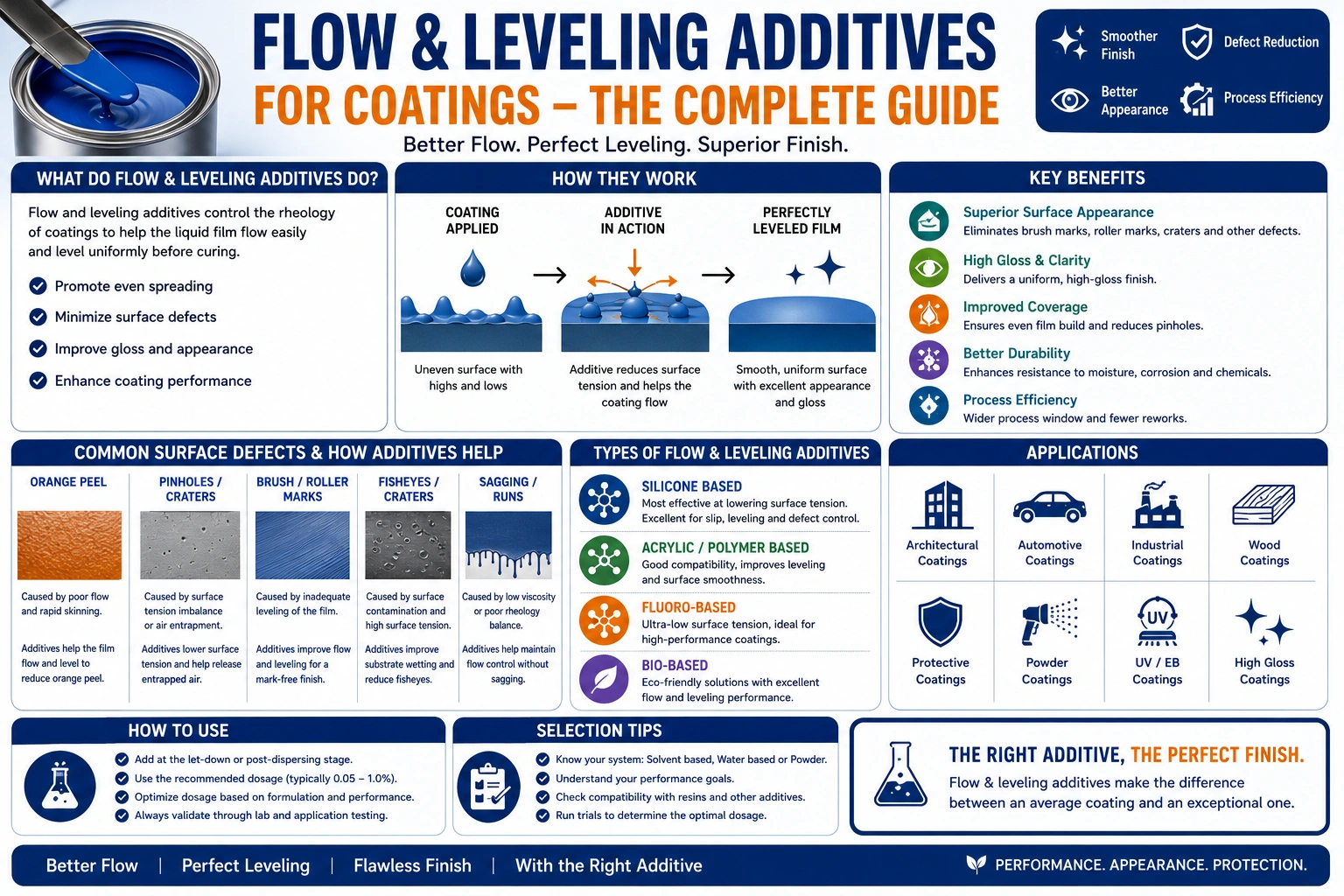
Flow Additive vs Leveling Additive: Key Difference in Paints and Coatings
Flow additives and leveling additives both improve coating appearance, but they solve slightly different surface problems. Understanding the difference helps coating manufacturers reduce orange peel, brush marks, roller marks, craters, poor smoothness and uneven film formation.
Why surface control matters in coating formulations
Surface appearance is one of the first quality indicators in paints and coatings. Even if the coating has good adhesion, color and durability, visible defects such as poor leveling, orange peel, brush marks, roller marks, craters or uneven gloss can reduce product acceptance.
The right surface additive depends on resin chemistry, solvent or water balance, application method, film thickness, drying speed, surface tension and the type of defect being observed in the coating film.
Surface defects may include:
- Orange peel and poor smoothness
- Brush marks and roller marks
- Craters and fish eyes
- Uneven gloss or poor appearance
- Poor substrate wetting
- Flow lines and poor film uniformity
Flow additive vs leveling additive in coatings
The difference is mainly based on how the additive improves coating movement and final film appearance.
| Point of Difference | Flow Additive | Leveling Additive |
|---|---|---|
| Main role | Improves the movement, spreading and wetting behaviour of the coating during application. | Helps the wet coating film become more uniform before drying or curing. |
| Primary focus | Better flow, spreading, substrate wetting and film movement. | Better surface smoothness, defect reduction and uniform appearance. |
| Common problems addressed | Poor spreading, poor wetting, flow lines and uneven application. | Orange peel, brush marks, roller marks and uneven surface finish. |
| Application stage impact | Important during application and film formation. | Important after application while the wet film levels before drying. |
| Practical use | Useful when coating does not spread or wet the surface properly. | Useful when applied coating does not settle into a smooth, uniform film. |
Coating defects linked to poor flow and leveling
Flow and leveling issues are often linked to surface tension, viscosity, drying speed, application method and additive compatibility.
Orange Peel
Orange peel appears as a textured surface that looks uneven instead of smooth and uniform.
Brush Marks
Brush marks remain visible when the coating does not flow and level properly after application.
Roller Marks
Roller marks can occur when the wet film cannot relax into an even coating layer.
Craters & Fish Eyes
Surface tension imbalance or contamination can create circular defects in the applied coating film.
Uneven Gloss
Poor leveling can create patchy appearance, uneven gloss and inconsistent visual quality.
Poor Film Uniformity
Flow lines and uneven film build can reduce final coating quality and appearance.
When flow additive may be suitable
Flow additives may be useful when the coating does not spread evenly, does not wet the substrate properly or shows application-related flow defects.
- Poor spreading during application
- Poor wetting on the substrate
- Flow lines or uneven application
- Difficulty achieving uniform film movement
When leveling additive may be suitable
Leveling additives may be useful when the applied wet film does not settle into a smooth and uniform surface before drying or curing.
- Orange peel after application
- Brush marks or roller marks
- Uneven surface smoothness
- Patchy appearance or uneven gloss
How to choose flow and leveling additives
The right additive depends on the coating chemistry, application process, defect type and final surface requirement.
- Identify whether the main issue is poor spreading, poor wetting, orange peel, brush marks or craters.
- Check compatibility with water-based or solvent-based coating systems.
- Evaluate impact on gloss, surface smoothness, adhesion and recoating performance.
- Check interaction with antifoam, wetting agents, rheology additives and pigment dispersants.
- Optimize dosage because overdosing may cause craters, slip issues or surface defects.
- Test under actual application method such as spray, roller, brush, dip or curtain coating.
Practical formulation note
Many coating defects look similar but have different root causes. Orange peel, craters and poor leveling may be linked to viscosity, surface tension, foam, contamination, drying speed or additive incompatibility. Correct diagnosis should come before additive selection.
Flow and leveling needs by coating system
Different coating systems need different surface control support depending on application and appearance requirements.
| Coating System | Common Surface Issue | Helpful RSA Resource |
|---|---|---|
| Water-Based Coatings | Foam, poor wetting, roller marks, brush marks and leveling defects. | Additives for Water-Based Coatings |
| Solvent-Based Coatings | Orange peel, craters, poor smoothness and uneven gloss. | Additives for Solvent-Based Coatings |
| Industrial Coatings | Poor surface finish, spray defects, film unevenness and poor appearance. | Coating Additives Manufacturer |
| Decorative Paints | Brush marks, roller marks, poor flow and uneven surface appearance. | Paint Additives Supplier |
| Protective Coatings | Uneven film build, sagging, poor leveling and surface inconsistency. | Rheology Additives |
Mistakes to avoid while solving flow and leveling defects
Surface defects are not always solved by adding more surface additive. Correct root-cause analysis is important.
Overdosing Surface Additives
Too much surface additive may create craters, slip issues, poor adhesion or recoating problems.
Ignoring Foam Problems
Some surface defects are caused by foam or microfoam, so antifoam selection may also be required.
Ignoring Rheology Balance
Viscosity, sag resistance and drying speed can affect leveling even when a surface additive is present.
FAQs on flow additive vs leveling additive
Common questions from paint and coating manufacturers evaluating flow and leveling additive solutions.
What is the difference between flow additive and leveling additive?
A flow additive improves the movement, spreading and wetting behaviour of the coating during application, while a leveling additive helps the wet film become smooth and uniform before drying or curing.
Are flow and leveling additives the same?
They are closely related but not always the same. Many coating additives provide both flow and leveling benefits, but the exact function depends on chemistry, dosage and formulation compatibility.
Which additive helps reduce orange peel?
Leveling additives and suitable flow modifiers can help reduce orange peel, but the root cause may also involve viscosity, drying speed, spray condition, foam, surface tension or formulation balance.
Which additive helps reduce brush marks and roller marks?
Flow and leveling additives can help reduce brush marks and roller marks by improving wet film movement and allowing the coating to settle into a smoother surface.
Can too much flow additive cause coating defects?
Yes. Excessive surface additive can sometimes cause craters, poor adhesion, slip issues, recoating problems or surface irregularities. Correct dosage and compatibility testing are important.
Are flow and leveling additives used in water-based coatings?
Yes. Flow and leveling additives can be used in water-based coatings, but the additive must be compatible with the specific resin system, pigment package, pH and application method.
Can RSA help select flow and leveling additives?
Yes. Raj Speciality Additives can help coating manufacturers evaluate suitable flow and leveling additive categories based on coating type, surface defect, application method and performance requirement.
Need help improving coating flow and leveling?
Share your coating system, application method or surface defect challenge with Raj Speciality Additives. Our team can help identify suitable flow and leveling additive options.
Send Your Enquiry
Please fill out the form and our team will get back to you.