
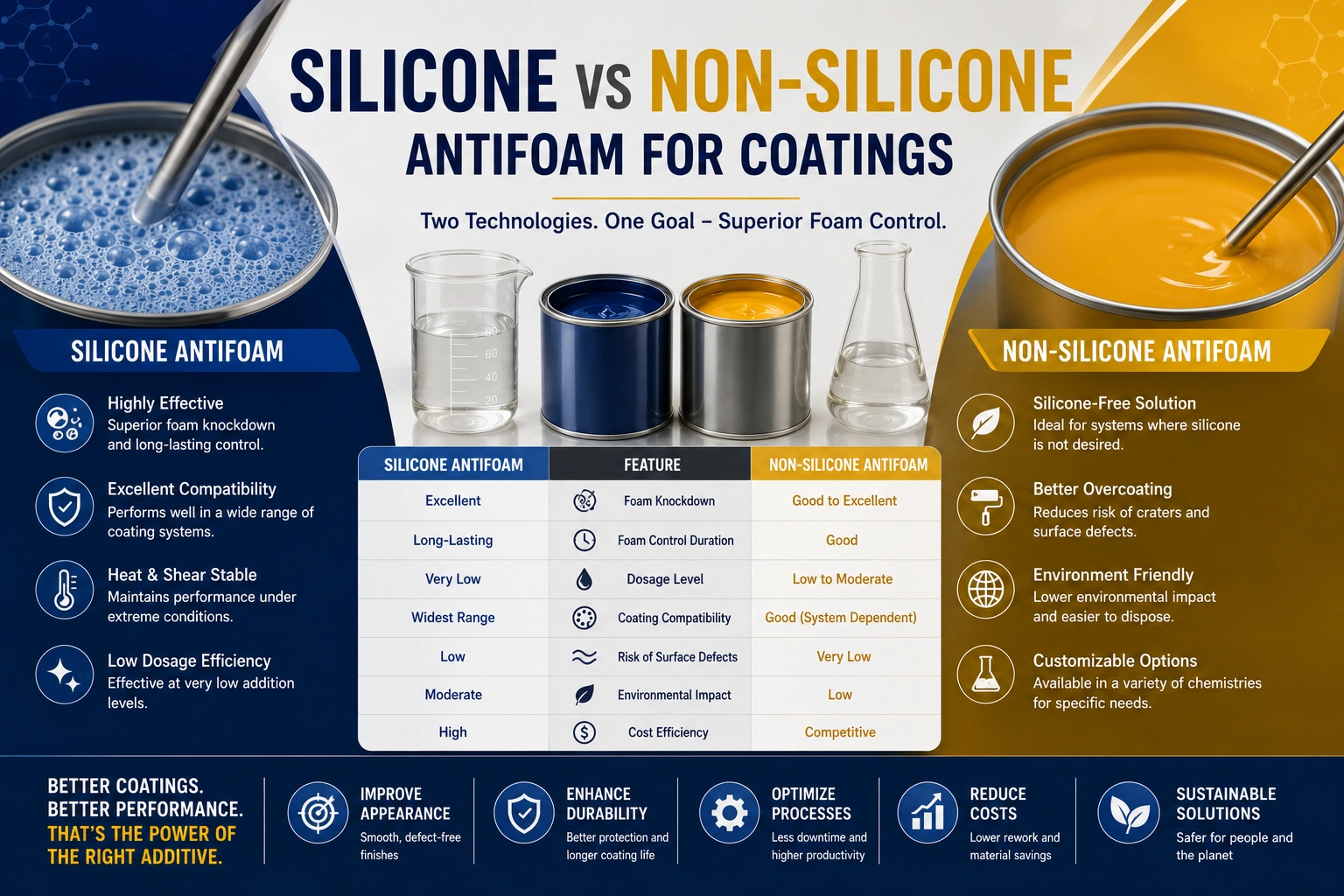
Silicone vs Non-Silicone Antifoam for Industrial Coatings
Choosing between silicone and non-silicone antifoam is an important decision in industrial coating formulation. The right foam control additive can reduce foam, microfoam, craters and pinholes without affecting gloss, leveling, recoating or surface appearance.
Why antifoam selection matters in industrial coatings
Industrial coatings are exposed to demanding production and application conditions such as high-speed mixing, pigment grinding, spray application, roller coating, high-build film formation and long storage periods. Foam control becomes important because trapped air can affect both production efficiency and final coating quality.
There is no universal “best” antifoam for every industrial coating. A product that works well in one resin system may create surface defects in another. That is why silicone and non-silicone antifoams should be evaluated based on actual formulation conditions.
Antifoam selection affects:
- Foam knockdown during production
- Microfoam and air release
- Craters, pinholes and surface defects
- Gloss, leveling and final appearance
- Spray, roller or brush application quality
- Compatibility with resin, pigment and additive package
Silicone vs non-silicone antifoam: key differences
Both types are useful, but their performance depends on the formulation and application requirement.
| Factor | Silicone Antifoam | Non-Silicone Antifoam |
|---|---|---|
| Foam knockdown | Often strong and fast due to high surface activity. | Can be effective, but performance depends strongly on formulation compatibility. |
| Surface activity | High surface activity can help foam control but may need careful dosage. | Generally selected when lower silicone-related surface risk is desired. |
| Risk of craters | Possible if overdosed or incompatible with the coating system. | May reduce certain silicone-related defect risks, but still needs testing. |
| Gloss and appearance | Can affect gloss or surface appearance if not optimized. | Often evaluated where gloss, clarity or recoating sensitivity is important. |
| Recoating / intercoat concerns | Needs careful evaluation where recoating or multi-layer systems are involved. | Often considered where silicone contamination concerns exist. |
| Best-fit use case | Systems needing strong foam knockdown and fast foam control. | Systems where compatibility, surface finish, recoating or silicone sensitivity are key concerns. |
When silicone antifoam may be suitable
Silicone antifoam may be considered when the coating system needs strong foam knockdown, fast air release or foam control during high-speed manufacturing.
- High foam tendency during grinding or mixing
- Foam during filling, pumping or packaging
- Air entrapment during application
- Industrial systems where strong foam reduction is required
When non-silicone antifoam may be suitable
Non-silicone antifoam may be preferred when formulators want foam control while reducing concerns around silicone-related surface effects.
- Systems sensitive to craters or surface defects
- High-gloss or appearance-sensitive coatings
- Recoatable or multi-layer coating systems
- Formulations where silicone contamination is a concern
Industrial coating problems linked to foam and air entrapment
Foam control is not only a production issue. It directly affects coating finish, film quality and customer acceptance.
Pinholes
Trapped air can create small holes in the coating film after application or drying.
Craters
Surface tension imbalance or incompatible additives may create crater-like defects in the coating film.
Microfoam
Fine trapped bubbles can reduce film clarity, smoothness, gloss and coating appearance.
Poor Leveling
Foam and air entrapment can disturb film formation and reduce surface smoothness.
Gloss Reduction
Surface defects and microfoam can reduce final gloss and make the coating look uneven.
Production Delays
Excess foam can slow down mixing, filling, packaging and quality control processes.
How to choose the right antifoam type
Antifoam selection should be based on foam source, resin compatibility, pigment loading, application method and final film requirement.
- Check whether foam is generated during grinding, let-down, filling or application.
- Evaluate compatibility with water-based or solvent-based coating systems.
- Test impact on gloss, leveling, craters, pinholes and film appearance.
- Use recommended dosage ranges and avoid overdosing.
- Evaluate performance under real application conditions such as spray, roller or brush.
- Check recoating or intercoat adhesion requirements before final approval.
Practical recommendation
Do not select silicone or non-silicone antifoam only by category name. Test the additive in the actual coating system, because the same antifoam can behave differently depending on resin, pigment, solvent, water content, pH, viscosity and application method.
Antifoam selection by coating application
Industrial coating applications have different foam control and surface finish expectations.
| Application | Common Foam Concern | Selection Focus |
|---|---|---|
| Water-Based Industrial Coatings | Foam during grinding, let-down, mixing and application. | Compatibility with water-based coating systems |
| Solvent-Based Industrial Coatings | Air entrapment, craters, pinholes and surface defects. | Surface appearance and solvent compatibility |
| High-Gloss Coatings | Gloss reduction, craters or flow defects from incompatible additives. | Careful dosage and surface appearance testing |
| Protective Coatings | Air entrapment affecting film build and surface quality. | Foam knockdown with film integrity |
| Pigment Concentrates | Foam during high-speed grinding and high pigment loading. | Foam control during pigment processing |
Mistakes to avoid while selecting antifoam
A foam control additive should solve foam without creating new surface or compatibility problems.
Choosing Only by Label
Silicone or non-silicone category alone is not enough. Actual system compatibility matters more.
Overdosing
Too much antifoam can sometimes create craters, gloss loss, poor leveling or surface defects.
Skipping Application Testing
Foam control should be tested during production and final application, not only in a lab mixing stage.
FAQs on silicone and non-silicone antifoam
Common questions from industrial coating manufacturers and formulators evaluating foam control additives.
What is the difference between silicone and non-silicone antifoam?
Silicone antifoams usually provide strong foam knockdown due to high surface activity, while non-silicone antifoams are often selected where silicone-related surface defects, recoating issues or compatibility concerns need to be reduced.
Which antifoam is better for industrial coatings?
There is no single best antifoam for all industrial coatings. The better choice depends on coating chemistry, foam source, application method, gloss requirement, surface sensitivity and compatibility testing.
Can silicone antifoam cause craters?
Silicone antifoam can cause craters or surface defects if it is incompatible with the coating system or used at excessive dosage. Proper selection and testing are important.
When should non-silicone antifoam be used?
Non-silicone antifoam may be considered when the coating system is sensitive to silicone-related surface defects, recoating issues, gloss reduction or compatibility concerns.
Can antifoam be used in water-based and solvent-based coatings?
Yes. Antifoam additives can be used in both water-based and solvent-based coatings, but the additive must be compatible with the specific formulation system.
How much antifoam should be added?
The dosage depends on the formulation, foam level, additive type and application method. Formulators should follow supplier guidance and perform trials to confirm dosage and compatibility.
Can RSA help select silicone or non-silicone antifoam?
Yes. Raj Speciality Additives can help coating manufacturers evaluate suitable foam control additive options based on coating type, formulation challenge, application method and performance requirement.
Need help selecting antifoam for industrial coatings?
Share your coating system, foam issue, application method or surface defect challenge with Raj Speciality Additives. Our team can help identify suitable foam control additive options.
Send Your Enquiry
Please fill out the form and our team will get back to you.