
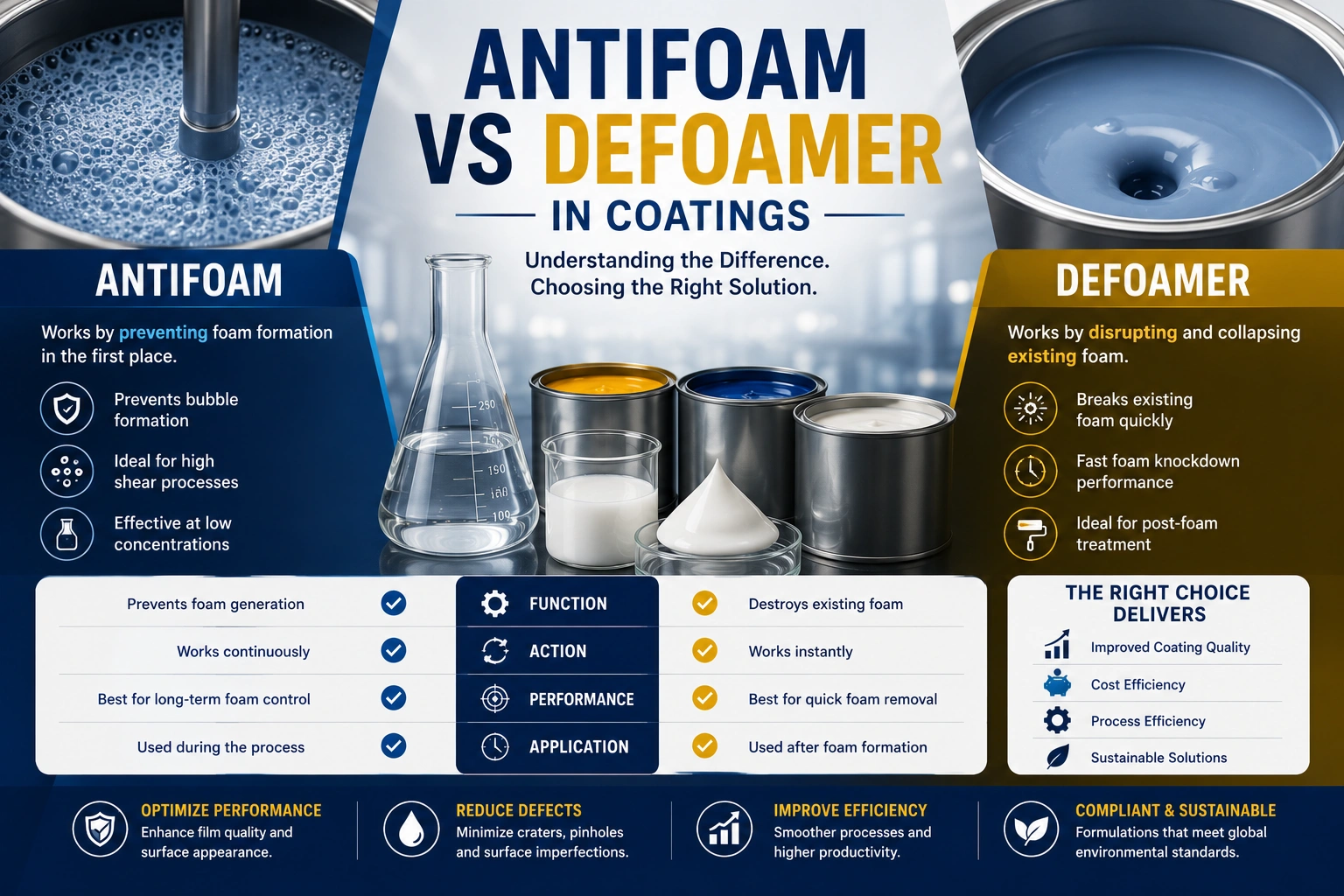
Antifoam vs Defoamer: What Is the Difference in Coatings?
Foam is one of the most common formulation and application problems in paints and coatings. Understanding the difference between antifoam and defoamer additives helps coating manufacturers choose the right foam control solution for better surface finish, processing stability and coating quality.
Why foam control matters in coating formulations
Foam can enter a coating system during pigment grinding, high-speed mixing, let-down, filling, transport or application. If foam is not controlled properly, it can lead to defects such as craters, pinholes, poor leveling, weak gloss, uneven film formation and reduced coating performance.
In practical coating formulation, the selection is not based only on the name “antifoam” or “defoamer.” It depends on the coating system, resin chemistry, water-based or solvent-based medium, pigment loading, application method, foam tendency and final surface appearance requirement.
Foam can cause coating defects like:
- Craters and pinholes
- Microfoam and air entrapment
- Poor surface smoothness
- Low gloss and uneven appearance
- Application issues during spraying, rolling or brushing
- Reduced production efficiency during mixing and filling
Antifoam vs Defoamer in coatings
The difference is mainly based on when the additive works in the foam control process.
| Point of Difference | Antifoam | Defoamer |
|---|---|---|
| Main role | Helps prevent foam formation before foam becomes a major problem. | Helps break foam that has already formed in the system. |
| Used during | Usually added during formulation, grinding or manufacturing stages to control foam early. | Often used to knock down existing foam during processing or application. |
| Primary benefit | Reduces foam build-up and helps maintain processing stability. | Reduces visible foam, trapped air and foam-related defects. |
| Coating problems addressed | Foam tendency during mixing, grinding, let-down and filling. | Microfoam, air entrapment, craters, pinholes and surface defects. |
| Practical use | Used when a formulation is known to generate foam during processing. | Used when foam has already appeared or surface defects are visible. |
Where foam comes from in paints and coatings
Foam can come from raw materials, formulation design, processing conditions or application methods.
High-Speed Mixing
High shear mixing and grinding can introduce air into the system, especially in water-based coatings and pigment dispersions.
Pigment Dispersion
Pigments, fillers and wetting agents can influence foam stability during the grinding and let-down stage.
Surfactants & Additives
Some surfactants, wetting agents and formulation ingredients may increase foam tendency if not balanced correctly.
Filling & Packaging
Foam may develop during transfer, pumping, filling and packaging, especially when air gets trapped in the coating system.
Application Method
Rolling, brushing, spraying and curtain coating can introduce foam depending on viscosity, surface tension and additive balance.
Viscosity & Temperature
High viscosity, temperature changes and poor leveling can trap air and make foam defects more visible in the final film.
How to choose between antifoam and defoamer
The right foam control additive should reduce foam without causing surface defects, compatibility issues, gloss reduction or coating instability.
- Use preventive foam control when foam forms during grinding, mixing or production.
- Use stronger foam knockdown when visible foam or microfoam is already present.
- Check compatibility with water-based or solvent-based systems.
- Evaluate effect on gloss, leveling, craters and surface appearance.
- Optimize dosage because overuse can sometimes create surface defects.
- Test the additive in the actual formulation and application method.
Practical formulation note
In many coating systems, the best approach is not choosing only an antifoam or only a defoamer. The better approach is selecting a compatible foam control additive that works during both manufacturing and application without affecting coating appearance.
Foam control needs by coating system
Foam behaviour changes depending on the formulation type and application process.
| Coating System | Common Foam Issue | Recommended Focus |
|---|---|---|
| Water-Based Coatings | High foam tendency during mixing, grinding and application. | Antifoam for water-based coating systems |
| Solvent-Based Coatings | Air entrapment, craters, pinholes and surface defects. | Foam control for solvent-based coatings |
| Industrial Coatings | Foam during processing, filling, spraying and high-build application. | Antifoam for industrial coatings |
| Pigment Concentrates | Foam during high-speed grinding and high pigment loading. | Foam control in pigment concentrates |
| Decorative Paints | Foam during roller or brush application causing poor surface finish. | Paint additive support |
Mistakes to avoid while using foam control additives
Foam control additives are highly useful, but incorrect selection or dosage can create new formulation issues.
Using Too Much Additive
Overdosing can sometimes cause craters, poor leveling, gloss reduction or compatibility issues.
Ignoring Compatibility
A foam control additive should be compatible with the resin, solvent, pigment and other additives in the system.
Not Testing Application Stage
An additive may work during mixing but still need evaluation during spraying, rolling, brushing or final application.
FAQs on antifoam vs defoamer in coatings
Common questions from coating manufacturers and formulators evaluating foam control additives.
What is the difference between antifoam and defoamer?
An antifoam helps prevent foam formation, while a defoamer helps break foam that has already formed. In coatings, many foam control additives may provide both preventive and foam-breaking action.
Is antifoam used in water-based coatings?
Yes. Water-based coatings often need antifoam additives because they are more prone to foam during mixing, grinding, let-down, filling and application.
Can defoamer reduce craters and pinholes?
A suitable defoamer can help reduce foam-related craters and pinholes, but selection and dosage must be tested carefully because incompatible or excessive foam control additives may also cause surface defects.
When should antifoam be added in coatings?
Antifoam may be added during grinding, mixing or let-down depending on the formulation design and foam generation stage. The best addition point should be evaluated through formulation trials.
How much antifoam should be used in coatings?
The dosage depends on the coating system, resin, pigment loading, application method and additive type. Formulators should follow supplier guidance and test the additive in the actual formulation.
Can too much defoamer cause problems?
Yes. Overuse of defoamer can sometimes cause craters, gloss reduction, poor leveling or compatibility issues. Correct dosage and compatibility testing are important.
Can RSA help select antifoam or defoamer additives?
Yes. Raj Speciality Additives can help coating manufacturers evaluate suitable foam control additive categories based on coating type, formulation challenge, application method and performance requirement.
Need help choosing antifoam or defoamer for coatings?
Share your coating system, foam issue, application method or surface defect challenge with Raj Speciality Additives. Our team can help you identify suitable foam control additive options.
Send Your Enquiry
Please fill out the form and our team will get back to you.