
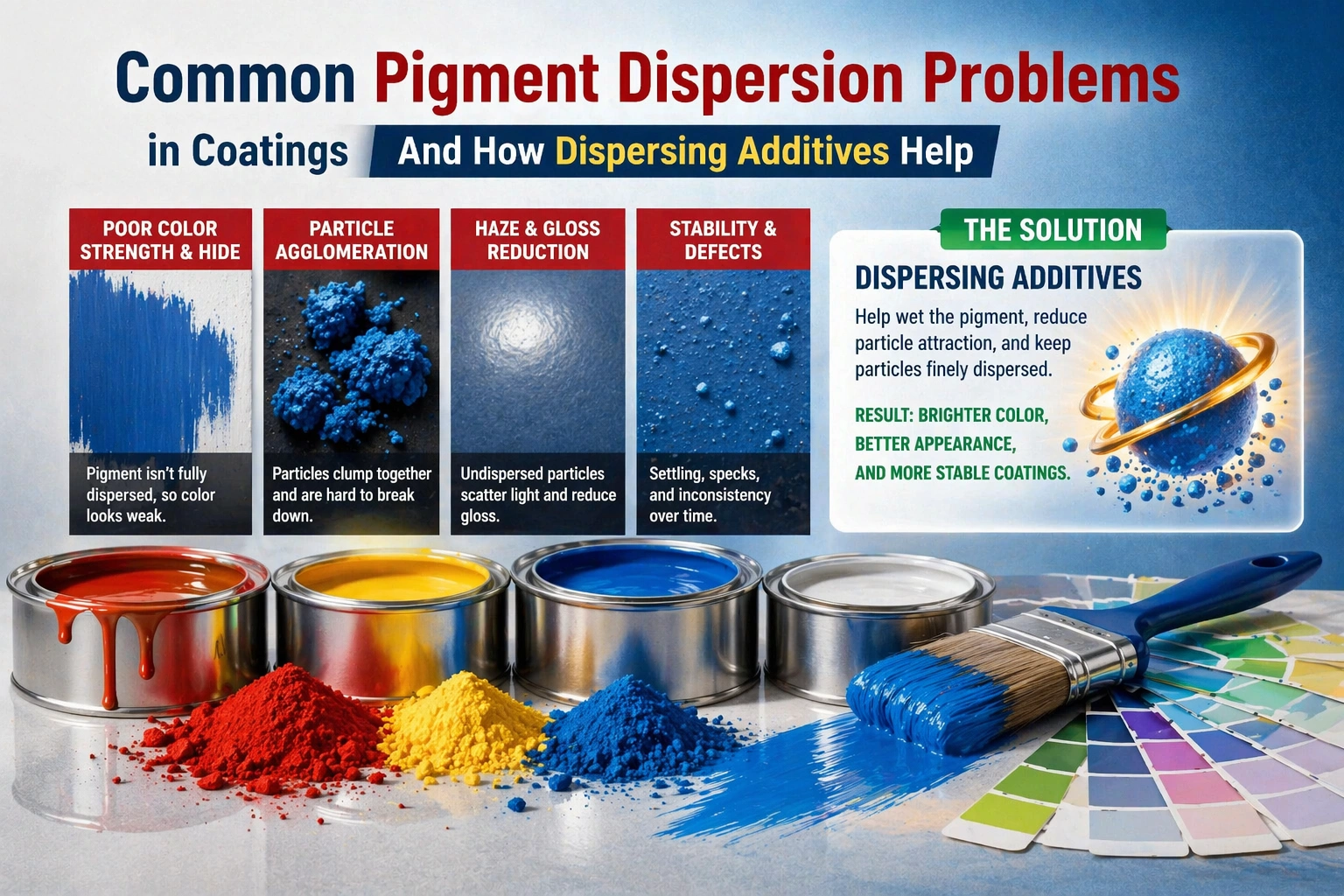
Common Pigment Dispersion Problems in Coatings and How Dispersing Additives Help
Pigment dispersion problems in coatings can lead to colour inconsistency, gloss loss, poor stability, and visible film defects. This blog explains the most common dispersion-related issues and how the right dispersing additive for coatings helps improve stability, process efficiency, and final performance.
In industrial coatings, dispersion quality has a direct effect on the way a coating looks, behaves, stores, and performs. Even when the resin system and pigment package are well selected, poor pigment dispersion can create multiple performance problems that affect both manufacturing efficiency and final film quality.
This is why formulators pay close attention to pigment wetting, deagglomeration, and stabilization. A properly selected dispersing additive for coatings helps reduce many of the common issues seen in pigment-loaded systems and supports more stable, more reproducible formulations.
Main challenge
Pigment particles tend to agglomerate, destabilize, or distribute unevenly if the system is not properly controlled.
Main solution
A dispersing additive helps improve pigment wetting, particle separation, and long-term stabilization inside the coating.
Why do pigment dispersion problems happen in coatings?
Pigments are solid particles with surface characteristics that make them difficult to distribute uniformly in a liquid coating system. Without proper wetting and stabilization, these particles can remain in agglomerated form or re-agglomerate after grinding. This affects optical properties, rheology behaviour, storage stability, and final appearance.
Dispersion problems may become even more pronounced in high pigment formulations, difficult pigment systems, carbon black-based coatings, and formulations where viscosity balance or appearance control is critical.
Common pigment dispersion problems in coatings
1. Flocculation
Flocculation happens when pigment particles come together in loosely associated groups after dispersion. Even if the particles appear dispersed initially, unstable systems can allow them to interact again over time. Flocculation is one of the most common and important dispersion-related problems in coatings.
It can reduce colour strength, lower gloss, affect transparency, create shade inconsistency, and cause floating or flooding. In many cases, the coating may look acceptable immediately after manufacture but drift later during storage or application.
2. Poor colour development
When pigments are not efficiently dispersed, the available surface area is not fully optimized. As a result, the formulation may deliver weaker colour strength, reduced tinting efficiency, and less clean shade development than expected. This is especially important in systems where visual precision and reproducibility matter.
3. Gloss loss and haze
Poor pigment distribution can create micro-level film irregularities that reduce gloss and affect overall appearance. In high-gloss coatings, these issues become more visible. Haze, dullness, and poor optical clarity may point to incomplete or unstable dispersion.
4. Flooding and floating
Flooding and floating are common defects in multicolour pigment systems where the pigment distribution becomes uneven during drying or film formation. These defects are often associated with pigment incompatibility, poor stabilization, and flocculation behaviour. The result may be colour separation, shade inconsistency, or visible patterning.
5. Rub-out difference
Rub-out difference is often used as a practical sign of unstable pigment dispersion. If rubbing the wet film changes the colour appearance noticeably, it can indicate pigment separation or flocculation in the system. This is a useful warning sign for formulators evaluating dispersion quality.
6. Viscosity instability
Dispersion quality can influence viscosity significantly. Poorly stabilized pigment systems may show higher or drifting viscosity because particle interaction remains uncontrolled. This can affect manufacturing consistency, pumping, filling, and application behaviour.
7. Settling and hard sedimentation
Unstable pigment systems may settle during storage, especially if stabilization is poor. Light settling that easily re-disperses may be manageable, but hard sedimentation can create serious quality and usability issues. A stable dispersion system helps reduce this risk.
8. Batch-to-batch inconsistency
When dispersion quality is not robust, coating manufacturers may see unpredictable variation between batches. Colour, viscosity, gloss, and storage behaviour may shift more than expected. This creates operational inefficiency and affects customer confidence in product consistency.
How dispersing additives help solve these problems
A dispersing additive for coatings is designed to improve the behaviour of solid particles within the coating system. It typically supports both wetting and stabilization, which helps reduce the chances of agglomeration and re-agglomeration.
| Problem | How a Dispersing Additive Helps | Expected Benefit |
|---|---|---|
| Flocculation | Improves particle stabilization and reduces re-agglomeration tendency | Better colour consistency and gloss retention |
| Poor colour strength | Supports finer and more effective pigment distribution | Improved colour development and tint strength |
| Gloss loss | Helps reduce surface irregularities linked to unstable dispersion | Cleaner film appearance and higher gloss |
| Flooding / floating | Promotes more uniform pigment stabilization in multicolour systems | Reduced risk of pigment separation defects |
| Viscosity drift | Helps control particle interaction and structure development | More stable process and storage viscosity |
| Settling | Improves pigment stability in storage | Better shelf stability and easier redispersion |
What exactly does the dispersing additive do?
During the dispersion process, the additive first helps the liquid phase wet the pigment surface more effectively. Once the pigment agglomerates are broken down by mechanical energy, the additive helps stabilize the particles so they remain separated. This is important because pigment systems often become unstable not during grinding, but afterward.
Depending on chemistry and formulation type, the stabilization mechanism may be steric, electrostatic, or electrosteric. The practical goal is the same: keep particles from coming back together in ways that reduce formulation performance.
Which systems are most vulnerable to dispersion problems?
Dispersion-related defects can occur in many formulations, but the risk is often higher in systems with complex pigment blends, difficult-to-disperse pigments, high solids loading, or demanding appearance requirements.
- Industrial coatings with high pigment loading
- Carbon black-containing formulations
- Organic pigment systems
- High-gloss coatings
- Pigment concentrates
- Multicolour systems prone to flooding and floating
- Formulations where viscosity balance is critical
What should formulators look at when selecting a dispersing additive?
Selecting the right dispersing additive for coatings requires evaluation under actual formulation conditions. A product that performs well in one resin-pigment system may behave differently in another. The additive should therefore be assessed not just for grind performance, but for total system behaviour.
Useful evaluation points
- Compatibility with solvent-based or water-based coating systems
- Suitability for inorganic, organic, and carbon black pigments
- Effect on colour strength and gloss
- Storage stability and anti-settling behaviour
- Influence on viscosity profile
- Rub-out performance and defect reduction
- Overall reproducibility across batches
Why solving pigment dispersion problems matters commercially
Dispersion problems do not stay limited to the lab. They can affect throughput, quality consistency, customer complaints, rework levels, and total manufacturing cost. Poorly dispersed coatings may require longer milling, show higher rejection rates, or produce variable appearance results that affect end-user satisfaction.
For coating manufacturers, this makes dispersion control a quality, efficiency, and business issue. A properly selected dispersing additive helps support better formulation stability and stronger production reliability.
Conclusion
Common pigment dispersion problems in coatings include flocculation, poor colour development, gloss loss, flooding, floating, viscosity instability, settling, and batch inconsistency. These issues can reduce formulation reliability and final coating quality.
A well-selected dispersing additive for coatings helps reduce these problems by improving pigment wetting and stabilizing particles after deagglomeration. For formulators working on industrial coatings, this makes dispersing additives an essential part of building more stable and better-performing systems.
Frequently Asked Questions
Common problems include flocculation, weak colour development, gloss loss, flooding, floating, viscosity drift, settling, and batch-to-batch inconsistency.
A dispersing additive helps pigments wet out better, disperse more effectively, and remain stabilized after grinding. This can improve colour strength, gloss, stability, and formulation consistency.
Flocculation happens when pigment particles are not stabilized properly and begin to associate again after dispersion. This can lead to colour changes, gloss reduction, and film defects.
Yes. Poor or unstable dispersion can increase uncontrolled particle interaction, which may cause viscosity rise, viscosity drift, and reduced processing consistency.
Dispersing additives are especially important in pigment-loaded industrial coatings, difficult pigment systems, carbon black formulations, multicolour coatings, and systems where appearance and stability are critical.
Need stronger dispersion performance in your coating formulations?
Explore RSA’s coating additive solutions for dispersion, wetting, stability, and formulation support across industrial coating systems.
- European Coatings. Industry resources on additives, pigment dispersion, and coating formulation. https://www.european-coatings.com/
- PCI Magazine. Technical coating articles related to pigment stabilization, gloss, colour development, and defect control. https://www.pcimag.com/
- UL Prospector. Formulation guidance and additive information relevant to coatings and pigment dispersion. https://www.ulprospector.com/
- SpecialChem Coatings. Technical knowledge resources on wetting, dispersing additives, and coating defects. https://www.specialchem.com/coatings
- General formulation and technical literature used across the coatings industry for evaluating pigment wetting, flocculation behaviour, particle stabilization, and storage performance.