
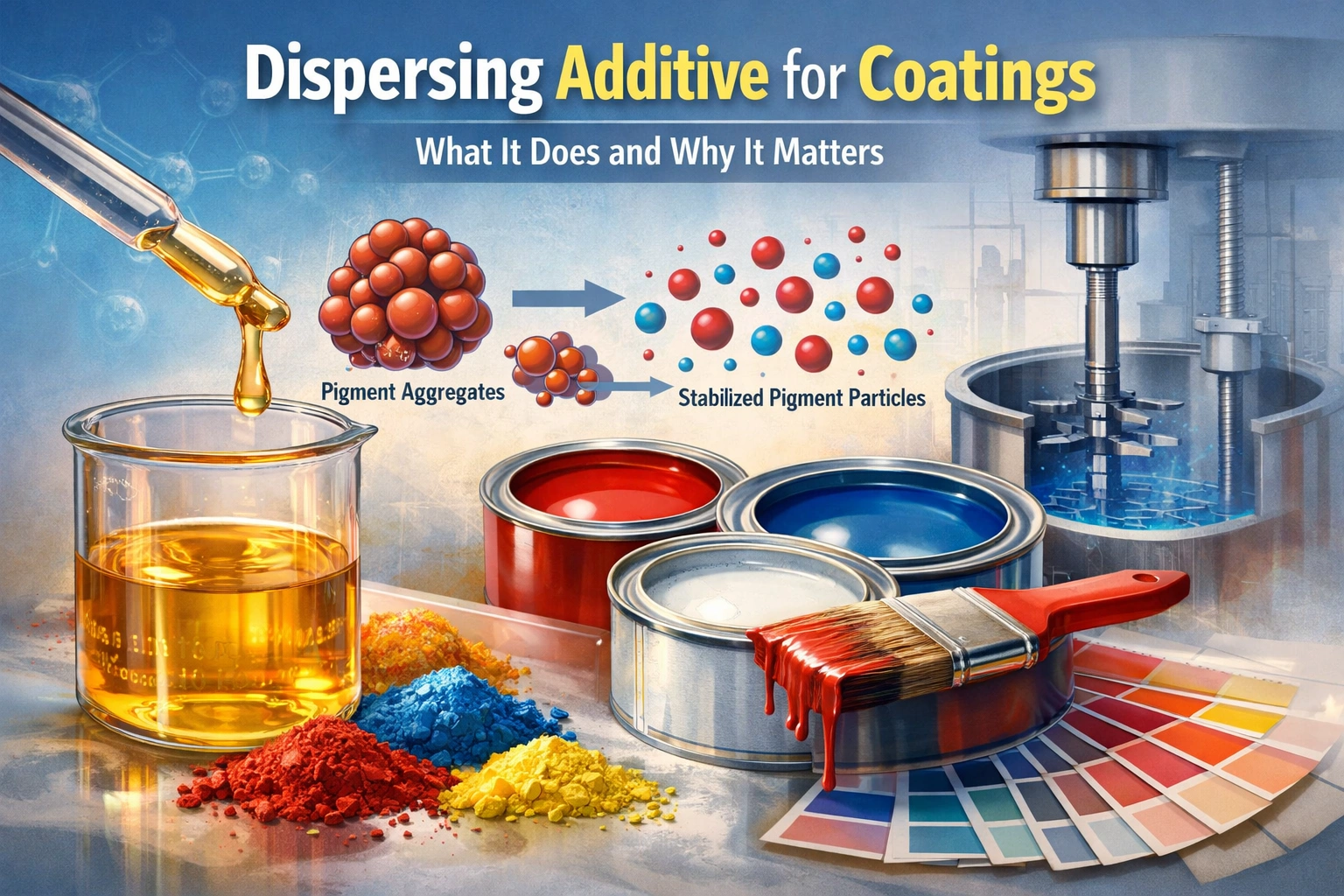
Dispersing Additive for Coatings: What It Does and Why It Matters
A dispersing additive for coatings plays a critical role in helping pigments distribute evenly, remain stable, and deliver the appearance, strength, and consistency expected from modern industrial coating formulations. In this blog, we explain what dispersing additives do, why they matter, and how they support better coating performance across pigment-loaded systems.
In industrial coatings, good dispersion is not just about making pigment easier to mix. It directly affects colour strength, gloss, stability, viscosity, storage performance, film appearance, and overall process consistency. This is why selecting the right dispersing additive for coatings can influence both manufacturing efficiency and end-use performance.
When pigments are not properly dispersed, coating systems can show flocculation, poor colour development, flooding, floating, lower gloss, inconsistent viscosity, and reduced reproducibility from batch to batch. A well-designed dispersing additive helps prevent these issues by improving particle separation and maintaining a stable pigment distribution within the system.
What it does
Helps pigment particles separate, wet out properly, and remain stable inside the coating system.
Why it matters
Supports colour strength, gloss, storage stability, process efficiency, and consistent final film quality.
What is a dispersing additive for coatings?
A dispersing additive for coatings is a formulation aid used to improve the distribution and stabilization of solid particles such as pigments and extenders within a liquid coating medium. It works during and after dispersion. First, it helps the liquid phase wet the pigment surface more effectively. Then, it helps keep those particles separated so they do not re-agglomerate.
In practical terms, this means the additive supports better milling efficiency, finer particle distribution, lower risk of flocculation, and better long-term stability of the pigment system. In many formulations, the dispersing additive is essential for achieving the target optical and mechanical properties of the coating.
Why does dispersion matter so much in coatings?
Coatings often contain pigments, fillers, matting agents, and specialty solids that must be uniformly distributed. These particles naturally tend to form agglomerates because of surface energy, attractive forces, and incomplete wetting. When those agglomerates remain in the system, the coating may not perform as intended.
Common problems linked to poor dispersion
- Reduced colour strength and poor tinting efficiency
- Lower gloss and haze formation
- Flooding and floating defects
- Rub-out differences
- Viscosity drift and poor rheology balance
- Settling or hard sediment formation during storage
- Uneven film appearance and inconsistent production quality
These issues can affect production cost, rework levels, quality consistency, and customer acceptance. For industrial coating manufacturers, dispersion control is therefore a technical and commercial priority.
How does a dispersing additive work?
A dispersing additive usually supports two core functions: wetting and stabilization. Wetting allows the resin or liquid medium to spread more effectively across the pigment surface. Stabilization helps keep the individual pigment particles apart after they are deagglomerated during dispersion.
Step 1: Better wetting of pigment surfaces
Pigment particles have surfaces that are often difficult to wet uniformly, especially in high pigment volume systems or complex formulations. A dispersing additive helps the liquid phase reach and cover those surfaces more effectively, allowing the grinding process to work more efficiently.
Step 2: Stabilization after deagglomeration
Once agglomerates are broken down, the system must keep the individual particles apart. Dispersing additives may achieve this through electrostatic, steric, or electrosteric stabilization mechanisms, depending on chemistry and system design. This reduces the risk of particles coming back together and destabilizing the coating.
What performance areas does a dispersing additive influence?
The right dispersing additive for coatings can influence multiple performance areas at once. That is one reason why it is such an important additive category for formulators working with industrial coatings, pigment concentrates, and high-performance systems.
| Performance Area | How the Dispersing Additive Helps | Potential Result |
|---|---|---|
| Colour development | Promotes finer and more stable pigment distribution | Higher colour strength and cleaner shade development |
| Gloss | Reduces micro-flocculation and surface irregularity | Improved gloss and better film appearance |
| Viscosity control | Improves pigment stabilization and reduces uncontrolled interaction | More stable process viscosity and application consistency |
| Storage stability | Helps prevent settling and hard sedimentation | Better shelf stability and easier redispersion |
| Manufacturing efficiency | Supports faster and more effective grinding | Possible reduction in milling time or improved throughput |
| Defect control | Minimizes flocculation-related film issues | Lower risk of flooding, floating, and rub-out differences |
Where is a dispersing additive used in coatings?
Dispersing additives are used across a wide range of coating types, especially where pigment loading, appearance control, or storage stability are critical. The exact chemistry choice depends on the resin system, pigment type, solvent balance, and required performance profile.
- Industrial coatings
- Protective coatings
- Wood coatings
- General metal coatings
- Pigment concentrates and universal colourants
- Solvent-based coating systems
- Water-based coating systems
- High pigment and difficult pigment formulations
Special attention is often required for challenging pigments such as carbon black, transparent iron oxides, and certain organic pigments, where dispersion efficiency and stabilization quality can strongly influence final performance.
Is a dispersing additive the same as a wetting agent?
Not exactly. The two functions are related, but they are not identical. A wetting agent mainly helps the liquid phase spread over and contact the solid surface. A dispersing additive usually goes further by helping stabilize the particles after deagglomeration.
In some modern additive systems, both functions may be built into one product. In other cases, the formulator may use separate solutions depending on the application and system requirements. This is why understanding the formulation objective is important when selecting additives.
How should formulators evaluate a dispersing additive for coatings?
Selection should always be based on the total formulation system and required end-use performance. A dispersing additive that performs well in one resin-pigment combination may not perform the same way in another.
Key evaluation points
- Compatibility with solvent-based or water-based systems
- Suitability for inorganic, organic, and carbon black pigments
- Impact on viscosity and flow behaviour
- Effect on gloss, colour strength, and haze
- Storage stability and resistance to settling
- Performance under actual process conditions and shear levels
- Interaction with other additives in the formulation
Pilot formulation testing remains essential. The right choice is usually the one that gives balanced performance across dispersion efficiency, stability, film quality, and manufacturing practicality.
Why this matters commercially for coating manufacturers
A dispersing additive affects more than just technical lab data. It can influence batch reproducibility, milling economics, rejection rate, visual consistency, and customer satisfaction. In competitive industrial coating markets, these factors matter. A stable and efficient pigment system helps manufacturers reduce variability and maintain product quality across production cycles.
This is why the topic of dispersing additive for coatings deserves focused attention in any additive strategy. It sits at the intersection of productivity, formulation quality, and end-use performance.
Conclusion
A dispersing additive for coatings plays a vital role in helping pigments distribute uniformly and remain stable within the coating system. Its impact can be seen in colour development, gloss, viscosity behaviour, storage stability, and overall coating consistency.
For industrial coating formulators, dispersion quality is not just a lab-stage concern. It affects manufacturing efficiency and final product reliability. Choosing the right dispersing additive is therefore a key step in building better-performing coating formulations across a wide range of applications.
Frequently Asked Questions
A dispersing additive helps pigments and other solid particles wet out more effectively and remain separated after deagglomeration. This improves stability, colour development, gloss, and formulation consistency.
Poor dispersion can lead to flocculation, lower gloss, weak colour strength, settling, flooding, floating, and inconsistent batch quality. Good dispersion helps improve both process efficiency and final coating performance.
Not exactly. A wetting agent mainly helps the liquid phase contact the solid surface, while a dispersing additive usually also helps stabilize the particles after they are separated. Some additive systems may combine both functions.
Yes. Better dispersion can support more efficient pigment separation and distribution, which often improves colour development, tinting strength, and shade consistency.
They are commonly used in industrial coatings, protective coatings, metal coatings, wood coatings, pigment concentrates, and both solvent-based and water-based formulations where pigment stability matters.
Looking for the right additive approach for coating performance?
Explore RSA’s coating additive solutions for dispersion, wetting, foam control, rheology, and formulation support across industrial coating systems.
- European Coatings. “Additives for Paint and Coatings Formulation.” https://www.european-coatings.com/
- PCI Magazine. Technical articles on pigment dispersion, wetting, and formulation performance in coatings. https://www.pcimag.com/
- UL Prospector. Coatings formulation resources including dispersants, wetting agents, and pigment dispersion concepts. https://www.ulprospector.com/
- SpecialChem. Formulation knowledge resources related to pigment dispersion and additives in coatings. https://www.specialchem.com/coatings
- Technical formulation literature and industry guidance commonly used for evaluating pigment wetting, stabilization, flocculation control, and storage stability in coatings systems.