
Dispersing Additive for Coatings for Industrial Formulations
Looking for a dispersing additive for coatings? RSA offers dispersing additive solutions designed to support better pigment stabilization, improved colour development, gloss retention, viscosity balance, and formulation consistency across industrial coating systems.
In coating formulations, pigment dispersion quality directly affects appearance, processing, storage stability, and final film performance. When pigments are not properly wetted, deagglomerated, and stabilized, the result may be weaker colour strength, gloss loss, viscosity drift, settling, flooding, floating, and batch inconsistency. A dispersing additive helps reduce these risks and supports more reliable coating performance.
What this page covers
- What a dispersing additive for coatings does
- Why pigment stabilization matters in industrial formulations
- Common coating problems linked to poor dispersion
- Where dispersing additives are used in industrial coating systems
Why coating formulators need a dispersing additive for coatings
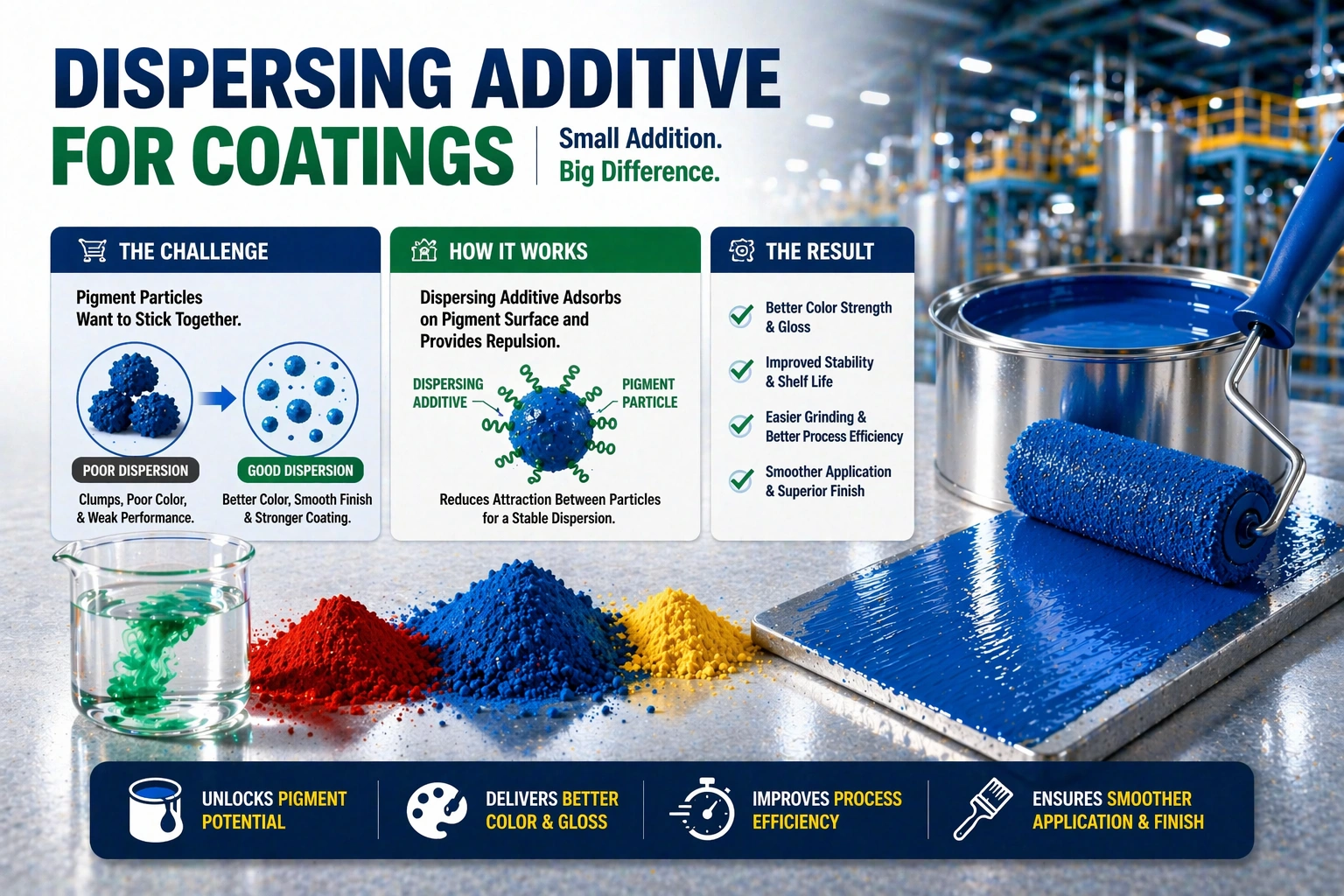
In industrial coatings, pigment and filler particles must be distributed uniformly and remain stable inside the liquid system. This is essential for colour development, gloss, viscosity behaviour, storage stability, and overall formulation reproducibility. A dispersing additive for coatings helps achieve this by supporting more effective particle wetting and stabilization.
Without proper dispersion support, pigment systems may remain partially agglomerated or become unstable after grinding. This can reduce visual quality, affect processing behaviour, and make long-term storage more difficult. For many industrial coating formulations, dispersing additives are therefore a functional part of system performance rather than a minor optional aid.
Why it matters
Good dispersion supports colour strength, gloss, stable viscosity, better storage behaviour, and more consistent coating performance.
What happens without it
Poor dispersion can lead to flocculation, flooding, floating, settling, reduced gloss, weak colour development, and variable batch quality.
What is a dispersing additive for coatings?
A dispersing additive for coatings is an additive used to improve the distribution and stabilization of solid particles such as pigments, extenders, and specialty solids within a liquid coating medium. Its role generally includes helping the system wet the particle surface more effectively and helping the dispersed particles remain separated after deagglomeration.
In practical formulation terms, dispersing additives help coating systems perform more reliably by improving pigment efficiency and reducing instability-related issues that can develop during manufacture, storage, application, or film formation.
Main functions of a dispersing additive
- Improve pigment wetting
- Support deagglomeration during grinding
- Help stabilize pigment particles after dispersion
- Reduce the risk of flocculation and re-agglomeration
- Support more consistent visual and rheological performance
Why dispersion quality matters in industrial coatings
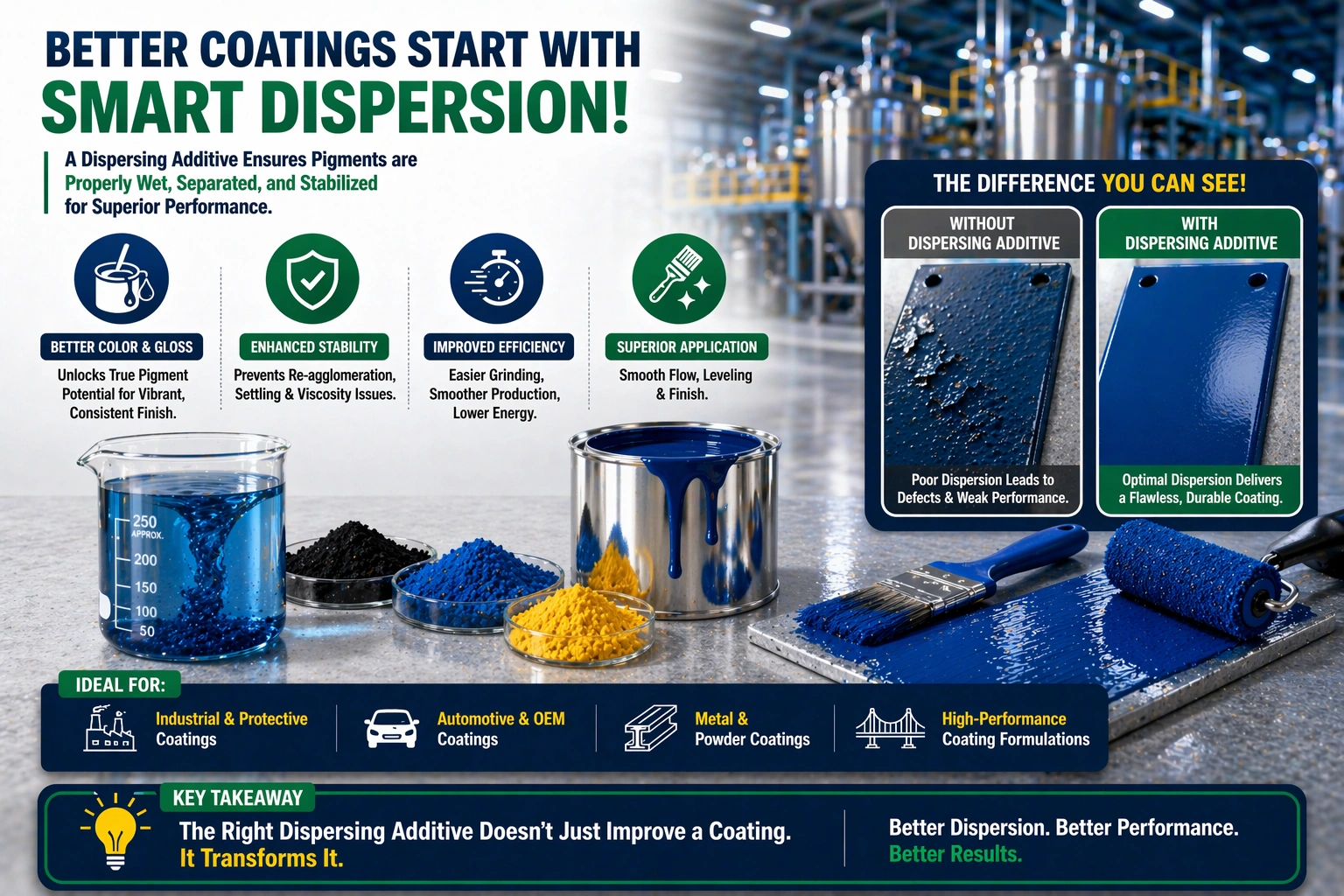
Pigment dispersion affects multiple parts of coating performance at once. When solid particles are distributed and stabilized properly, the formulation can perform more efficiently and more consistently. When dispersion is poor, the effects may appear in appearance, storage, and process control.
| Performance Area | How Dispersion Affects It | Why It Matters |
|---|---|---|
| Colour development | Better distribution improves pigment efficiency | Supports stronger and cleaner shade development |
| Gloss and appearance | Stable pigment systems reduce surface irregularity | Helps improve finish quality |
| Viscosity behaviour | Particle interaction influences rheology and stability | Important for processing and application consistency |
| Storage stability | Unstable particles may settle or flocculate | Important for shelf life and usability |
| Batch reproducibility | Stable dispersion improves formulation consistency | Supports predictable production quality |
Common coating problems linked to poor dispersion
When pigments are not properly wetted and stabilized, several performance issues may develop. Some appear during production, while others become more visible during storage or final application.
- Reduced colour strength
- Gloss loss and haze
- Flocculation
- Flooding and floating
- Rub-out differences
- Viscosity rise or viscosity drift
- Settling and hard sedimentation
- Batch-to-batch inconsistency
These issues can affect process efficiency, quality control, and customer satisfaction. That is why selecting the right dispersing additive for coatings is important for many industrial formulations.
How a dispersing additive works in coatings
A dispersing additive generally helps in two stages. First, it supports better wetting of the pigment surface so the coating medium can reach and interact with the particles more effectively. Second, after mechanical energy helps break down pigment agglomerates, the additive supports particle stabilization so they remain separated.
This second stage is especially important because pigment systems may otherwise re-agglomerate after grinding, leading to instability and loss of performance.
Step 1: Wetting
Helps the liquid medium spread over the particle surface and support more efficient initial pigment incorporation.
Step 2: Stabilization
Helps keep dispersed particles apart after deagglomeration so the coating remains more stable over time.
Applications for dispersing additive solutions in coatings
Dispersing additive solutions are relevant across many industrial coating systems where pigment stability, appearance, and formulation consistency matter.
- Industrial coatings
- Protective coatings
- Metal coatings
- Wood coatings
- Pigment concentrates
- Solvent-based coating systems
- Water-based coating systems
- Formulations with carbon black and difficult pigments
The exact additive choice depends on pigment type, resin system, process conditions, and the main performance priorities of the formulation.
What should formulators evaluate when selecting a dispersing additive?
Selecting the right dispersing additive for coatings requires more than checking grind speed alone. The additive should fit the full system and support stable performance under real formulation conditions.
Key evaluation points
- Pigment type and difficulty level
- Compatibility with the coating resin system
- Effect on colour strength and gloss
- Viscosity profile and rheology balance
- Storage stability and settling tendency
- Performance in difficult pigment systems such as carbon black
- Consistency after let-down and during application
Why RSA for dispersing additive requirements in coatings
RSA’s coating additive approach is aligned to the formulation needs of industrial coating systems where pigment wetting, dispersion stability, and long-term consistency matter. For customers searching for a dispersing additive for coatings, the goal is to identify a solution that supports real performance requirements across pigment-loaded systems.
Dispersing additive solutions should help coating formulators work more effectively with demanding pigment systems and reduce the risk of dispersion-related issues that affect production and final film quality.
Looking for a dispersing additive for coatings?
Connect with RSA to explore dispersing additive solutions for pigment stabilization, colour development, gloss improvement, and formulation consistency in industrial coatings.
Frequently Asked Questions
A dispersing additive helps pigments and other solid particles wet out more effectively and remain stabilized after dispersion, improving colour development, gloss, stability, and formulation consistency.
It is important because poor dispersion can lead to flocculation, gloss loss, flooding, floating, settling, viscosity issues, and batch inconsistency.
They are commonly used in industrial coatings, protective coatings, pigment concentrates, metal coatings, wood coatings, and systems containing difficult pigments.
Yes. In many formulations, dispersing additives are especially valuable for difficult pigments such as carbon black because these systems need stronger wetting and stabilization support.
Pigment type, resin compatibility, colour development, gloss, viscosity behaviour, storage stability, and overall formulation performance should all be evaluated during selection.