
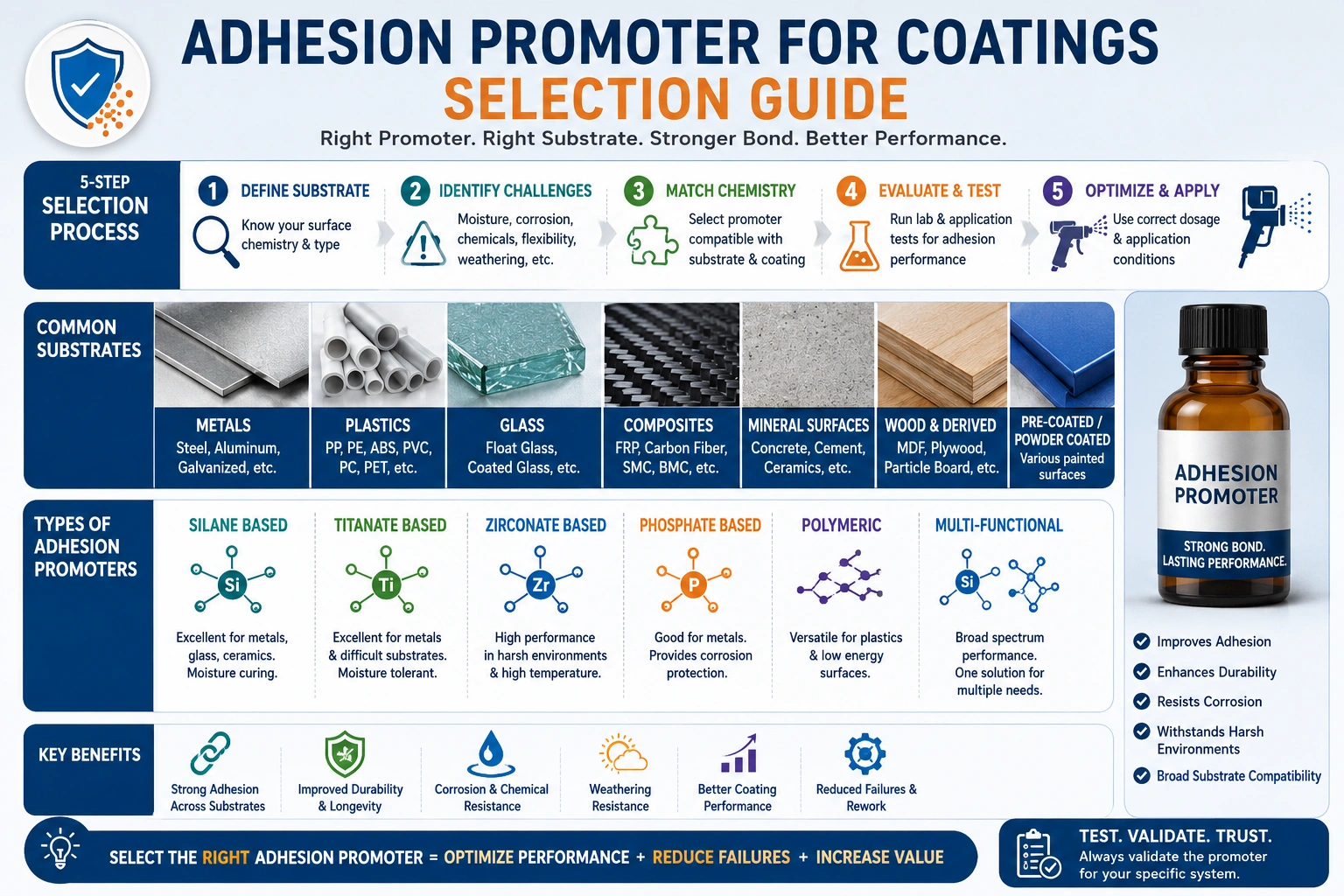
How to Select the Right Adhesion Promoter for Industrial Coatings
Adhesion problems in industrial coatings often start at the interface between the coating film and the substrate. The right adhesion promoter can support better bonding, substrate wetting, film integrity, and long-term coating performance when selected according to the substrate, resin system, surface preparation, and application conditions.
Quick Summary
Selecting an adhesion promoter is not only about adding one more ingredient into a formulation. It requires understanding the substrate, coating chemistry, application process, curing condition, and the type of adhesion failure being observed.
Start with the substrate
Metal, plastic, glass, wood, concrete, and low surface energy substrates need different adhesion approaches.
Check formulation compatibility
The adhesion promoter must work with the resin, pigment package, solvent or water phase, and other additives.
Validate through testing
Cross-cut, tape adhesion, pull-off, water resistance, and aging tests help confirm performance before scale-up.
Industrial coatings are expected to perform under demanding conditions such as humidity, heat, abrasion, chemical exposure, outdoor weathering, handling stress, and repeated cleaning. If the coating does not bond well to the substrate, even a technically strong formulation can fail early.
This is where an adhesion promoter for coatings becomes important. It helps improve the interaction between the coating film and the substrate, especially when the surface is difficult, contaminated, low in surface energy, or chemically less receptive to the coating system.
What Is an Adhesion Promoter in Industrial Coatings?
An adhesion promoter is a specialty additive used to improve bonding between a coating film and the substrate. In simple terms, it helps the coating hold better to the surface it is applied on.
In industrial coating formulations, adhesion depends on several factors, including surface cleanliness, surface roughness, surface energy, resin chemistry, pigment loading, curing conditions, and the ability of the liquid coating to wet the substrate properly.
Adhesion promoters are commonly used in coatings for metals, plastics, glass, treated surfaces, automotive parts, industrial components, packaging, wood finishes, inks, and other applications where coating-substrate bonding is critical.
Why Adhesion Promoters Are Important in Coating Formulations
Adhesion is one of the most important performance properties in coatings. If adhesion is weak, the coating may peel, flake, blister, chip, delaminate, or fail during service. This can affect appearance, corrosion protection, durability, chemical resistance, and customer acceptance.
A well-selected adhesion promoter may help improve:
- Bonding between the coating and substrate
- Resistance to peeling, chipping, and delamination
- Performance on difficult substrates
- Water and humidity resistance in selected systems
- Coating durability after curing or drying
- Film integrity during handling, bending, or mechanical stress
- Compatibility between layers in multilayer coating systems
For companies searching for a coating additives manufacturer or paint additives supplier, adhesion promoter selection should be part of a broader additive strategy that also includes dispersion, foam control, surface performance, and rheology balance.
Key Factors to Consider Before Selecting an Adhesion Promoter
The right adhesion promoter depends on both the surface and the coating system. A product that performs well on metal may not automatically work on plastic. A grade suitable for solvent-based coatings may not be the best choice for water-based formulations.
| Selection Factor | Why It Matters | What to Check |
|---|---|---|
| Substrate type | Different surfaces have different surface energy, chemistry, and roughness. | Metal, plastic, glass, wood, concrete, treated surface, composite, or coated surface. |
| Resin system | The adhesion promoter must be compatible with the binder chemistry. | Acrylic, epoxy, polyurethane, alkyd, polyester, UV-curable, or hybrid systems. |
| Solvent or water phase | Solubility and dispersion behavior affect performance and stability. | Water-based, solvent-based, high-solid, or low-VOC systems. |
| Application method | Spray, dip, roller, brush, or printing can affect wetting and film formation. | Film thickness, drying speed, leveling, and surface coverage. |
| Curing condition | Heat, air drying, UV curing, or chemical curing can influence bonding. | Temperature, time, humidity, and post-cure performance. |
| End-use exposure | Adhesion must survive real service conditions. | Humidity, water, chemicals, abrasion, outdoor exposure, and mechanical stress. |
Substrate Type: Metal, Plastic, Glass, Wood, and Difficult Surfaces
Substrate selection is usually the first step in adhesion promoter evaluation. The surface determines how easily the coating can spread, wet, and bond.
Metal substrates
Metal coatings often require strong adhesion because the coating may also provide corrosion protection. Surface preparation, cleaning, pretreatment, roughness, and oxide layer condition can influence adhesion. Adhesion promoters may be considered when the coating shows poor grip, edge failure, chipping, or weak performance after humidity testing.
Plastic substrates
Plastics can be more difficult because many plastic surfaces have low surface energy. This makes it harder for liquid coatings to wet the surface properly. Adhesion promoters may help improve bonding, but surface treatment, cleaning, flame treatment, corona treatment, or plasma treatment may also be required depending on the plastic.
Glass and ceramic surfaces
Glass and ceramic surfaces may need adhesion support because of their smooth, inorganic, and relatively low-reactive surface behavior. The choice of adhesion promoter depends on the resin system and the expected exposure conditions.
Wood and porous surfaces
Wood and porous substrates behave differently because penetration, moisture content, surface sanding, and absorption can influence coating adhesion. A formulation must balance penetration, film formation, flexibility, and surface protection.
Previously coated or treated surfaces
Adhesion on an existing coating layer depends on intercoat compatibility. If the new coating does not bond well with the earlier layer, delamination can happen even when the substrate itself is stable.
Resin Compatibility and Formulation Balance
Adhesion promoters must be compatible with the resin and the total additive package. If the additive is not compatible, it may create haze, separation, poor film clarity, instability, surface defects, or reduced performance.
Formulators should evaluate compatibility with:
- Binder or resin chemistry
- Pigment and filler package
- Wetting and dispersing agents for coatings
- Dispersing additive for coatings
- Antifoam and defoamer additives
- Flow and leveling additives
- Solvents, co-solvents, or water phase
- Curing agents or crosslinkers
Adhesion should never be optimized in isolation. For example, increasing adhesion may affect flexibility, recoatability, chemical resistance, wetting, pot life, or surface appearance. The objective is to find a balanced additive package that supports the final coating requirement.
Need help selecting the right adhesion promoter?
Share your substrate, resin system, application method, and adhesion issue with Raj Speciality Additives. Our team can help you evaluate the right additive direction for coatings, inks, and industrial formulations.
Common Adhesion Problems Adhesion Promoters Help Address
Adhesion problems may appear immediately after drying or curing, or they may develop later during storage, handling, field exposure, or performance testing.
| Problem | Possible Cause | How Adhesion Promoter Selection Helps |
|---|---|---|
| Peeling or flaking | Poor substrate bonding, contamination, or incompatible resin system. | May improve coating-substrate interaction when selected correctly. |
| Delamination | Weak intercoat adhesion or poor surface preparation. | Can support better bonding between coating layers or between film and substrate. |
| Chipping | Low impact resistance or weak film-substrate grip. | May support adhesion under mechanical stress depending on the formulation. |
| Blistering | Moisture, trapped contaminants, poor adhesion, or osmotic pressure. | Can help only when poor adhesion is one contributing factor; surface preparation remains critical. |
| Poor adhesion on plastic | Low surface energy or insufficient surface treatment. | May improve bonding when paired with suitable surface treatment and compatible resin chemistry. |
To understand more about adhesion failure patterns, also read RSA’s related blogs on why coating adhesion failure happens, common adhesion problems in industrial coatings, and adhesion promoters for metal, plastic, and difficult substrates.
How to Test Adhesion Performance in Coatings
Adhesion promoter selection should be validated through proper testing. Laboratory drawdowns alone may not always show real performance. Testing should include the actual substrate, actual film thickness, curing condition, and expected end-use environment.
Common adhesion test methods
- Cross-cut adhesion test
- Tape adhesion test
- Pull-off adhesion test
- Humidity resistance testing
- Water immersion testing
- Thermal cycling
- Chemical resistance testing
- Bend, impact, or flexibility testing
ASTM D3359 is widely referenced for tape adhesion testing of coating films, while ISO 2409 specifies a cross-cut method for assessing resistance of paint coatings and varnishes to separation from substrates. These methods help formulators compare adhesion performance under controlled conditions.
Mistakes to Avoid While Using Adhesion Promoters
Adhesion promoters can be highly useful, but wrong selection or incorrect dosage may create new formulation problems. Avoid these common mistakes:
- Skipping surface preparation: Adhesion promoters cannot fully compensate for oil, dust, moisture, rust, or poor surface cleaning.
- Using one grade for every substrate: Metal, plastic, glass, and coated surfaces may need different additive approaches.
- Ignoring resin compatibility: The additive must fit the binder chemistry and the complete formulation.
- Overdosing the additive: Excessive dosage may affect surface properties, clarity, compatibility, or coating performance.
- Testing only fresh panels: Adhesion should also be checked after water, humidity, heat, or chemical exposure where relevant.
- Not checking interaction with other additives: Wetting agents, dispersants, antifoams, and flow additives can influence final film behavior.
How RSA Supports Coating Formulators with Specialty Additives
Raj Speciality Additives supports coating, ink, and paint manufacturers with specialty additive solutions for adhesion, dispersion, foam control, rheology, surface performance, and formulation stability.
As a growing coating additives manufacturer and paint additives supplier, RSA focuses on practical formulation needs across coatings and inks. For adhesion-related challenges, our team can help evaluate the substrate, coating system, application method, and performance requirement before suggesting suitable additive options.
- Adhesion promoters
- Wetting and dispersing agents
- Hyperdispersant additives
- Antifoam additives
- Rheology additives
- Surface performance additives
- Coatings and inks support
Looking for adhesion promoter support for coatings?
Connect with Raj Speciality Additives to discuss adhesion promoter selection for metal, plastic, glass, wood, industrial coatings, inks, and specialty coating applications.
FAQs on Adhesion Promoter for Coatings
What is an adhesion promoter for coatings?
An adhesion promoter for coatings is a specialty additive used to improve bonding between a coating film and the substrate. It is commonly used when coatings face peeling, flaking, delamination, or poor grip on difficult surfaces.
How do I choose the right adhesion promoter?
Start by identifying the substrate, resin system, application method, curing condition, and end-use exposure. The adhesion promoter should be compatible with the complete formulation and validated through adhesion testing.
Can adhesion promoters improve coating adhesion on plastic?
Yes, adhesion promoters may help improve bonding on plastic substrates, especially when the surface has low surface energy. However, plastic coatings may also require cleaning, surface treatment, flame treatment, corona treatment, or plasma treatment depending on the substrate.
Are adhesion promoters used only for metal coatings?
No. Adhesion promoters can be used for metal, plastic, glass, wood, treated surfaces, industrial coatings, inks, and multilayer coating systems. The selection depends on the substrate and coating chemistry.
Can wrong adhesion promoter selection cause coating defects?
Yes. If the additive is not compatible with the resin or other formulation ingredients, it may cause instability, haze, surface defects, poor film formation, or inconsistent performance. Proper lab evaluation is important before scale-up.
Does RSA provide adhesion promoter support for coatings and inks?
Yes. Raj Speciality Additives supports coating, ink, and paint manufacturers with specialty additives including adhesion promoters, dispersing additives, wetting agents, antifoams, hyperdispersants, and other formulation support additives.
References & Citations
- ASTM D3359-23 – Standard Test Methods for Rating Adhesion by Tape Test
- ISO 2409:2020 – Paints and varnishes — Cross-cut test
- AMPP – Surface Preparation Standards: A Quick Summary
- Biolin Scientific – What Is Adhesion?
- KTA – Measuring Adhesion by Tape Test per ASTM D3359
These references are included for technical context around coating adhesion, surface preparation, and adhesion test methods. Product selection should always be validated based on the actual formulation, substrate, process, and performance requirements.