
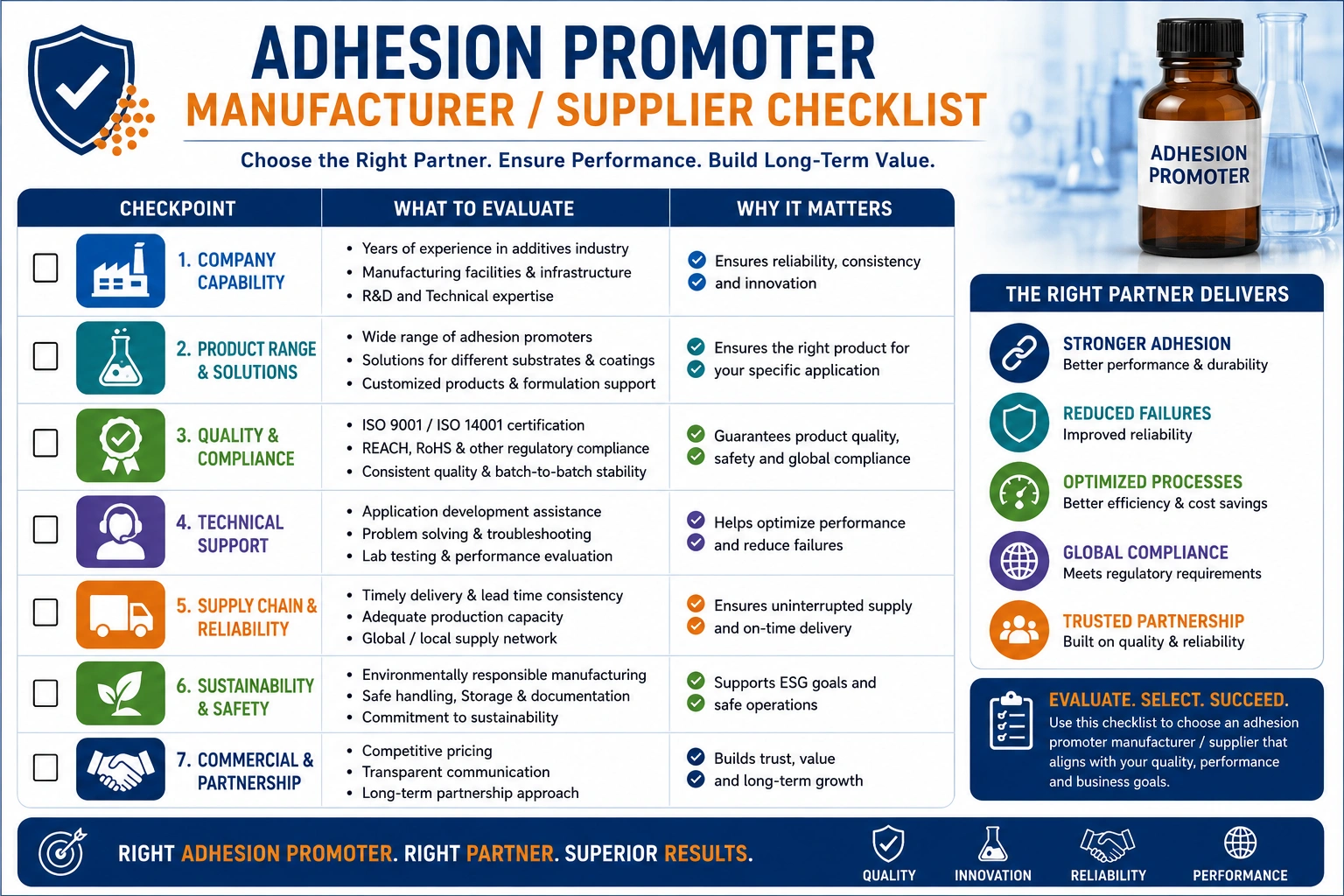
Adhesion Promoter Manufacturer: What Paint and Coating Companies Should Evaluate Before Choosing a Supplier
Choosing the right adhesion promoter manufacturer is important for paint, coating, and ink companies that need reliable additive support for difficult substrates, coating adhesion failure, film durability, and formulation consistency.
Quick Summary
A good adhesion promoter manufacturer should offer more than product supply. Paint, coating, and ink companies should evaluate technical understanding, formulation compatibility, substrate knowledge, quality consistency, and long-term support before finalizing a supplier.
Check technical fit
The supplier should understand substrate, resin, curing, surface preparation, and coating performance needs.
Evaluate application support
A manufacturer should support selection based on coating type, ink system, application method, and end-use conditions.
Review consistency
Batch consistency, documentation, technical communication, and long-term reliability matter in industrial supply.
An adhesion promoter manufacturer plays an important role in helping coating, paint, and ink companies improve bonding between the coating film and the substrate. When a formulation faces peeling, delamination, chipping, poor intercoat adhesion, or weak bonding on difficult substrates, the right supplier can help identify a suitable additive direction.
However, choosing a supplier only based on product availability or pricing can lead to inconsistent performance. Adhesion is affected by several factors, including the substrate, resin chemistry, surface preparation, application method, curing process, film thickness, and final exposure conditions.
Why Choosing the Right Adhesion Promoter Manufacturer Matters
Adhesion promoters are used when a coating or ink system needs stronger bonding to a substrate. But the final result depends not only on the additive itself. It also depends on how well the additive fits the complete formulation.
A reliable adhesion promoter manufacturer should be able to support the buyer with product direction, selection guidance, formulation understanding, and practical troubleshooting.
For paint and coating manufacturers, this matters because poor adhesion can result in:
- Peeling or flaking of the coating film
- Delamination from metal, plastic, glass, or treated surfaces
- Poor intercoat adhesion in multilayer systems
- Reduced durability under humidity or water exposure
- Chipping or film failure during handling
- Customer complaints and rework
- Difficulty maintaining consistent performance across batches
What Paint and Coating Companies Should Look For
Before selecting an adhesion promoter supplier, companies should evaluate both product capability and support capability. The supplier should understand the technical demands of coatings and inks, not just list a product in a catalogue.
| Evaluation Area | Why It Matters | What to Ask the Supplier |
|---|---|---|
| Coatings and inks experience | Adhesion problems vary across industrial coatings, decorative coatings, inks, and specialty systems. | Do you support additives for coatings and inks specifically? |
| Substrate understanding | Metal, plastic, glass, wood, and low surface energy surfaces need different adhesion approaches. | Which substrates are your adhesion promoters suitable for? |
| Formulation compatibility | The additive must work with resin, pigments, solvent or water phase, and other additives. | How should we evaluate compatibility in our system? |
| Technical documentation | Data sheets and usage guidance help formulators test the product correctly. | Can you provide TDS, application guidance, and recommended dosage range? |
| Testing support | Adhesion must be validated through actual panels, substrates, and service conditions. | Which adhesion tests should we run before approval? |
| Supply consistency | Industrial coating production needs stable supply and batch-to-batch consistency. | How do you maintain product consistency and supply reliability? |
Technical Expertise in Coating Formulations
A strong adhesion promoter supplier should understand the chemistry and practical behavior of coating systems. The same adhesion issue may have different root causes in different formulations.
For example, poor adhesion on a metal panel may be linked to inadequate surface preparation, contamination, insufficient curing, poor resin selection, or additive incompatibility. On plastic, poor adhesion may be related to low surface energy, release agents, insufficient cleaning, or the need for surface treatment.
A technically capable supplier should be able to discuss:
- Substrate type and surface condition
- Resin system and binder chemistry
- Water-based or solvent-based formulation needs
- Application method and film thickness
- Curing or drying conditions
- Interaction with wetting agents, dispersants, antifoams, and flow additives
- Final performance requirements such as humidity, water, abrasion, and chemical resistance
This is why choosing a broader coating additives manufacturer can be helpful. A supplier with knowledge of multiple additive categories can better understand how adhesion promoters interact with the rest of the formulation.
Looking for an adhesion promoter manufacturer for coatings and inks?
Raj Speciality Additives supports coating, ink, and paint companies with adhesion promoters and specialty additive solutions for substrate bonding, dispersion, foam control, and surface performance.
Product Compatibility Across Different Substrates
Adhesion promoter selection should always start with the substrate. A supplier should not recommend a product without understanding where the coating or ink will be applied.
Metal substrates
Metal coatings may require adhesion support for corrosion resistance, impact performance, humidity resistance, and long-term film durability. Surface cleanliness, roughness, pretreatment, and oxide condition can directly affect adhesion.
Plastic substrates
Plastics can be challenging because many plastic surfaces have low surface energy. Adhesion promoter selection must consider the plastic type, cleaning process, surface treatment, resin chemistry, and application conditions.
Glass and ceramic substrates
Glass and ceramic surfaces may require specialized adhesion support due to their smooth and inorganic nature. Compatibility with the binder and curing mechanism becomes important.
Wood and porous substrates
Wood and porous surfaces require a balance between penetration, film formation, flexibility, and adhesion. Moisture content and surface sanding may also affect final performance.
Previously coated substrates
In multilayer coating systems, intercoat adhesion is as important as adhesion to the base substrate. The supplier should help evaluate whether the issue is substrate adhesion or layer-to-layer bonding.
For more technical context, you can also read RSA’s blog on how to select the right adhesion promoter for industrial coatings and adhesion promoters for metal, plastic, and difficult substrates.
Support for Industrial Coatings, Paints, and Inks
Since RSA’s primary market includes coatings and inks, adhesion promoter selection should be aligned with the needs of paint manufacturers, coating formulators, ink producers, and specialty chemical users.
A supplier should be able to support applications such as:
- Industrial coatings
- Protective coatings
- Decorative paints
- Packaging inks
- Metal coatings
- Plastic coatings
- Wood coatings
- Specialty coatings and surface-treated systems
The supplier should also understand how adhesion promoters work with other additive categories such as wetting and dispersing agents for coatings, dispersing additives for coatings, antifoams, rheology additives, and flow and leveling additives.
Quality, Consistency, and Documentation
In industrial manufacturing, consistency is very important. If an additive performs well in one batch but behaves differently in the next, it can create production and customer issues.
Paint and coating companies should evaluate whether the adhesion promoter manufacturer can provide:
- Consistent product quality
- Clear product documentation
- Technical data sheets
- Recommended usage guidance
- Application-specific support
- Reliable communication
- Supply continuity
Testing standards are also important when evaluating adhesion. ISO 2409 describes a cross-cut method used to assess resistance of paint coatings and varnishes to separation from substrates, while ASTM D3359 is commonly referenced for rating adhesion by tape test.
Customization and Application-Specific Support
Not every coating company has the same requirement. Some need better adhesion on metal. Some need support on plastic. Some need water resistance. Others need better intercoat adhesion, chemical resistance, or performance under humidity exposure.
This is why application-specific support matters. A reliable paint additives supplier should understand the difference between supplying a standard product and supporting a formulation challenge.
Application-specific support may include:
- Understanding the formulation challenge
- Reviewing the substrate and surface preparation method
- Suggesting additive direction based on resin chemistry
- Recommending lab evaluation approach
- Helping compare performance across dosage levels
- Supporting future scale-up discussions
Questions to Ask Before Finalizing an Adhesion Promoter Supplier
Before selecting an adhesion promoter manufacturer, coating and ink companies can use this checklist:
| Question | Why It Helps |
|---|---|
| Do you supply adhesion promoters specifically for coatings and inks? | Confirms industry relevance and application focus. |
| Which substrates are your products suitable for? | Helps match product direction with metal, plastic, glass, wood, or other surfaces. |
| Can the product work in water-based and solvent-based systems? | Checks compatibility with the formulation base. |
| What dosage range should be tested? | Supports proper lab screening and avoids underuse or overuse. |
| Which tests should we run before approval? | Helps validate adhesion under realistic conditions. |
| Can your team support troubleshooting if adhesion failure continues? | Shows whether the supplier can support beyond product dispatch. |
Why RSA Is Building Strong Specialty Additive Support for Coatings and Inks
Raj Speciality Additives supports coating, ink, and paint manufacturers with specialty additives designed for formulation challenges such as adhesion, dispersion, foam control, rheology, surface performance, and stability.
As an adhesion promoter manufacturer, RSA focuses on helping customers evaluate additive selection in relation to substrate type, formulation chemistry, application process, and performance expectations.
- Adhesion promoters
- Coatings and inks
- Wetting agents
- Dispersing additives
- Hyperdispersants
- Antifoams
- Rheology additives
- Surface performance additives
For related reading, explore RSA’s blogs on why coating adhesion failure happens, common adhesion problems in industrial coatings, and selecting the right adhesion promoter for coatings.
Need an adhesion promoter supplier for your coating system?
Connect with Raj Speciality Additives to discuss adhesion promoter selection for coatings, inks, metal substrates, plastic substrates, and difficult industrial applications.
FAQs on Adhesion Promoter Manufacturer
What should I look for in an adhesion promoter manufacturer?
Look for technical experience in coatings and inks, substrate understanding, formulation compatibility support, product consistency, clear documentation, and practical troubleshooting support.
Why is supplier selection important for adhesion promoters?
Adhesion performance depends on the substrate, resin system, surface preparation, application method, and curing condition. A reliable supplier can help evaluate these factors instead of suggesting a product without context.
Can one adhesion promoter work for all coating substrates?
Usually no. Metal, plastic, glass, wood, and previously coated surfaces may require different adhesion promoter chemistry or different evaluation methods. Testing on the actual substrate is important.
Are adhesion promoters used in both coatings and inks?
Yes. Adhesion promoters may be used in coatings and inks where improved bonding to the substrate is required. The selection depends on the resin system, substrate, application method, and final performance requirement.
How should paint companies test adhesion promoter performance?
Paint companies can evaluate adhesion through cross-cut testing, tape adhesion testing, pull-off testing, water resistance, humidity exposure, chemical resistance, and application-specific performance tests.
Does RSA supply adhesion promoters for coatings and inks?
Yes. Raj Speciality Additives supports coating, ink, and paint manufacturers with adhesion promoters and other specialty additives including wetting agents, dispersing additives, antifoams, hyperdispersants, and rheology additives.
References & Citations
- ISO 2409:2020 – Paints and varnishes — Cross-cut test
- ASTM D3359-23 – Standard Test Methods for Rating Adhesion by Tape Test
- AMPP SC 05 – Surface Preparation Standards Committee
- SpecialChem – Adhesion Promoters for Coatings
- SpecialChem – Adhesion Promoters / Bonding Agents in Coatings and Inks
These references are included for technical context around coating adhesion, adhesion testing, surface preparation, and coatings/inks additive selection. Product selection should always be validated based on the actual substrate, formulation, process, and performance requirement.