
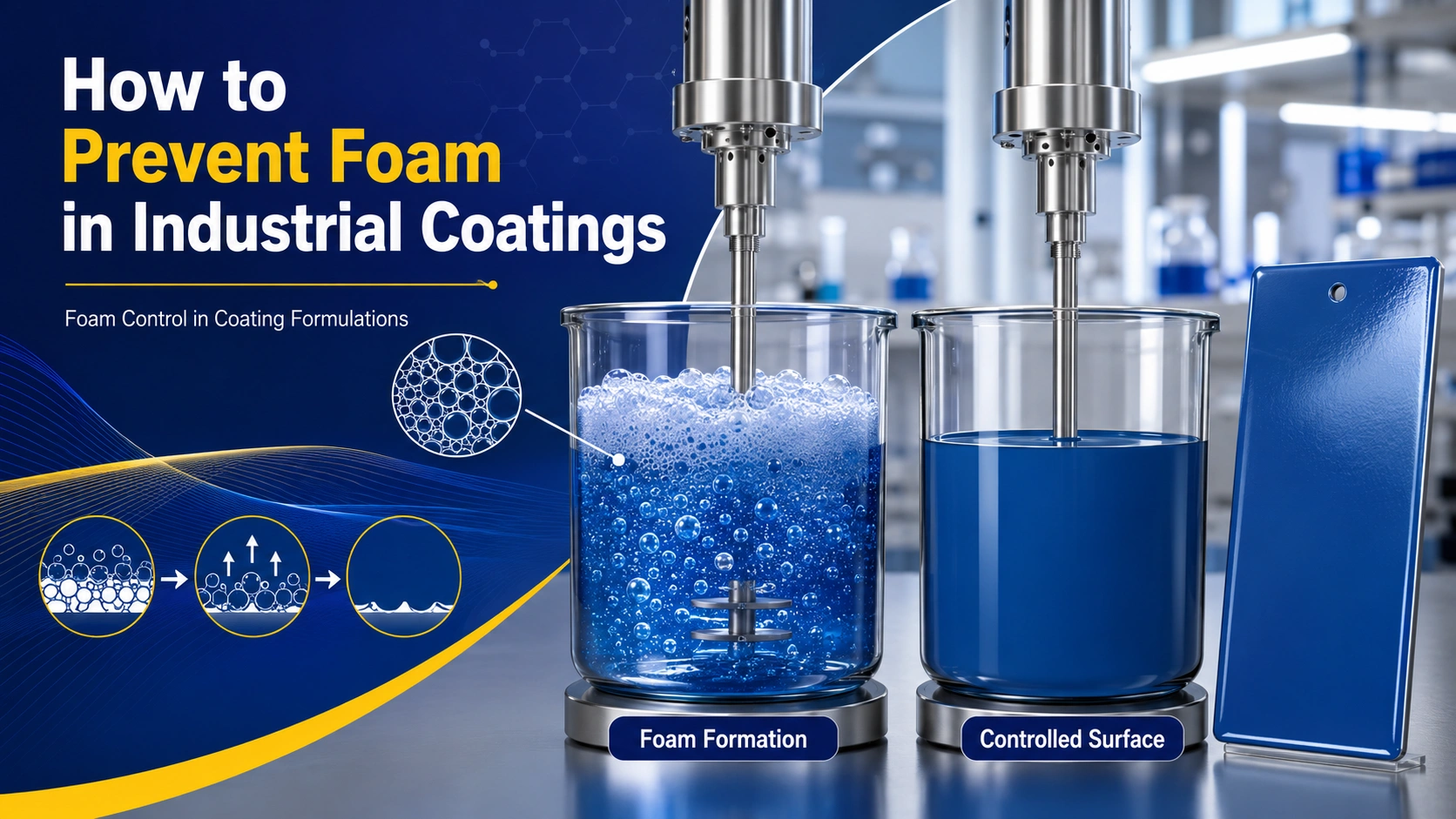
How to Prevent Foam in Industrial Coatings
Foam in industrial coatings can cause poor surface finish, craters, pinholes, air entrapment, reduced film performance and production delays. The right antifoam or defoamer additive helps control foam during manufacturing, mixing, filling and application.
Why foam control is critical in industrial coatings
Industrial coatings often go through high-speed mixing, pigment dispersion, let-down, filtration, filling and application. Each stage can introduce or stabilize air inside the system. If foam is not controlled properly, it can affect coating appearance, application quality and final film performance.
Foam control should not be treated only as a last-minute correction. It should be planned during formulation because the antifoam must work with the resin, pigment system, solvent or water phase, rheology package and application method.
Foam can lead to:
- Pinholes, craters and surface defects
- Air entrapment during mixing or application
- Reduced coating film appearance
- Poor filling and packaging efficiency
- Inconsistent coating application
- Lower productivity in manufacturing
Why foam forms in industrial coatings
Foam usually forms when air is introduced into a coating and then stabilized by surfactants, dispersants, rheology modifiers, pigments or other formulation components.
High-Speed Mixing
Strong agitation can pull air into the coating during manufacturing, pigment grinding or let-down.
Pigment Dispersion Stage
Wetting agents and dispersing additives can sometimes increase foam tendency if foam control is not balanced.
Water-Based Systems
Water-based coatings are often more foam-sensitive because surfactants and water-soluble components can stabilize foam.
Rheology & Viscosity
High viscosity can trap air bubbles and make foam release slower during processing and application.
Application Method
Roller, brush, spray or dip application can introduce air depending on the coating system and substrate.
Additive Incompatibility
An unsuitable antifoam may create surface defects, poor leveling, separation or reduced coating performance.
How to prevent foam in industrial coating formulations
Foam prevention requires both formulation-level additive selection and process-level control.
| Action | What It Does | Why It Matters |
|---|---|---|
| Select the right antifoam | Choose an antifoam compatible with the coating system, resin, pigment and application method. | Improves foam control without causing craters, fisheyes or surface defects. |
| Add antifoam at correct stage | Part of the antifoam may be added during grinding and part during let-down depending on formulation need. | Controls foam during both manufacturing and final application. |
| Optimize dosage | Run dosage trials to avoid underdosing or overdosing. | Too little may not control foam; too much may affect surface finish or compatibility. |
| Control mixing speed | Reduce unnecessary air entrainment during mixing, transfer and filling. | Prevents foam formation before it becomes a formulation problem. |
| Check viscosity balance | Manage rheology so air can release from the coating system. | Reduces trapped air, microfoam and slow bubble release. |
| Test application foam | Check foam during brush, roller, spray or other application methods. | Ensures the coating performs well beyond the lab mixing stage. |
Should you use antifoam or defoamer?
In practical coating formulation, the terms antifoam and defoamer are often used closely, but their role can be understood by when they act.
- Antifoam: Helps prevent foam from forming during processing or application.
- Defoamer: Helps break foam that has already formed in the system.
- Foam control additive: A broader term used for additives that help manage foam across formulation stages.
- The best choice depends on system chemistry, foam stage, application method and surface finish requirement.
Formulation note
A strong defoamer is not always the best answer. If the additive is too incompatible, it may control foam but create craters, fisheyes, poor leveling or film appearance problems.
Foam control by coating system
Foam behaviour changes depending on whether the coating is water-based, solvent-based, pigment-rich or high-viscosity.
| Coating System | Common Foam Challenge | Recommended Focus |
|---|---|---|
| Water-Based Coatings | Surfactant-stabilized foam, microfoam and slow air release. | Compatible antifoam for water-based coating systems. |
| Solvent-Based Coatings | Foam, air entrapment or surface defects depending on resin and solvent balance. | Antifoam selection with strong compatibility checks. |
| Industrial Paints | Foam during mixing, filling, spray or roller application. | Foam control across production and application stages. |
| Pigment Concentrates | Foam during high-shear dispersion and pigment wetting. | Balance dispersing additive and antifoam package. |
| Printing Inks | Foam affecting print quality, flow and processing. | Low-defect foam control for ink systems. |
Mistakes to avoid when solving foam in coatings
Foam control can fail when additive selection is not matched with the complete formulation.
Overdosing Antifoam
Too much antifoam may create craters, fisheyes, poor leveling or compatibility problems.
Testing Only in Lab Mixing
Foam must also be checked during filling, storage and actual application conditions.
Ignoring Recoat & Film Quality
Foam control should not compromise adhesion, gloss, leveling, wetting or final coating appearance.
FAQs on preventing foam in industrial coatings
Common questions from coating manufacturers, paint formulators and industrial coating producers.
What causes foam in industrial coatings?
Foam in industrial coatings is commonly caused by high-speed mixing, air entrainment, surfactants, wetting agents, dispersing additives, pigment dispersion, high viscosity and application methods such as spraying, brushing or rolling.
How can foam be prevented in industrial coatings?
Foam can be prevented by selecting a compatible antifoam or defoamer, optimizing dosage, adding it at the right formulation stage, controlling mixing speed and testing foam behaviour during manufacturing and application.
Which additive is used to reduce foam in coatings?
Antifoam and defoamer additives are used to reduce or prevent foam in coatings. The right selection depends on whether the system is water-based, solvent-based, pigment-rich or application-sensitive.
Can too much antifoam cause coating defects?
Yes. Overdosing antifoam can cause craters, fisheyes, poor leveling, separation or film appearance problems. Dosage should be optimized through formulation trials.
Is foam more common in water-based coatings?
Foam is often more common in water-based coatings because surfactants, wetting agents and water-soluble components can stabilize foam and microfoam.
What is the difference between antifoam and defoamer?
Antifoam generally helps prevent foam from forming, while defoamer helps break foam that has already formed. In coatings, both terms are often used together as foam control additives.
Can RSA help select antifoam for industrial coatings?
Yes. Raj Speciality Additives can help coating and paint manufacturers evaluate suitable antifoam or defoamer additive categories based on resin system, coating type, application method and foam problem.
Need help preventing foam in industrial coatings?
Share your coating system, resin type, manufacturing stage, foam issue, application method or surface defect problem with Raj Speciality Additives. Our team can help identify suitable antifoam or defoamer additive options.
Send Your Enquiry
Please fill out the form and our team will get back to you.