
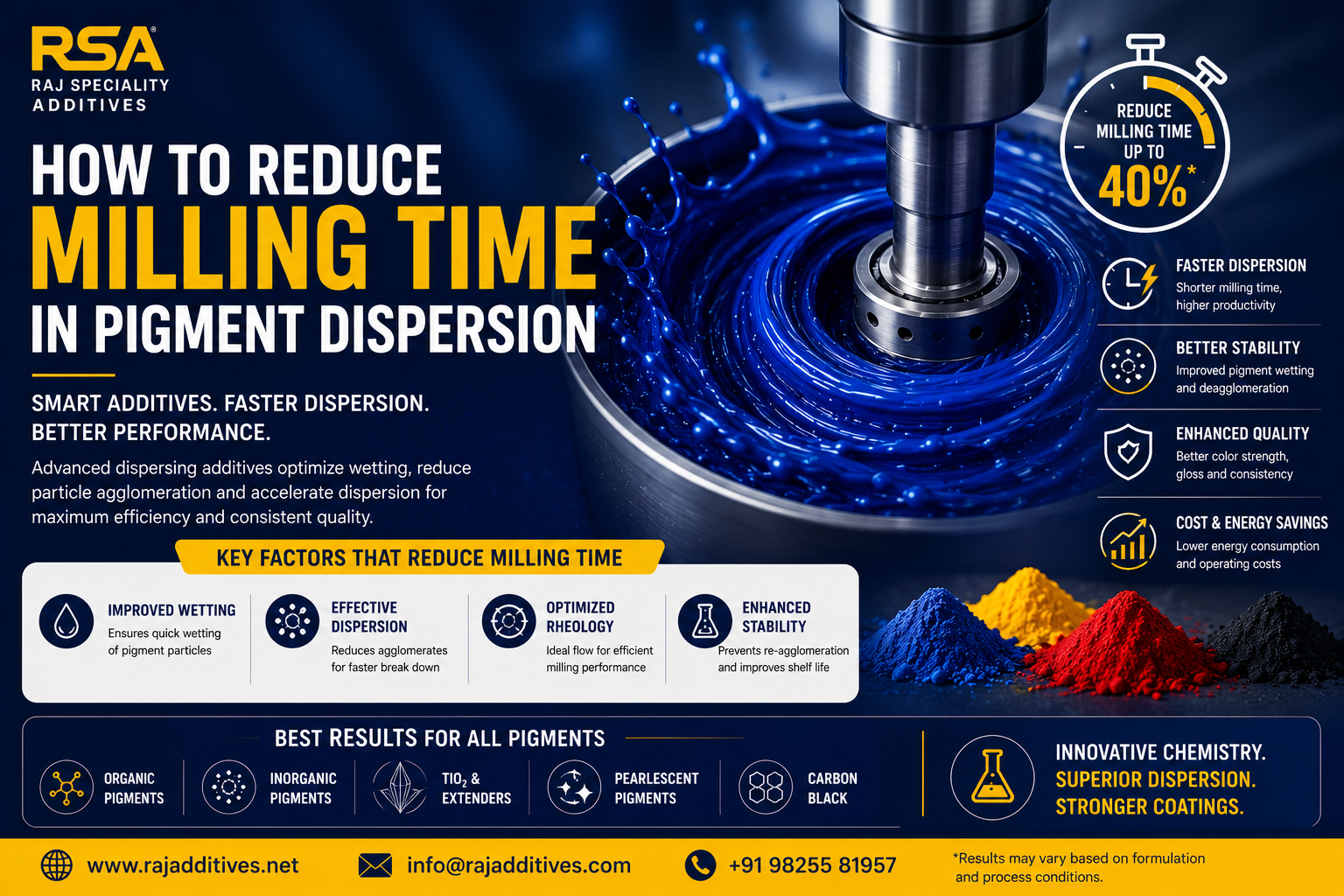
How to Reduce Milling Time in Pigment Dispersion
Milling time is a major factor in pigment dispersion efficiency, production cost and batch consistency. The right dispersing additives and hyperdispersants can help improve pigment wetting, reduce mill base viscosity, speed up dispersion and support long-term stability.
Why milling time matters in coatings, paints and inks
Pigment milling is used to break agglomerates, wet pigment surfaces and distribute particles evenly in the liquid medium. If the dispersion process is inefficient, manufacturers may face long grinding cycles, high energy use, high viscosity, poor color strength, poor gloss and inconsistent batch quality.
A dispersing additive does not only help during grinding. It also helps keep pigments separated after milling, improving storage stability, let-down compatibility and final coating performance.
Reducing milling time can help improve:
- Production efficiency and batch throughput
- Pigment wetting and grinding performance
- Mill base viscosity control
- Color strength, gloss and hiding
- Dispersion stability during storage
- Let-down compatibility in final systems
Why pigment milling takes too long
Long milling time is usually a sign that pigment wetting, viscosity balance or stabilization is not optimized.
Poor Pigment Wetting
When pigment surfaces are not wetted properly, agglomerates take longer to break down during milling.
High Mill Base Viscosity
Excessive viscosity reduces grinding efficiency, poor bead movement and energy transfer during milling.
Difficult Pigments
Carbon black, organic pigments and high-performance pigments often require stronger dispersing support.
Poor Resin Compatibility
The additive must match the resin, solvent or water system to maintain efficient dispersion and stability.
Re-Agglomeration
Pigments may separate during milling but come back together if stabilization is not strong enough.
Incorrect Additive Dosage
Too little additive may not wet and stabilize pigment; too much may create viscosity or compatibility issues.
How dispersing additives reduce milling time
Dispersing additives improve milling efficiency by helping the pigment wet faster, separate better and remain stable after dispersion.
| Dispersion Stage | Role of Dispersing Additive | Expected Formulation Benefit |
|---|---|---|
| Wetting Stage | Helps liquid medium replace air and moisture around pigment particles. | Faster pigment incorporation and improved grinding start-up. |
| De-agglomeration Stage | Supports particle separation during milling and reduces resistance from poor wetting. | Improved particle size reduction and shorter milling cycle in suitable systems. |
| Viscosity Control | Helps reduce unwanted mill base viscosity rise caused by poor pigment stabilization. | Better energy transfer, flow and processing efficiency. |
| Stabilization Stage | Helps prevent pigment particles from re-agglomerating after dispersion. | Improved storage stability, gloss, color strength and shade consistency. |
| Let-Down Stage | Supports compatibility between mill base or pigment concentrate and final paint system. | Reduced risk of shade shift, flocculation and let-down shock. |
Pigments that may need stronger milling support
Some pigments are more difficult to wet and stabilize, which can increase milling time and formulation complexity.
| Pigment / System | Common Milling Challenge | Recommended Focus |
|---|---|---|
| Carbon Black | Difficult wetting, high surface area, high viscosity and weak jetness. | Hyperdispersant support for carbon black |
| Organic Pigments | Flocculation, low color strength, viscosity rise and poor stability. | Strong pigment stabilization and compatibility testing. |
| Titanium Dioxide / TiO₂ | Poor hiding, crowding, viscosity issues and weak dispersion stability. | TiO₂ wetting and stabilization support |
| High Pigment Loading | High viscosity, poor flow and difficult milling behaviour. | Pigment concentrate additive support |
| Printing Ink Systems | Need fine dispersion, color strength, gloss and flow consistency. | Printing ink additive support |
Steps to reduce milling time in pigment dispersion
Use this practical checklist before changing mill time, pigment loading or additive dosage.
Identify Pigment Type
Start with pigment chemistry, surface area, oil absorption, particle structure and dispersion difficulty.
Select Additive Chemistry
Choose a dispersing additive or hyperdispersant suitable for the pigment, resin and coating medium.
Optimize Dosage
Run dosage ladder trials to find the best balance between viscosity, color strength and stability.
Control Mill Base Viscosity
Maintain a workable viscosity that supports efficient bead movement and pigment separation.
Check Grind Quality
Track particle size, color strength, gloss, hiding and viscosity at different milling intervals.
Test Let-Down Stability
Confirm the dispersion remains stable when added into the final paint, coating or ink system.
When to use hyperdispersants for faster dispersion
Hyperdispersants are often evaluated when standard dispersants are not enough for difficult pigment systems, high pigment loading or demanding stability requirements.
- Use standard dispersing additives for general pigment wetting and stabilization needs.
- Evaluate hyperdispersants for carbon black, organic pigments and difficult pigments.
- Use stronger dispersing support for pigment concentrates and high loading systems.
- Check whether reduced milling time also maintains gloss, color strength and storage stability.
- Confirm compatibility with water-based or solvent-based systems.
- Test final coating performance after let-down and application.
Practical formulation note
Reducing milling time should not compromise pigment stability. A shorter milling cycle is valuable only when the final dispersion still delivers color strength, gloss, viscosity control and storage stability.
FAQs on reducing milling time in pigment dispersion
Common questions from coating, paint, ink and pigment concentrate manufacturers.
How can milling time be reduced in pigment dispersion?
Milling time can be reduced by improving pigment wetting, selecting a suitable dispersing additive, controlling mill base viscosity, optimizing dosage and using hyperdispersants for difficult pigments or high pigment loading systems.
How do dispersing additives reduce grinding time?
Dispersing additives improve pigment wetting and stabilization, which helps pigment agglomerates break down more efficiently during milling and reduces re-agglomeration after dispersion.
Can hyperdispersants reduce milling time?
In demanding pigment systems, hyperdispersants may help improve wetting, lower viscosity, improve stabilization and reduce milling time when selected correctly.
Which pigments usually need longer milling time?
Carbon black, organic pigments, high-performance pigments, TiO₂ in difficult systems and high pigment loading formulations may need longer milling time or stronger dispersing additive support.
Can reducing milling time affect color strength?
Yes. Milling time should only be reduced if color strength, gloss, hiding, particle size, viscosity and storage stability remain acceptable after the shorter process.
Why does mill base viscosity increase during dispersion?
Mill base viscosity may rise due to poor pigment wetting, insufficient stabilization, high pigment loading, incompatible dispersing additive or pigment re-agglomeration.
Can RSA help select additives to reduce milling time?
Yes. Raj Speciality Additives can help coating, paint, ink and pigment concentrate manufacturers evaluate suitable dispersing additive or hyperdispersant categories based on pigment type, system chemistry and processing challenge.
Need help reducing pigment dispersion milling time?
Share your pigment type, mill base system, viscosity issue, grinding challenge or stability requirement with Raj Speciality Additives. Our team can help identify suitable dispersing additive options.
Send Your Enquiry
Please fill out the form and our team will get back to you.